
Key takeaways
A healthcare social media marketing plan should choose channels by how they support the patient journey and whether the content fits the moment, medium, and audience. Name who responds to comments, the expected response speed, escalation criteria, subjects that stay out of public replies, and how misinformation is handled. Roll out the plan in phases that match your available skills, time, and staff.
What can social media do for healthcare organizations?
Social media can distribute health information, support communication, and connect online attention with services or events. Its role is much broader than filling a content calendar. Health institutions, researchers, practitioners, and the public use social media for at least 10 distinct health purposes.
Those purposes include advancing health research and practice, social mobilization, and helping people reach offline health services and events. Social channels also support collaboration and research dissemination. This range matters to an operator because a post meant to share a health update is doing a different job from a post meant to support an event or invite discussion.
The reach comes with real responsibility. Social media messages can affect how patients and colleagues perceive and act on medical issues. Content accuracy and misinformation remain concerns, even while these channels support collaboration and the spread of research. A healthcare account therefore needs more than a publishing rhythm. It needs a clear purpose for each message and people who can protect its accuracy.
Social media can also improve the spread of health information and communication between patients and healthcare providers. Irresponsible use, however, creates safety and risk-management concerns. That tradeoff should shape the program from the start. A busy account is not automatically a useful one. The useful account connects each post to a patient need while giving the team enough control to handle the response.
Give each proposed message one clear health purpose. A research update can share work in the field. A social-mobilization message has another role. A notice about an offline service or event has a third. Naming that purpose helps the team judge whether the message belongs on social media and what kind of response it may invite.
That purpose also keeps the discussion grounded when several teams want space on the same feed. The useful question is simple: what health-related job is this message meant to do? If the team cannot answer it in plain language, the post does not yet have a sound place in the plan.
If social is one part of a larger growth plan, our guide to healthcare marketing and patient acquisition puts that channel in the broader mix.
What is the best social media platform for healthcare?
There is no universal winner. The best fit depends on the kind of content patients need, how they will use it, and whether your team can operate the channel well. Each platform supports a different content behavior.
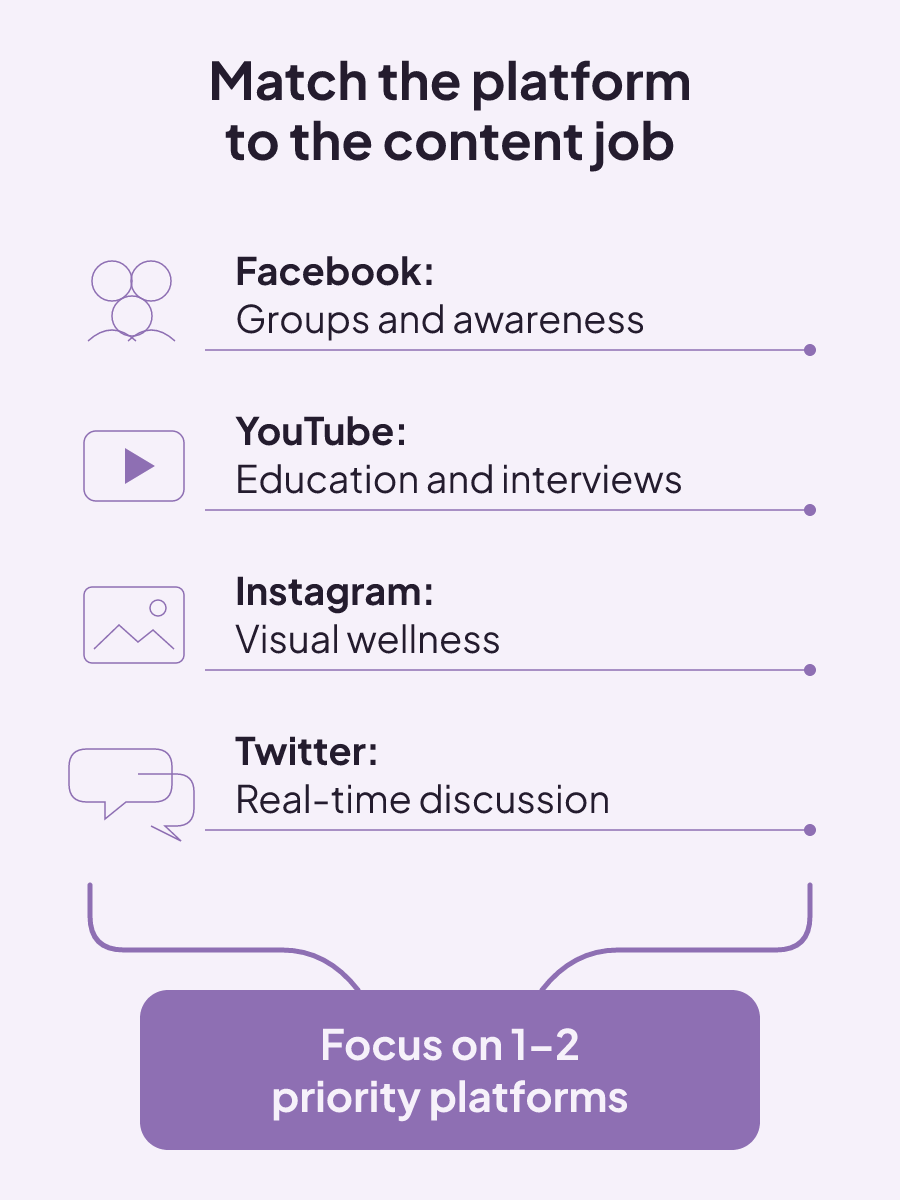
| Platform | Content behavior | Named healthcare uses |
|---|---|---|
| Groups and shareable information | Patient support groups, information distribution, and awareness campaigns | |
| Video-centered channel | Video-centered education | Patient education, expert interviews, and health-related updates |
| Visual storytelling | Wellness and healthy-lifestyle content, healthcare-influencer connections, and particular relevance to younger audiences | |
| Real-time exchange | Healthcare news, patient interaction, and health-related discussions |
These roles are not promises of results. The choice starts with the content behavior you need, not a generic platform ranking.
Operating focus matters too. Healthcare organizations that concentrate educational and entertaining content on one or two priority platforms can outperform organizations that spread resources across every network. That finding points to a practical filter: choose the small set your team has the capacity to feed, review, and monitor.
Platform choice also affects the workload behind the feed. Video education and real-time interaction ask for different production and response capacity. The platform table can narrow the candidates, but the operating plan decides whether those candidates are realistic.
Start the choice with the patient need. If the job is education, the video-centered role is relevant. If the job is an awareness campaign or a support group, the group and information role is relevant. The same test applies to visual wellness content, updates, and live discussion. Match the medium to the job, then check whether the team can keep the account active.
The one-or-two-platform focus creates a useful boundary for the first phase. It leaves the team with fewer feeds to supply and fewer public spaces to watch. The result is not guaranteed reach or growth. It is a plan built around the platforms the organization has chosen to operate.
Build a healthcare social media marketing plan around real capacity
A strategy focuses time and budget on marketing programs intended to reach defined goals. The marketing plan then turns that strategy into a roadmap. Without both, it is easy to select channels first and discover later that the team cannot keep up with the work.
Healthcare social media requires three operating capabilities: content production, medical oversight to reduce misinformation, and staff monitoring of inbound concerns. Put real names or roles beside those capabilities. A platform is not ready simply because someone can create an account or draft a post.
A properly trained internal social media manager can be a strong owner. Their knowledge of the healthcare organization can help them write and publish posts while maintaining an active presence. That role does not remove the need for medical oversight or inbound monitoring. It gives the publishing work an informed home inside the organization.
Implementation should be phased around the skills, time, and staff available, and the plan should change over time. That may mean operating fewer channels while the team develops its review and response capacity. It also keeps time and budget focused on the goals defined in the strategy.
Set a workable first phase
Check the three capabilities before adding a platform to the plan. Who can produce the content? Who provides medical oversight to reduce misinformation? Who monitors inbound concerns? The answers may point to one channel now and another later.
This is also a fair test of internal ownership. A trained manager may know the organization well enough to keep its presence active. The manager still needs the time to write and publish, plus access to the people responsible for oversight and monitoring. If those pieces are not available, the phased plan should reflect the gap instead of assuming the work will happen.
Capacity can change, so the roadmap can change with it. The goal is not to freeze the channel mix. It is to match each phase to the skills, staff, and time the organization can assign.
This operating view belongs beside your wider patient acquisition strategies. Social media has a job within that mix, but its staffing and controls must be workable on their own.
What must be decided before a healthcare post goes live?
Before publishing, decide where the content fits, who reviews or answers it, what cannot be handled in public, and where the person can go instead. Healthcare content-channel selection should reflect the patient journey and whether the content fits the moment, medium, and audience.
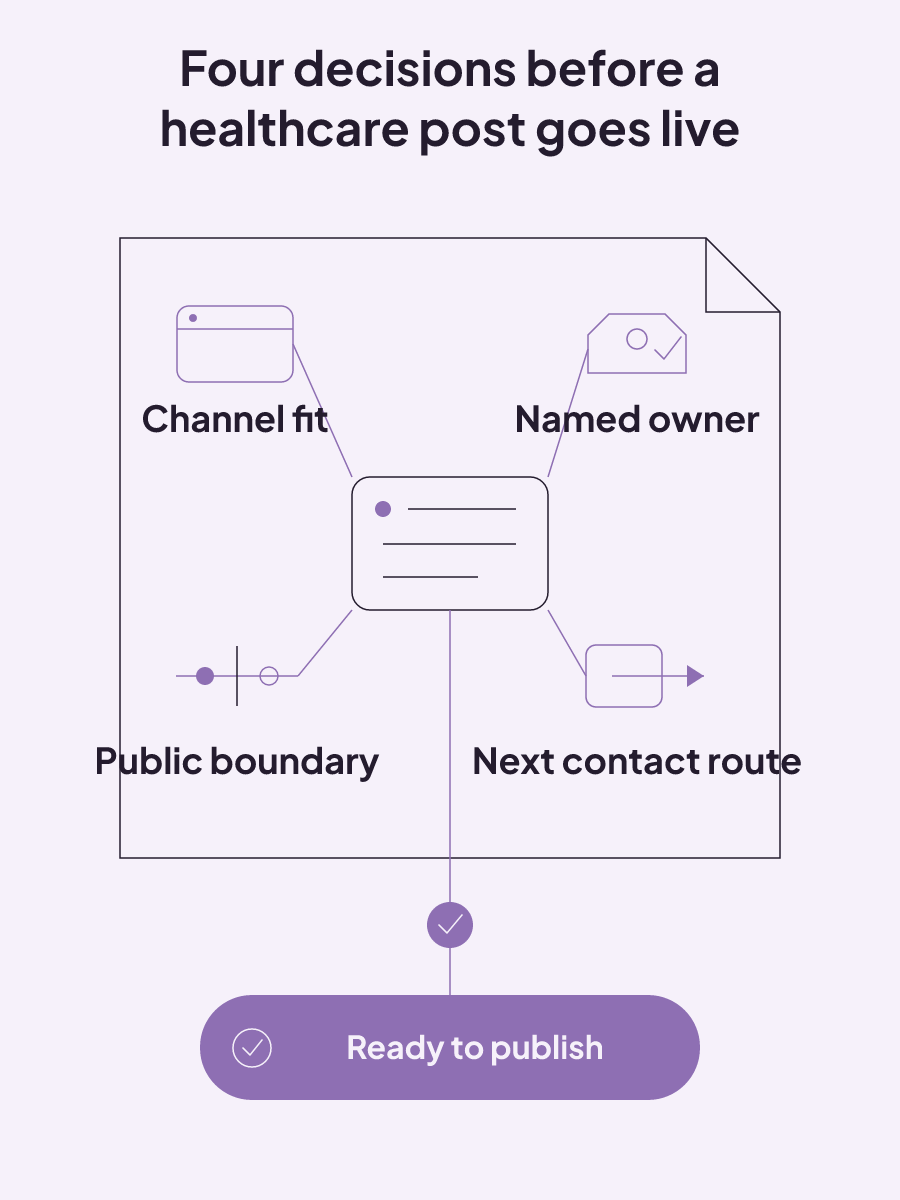
| Content or interaction | Channel and audience fit | Review or response owner | Public boundary or next contact route |
|---|---|---|---|
| Routine educational content | Does the medium fit the patient moment and audience? | Content owner, with medical oversight to reduce misinformation | Define subjects that must not be answered publicly |
| Privacy- or accuracy-sensitive content | Is this channel suitable for the subject and intended audience? | Appropriate medical, legal, or compliance reviewer | Move unsuitable exchanges to the listed contact route |
| Pre-publication review | Does the post still fit its planned channel and audience? | Named approver, including legal or compliance staff when appropriate | Do not publish until the required review is complete |
| Public comments or misinformation | Is a public reply suitable for this subject? | Named responder using defined escalation criteria | Apply the public-answer boundary and direct elsewhere when needed |
| Direct messages | Is the channel appropriate for the user's question? | Named response owner | Use an automated reply to explain channel fit and direct the user elsewhere; keep profile contact information available |
Unauthorized disclosures of Protected Health Information and inconsistent or inaccurate messages remain healthcare social media risks. Before the calendar is approved, every row needs a named owner and a usable route away from a public exchange.
Make review part of publishing
Review is part of healthcare publishing, not a final polish after the content is finished. Healthcare providers and their teams must account for legal and ethical considerations while maintaining a consistent, educational, and digestible social presence.
Professional guidance for healthcare social media covers patient privacy, confidentiality, disclosures, and copyright. These control points should appear in the workflow before the post reaches a public channel. Keep healthcare advertising compliance visible in the team's planning resources, especially when content includes promotional relationships or patient information.
A healthcare organization can connect its social media policy with its employment and confidentiality policies. It can also provide staff with documented patient-privacy education. That connection helps place social posting inside the same organizational responsibilities staff already carry, rather than treating the account as an informal side project.
Documentation matters at the post level as well. Without a documented approval process, an organization cannot trace who approved a post or demonstrate due diligence to regulators. The record should make approval ownership visible to the organization.
For each draft, the approval record needs to answer a few plain questions. Who reviewed the medical content? Was legal or compliance review required? Who approved publication? A documented answer creates a traceable path.
AI tools do not remove this responsibility. Healthcare social media posts created with AI tools need human review and compliance approval before publication. The tool may participate in content creation, but the approved workflow still needs people in the review path.
The Ownerized glossary provides a plain-language reference for a business associate agreement. Use that reference as background, while keeping the post-level review tied to privacy, confidentiality, disclosure, copyright, and approval ownership.
Gifts, paid relationships, and incentives need clear disclosures
Commercial relationships need visible, straightforward disclosure. The right treatment depends on what the creator received and how that relationship could affect the audience's view of the endorsement.
If someone receives a free product and that fact could affect how the audience evaluates the review, the free product should be disclosed. Free does not make the relationship invisible.
When content recommends products through a paid brand relationship, the financial relationship should be disclosed at the beginning. It should also be disclosed when specific products are endorsed, using straightforward language. Placing the disclosure where the recommendation happens makes the relationship part of the message the audience is evaluating.
Points, prizes, or other incentives need attention when they materially affect the weight or credibility of an endorsement. In that case, the incentive should be clearly and conspicuously disclosed. Advertisers should also take steps to monitor whether those disclosures are provided.
These cases belong in the approval workflow because the disclosure obligation is connected to the specific relationship.
The review can stay concrete. Identify what the creator received, whether it could affect how the audience weighs the endorsement, and where the disclosure appears. For a paid product recommendation, check the beginning and the specific endorsement. For a material incentive, check that the disclosure is clear and conspicuous.
What can go wrong after a post is public?
A post can change after publication because the public response becomes part of the situation. Patient-confidentiality breaches and unprofessional conduct remain challenges in healthcare social media, so monitoring cannot stop when the post goes live.
One patient-photo case shows how quickly the situation can shift. A patient consented by email to a Facebook photo. About two hours after the practice posted it, the patient asked for its removal because people were adding critical comments. Staff removed the photo immediately. The case does not turn one consent method into a universal rule. It shows that publication, comments, and the patient's later request can unfold within hours.
Negative comments also need a defined internal route. Staff should immediately report negative social media comments to practice leadership. That instruction gives the first staff member who sees the comment a clear escalation owner instead of leaving them to improvise a public response.
The consequences can extend beyond reputation. The United States Department of Health and Human Services' Office for Civil Rights can take enforcement action when a social media disclosure is found to be an impermissible disclosure of Protected Health Information. That enforcement scope is specific, but it is serious enough to make privacy review and post-publication monitoring part of the operating plan.
Apply the question-risk-handoff matrix to next month's content before the calendar is approved. For each post or interaction, name the channel fit, review or response owner, public boundary, and alternate contact route. Then compare the completed plan with the broader healthcare marketing and patient-acquisition mix.
ROI tracking: calculate the return and label what the number proves
ROI tracking is credible when every cost is counted and each result is labeled as observed, attributed, or experimentally incremental.
Read insight
Sample content marketing plan for med spas: a completed decision system
A sample content marketing plan works as a decision system, linking each asset to an audience need, owner, channel, approval path, KPI, and review.
Read insight
Local SEO report: what to measure and what to do next
A useful local SEO report compares a small KPI set, records completed work and movement, and ends with the business action and next step.
Read insight