

Key takeaways
- Patient acquisition is how you win first-time patients, not keep current ones.
- Rank channels by cost per new patient and payback, not tactic count.
- Fund the channel that recovers its spend within about 12 months first.
- No per-channel cost exists for aesthetics yet, so measure your own.
What healthcare marketing patient acquisition actually is
Patient acquisition is the set of marketing efforts a clinic uses to attract first-time patients. It runs across digital campaigns, community outreach, and referral programs. That is different from retention, which keeps the patients you already have booking again.
So if you want the one-line answer to "what is patient acquisition," here it is. Acquisition wins the first visit. Retention wins the fifth.
Here is the part most guides skip. Acquisition and retention are not rivals for your budget. A channel's payback depends on how well you keep patients. If a new patient comes back four times, the cost to win them is easy to justify. If they never rebook, the same cost is a loss. Judging acquisition on its own overstates what it really costs you.
Why a list of strategies won't tell you where to spend
Search this topic and you get the same page ten times. A definition, then seven to ten tactics. SEO, reviews, referrals, "omnichannel." None of them tell you which one to fund first.
The missing piece is economics. Start with one number. Patient acquisition cost, or PAC, is your total marketing and sales spend divided by the new patients you won in a period. Improvado states the formula plainly, and it is the number every guide mentions but none of them use to make a decision.
Turn it into a test. Union Square Consulting frames it as CAC payback: if you earn back a channel's spend within about 12 months, you are growing profitably. If payback runs past a year, that channel costs more to feed than it returns in that year. That single rule sorts a channel worth funding from one quietly losing money.
The honest catch: payback math needs a clear definition of a "new patient" and clean spend tracking by channel. Most clinics don't have either yet. So the first job is measurement, not spending.
What each channel tends to cost per new patient
Here is the at-a-glance version. The channels a Canadian med spa actually runs, against what the available numbers say and how fast each tends to pay back.
| Channel | Cost signal | Payback read |
|---|---|---|
| Referral program | About $280 per new patient (general healthcare) | Fastest to recover |
| Reviews and reputation | Low, mostly your own time and process | Fast; up to 60% lean on reviews |
| Local search and Google Business Profile | Profile setup plus steady upkeep | Builds over months |
| Medical SEO | $500 to $5,000 a month in Canada | Slow to start, cheap once ranking |
| Paid search and paid social | About $1,400 per new patient for paid search (general healthcare) | Fast volume, slowest payback |
Read the flag before you read the table. The $1,400 and $280 figures are blended general-healthcare numbers, not measured med-spa cost per patient. Use them to order channels from cheap to expensive, not as a benchmark to hit. Your own aesthetics numbers will differ, and only your own count.
Which channel to fund first, and when each is the wrong call
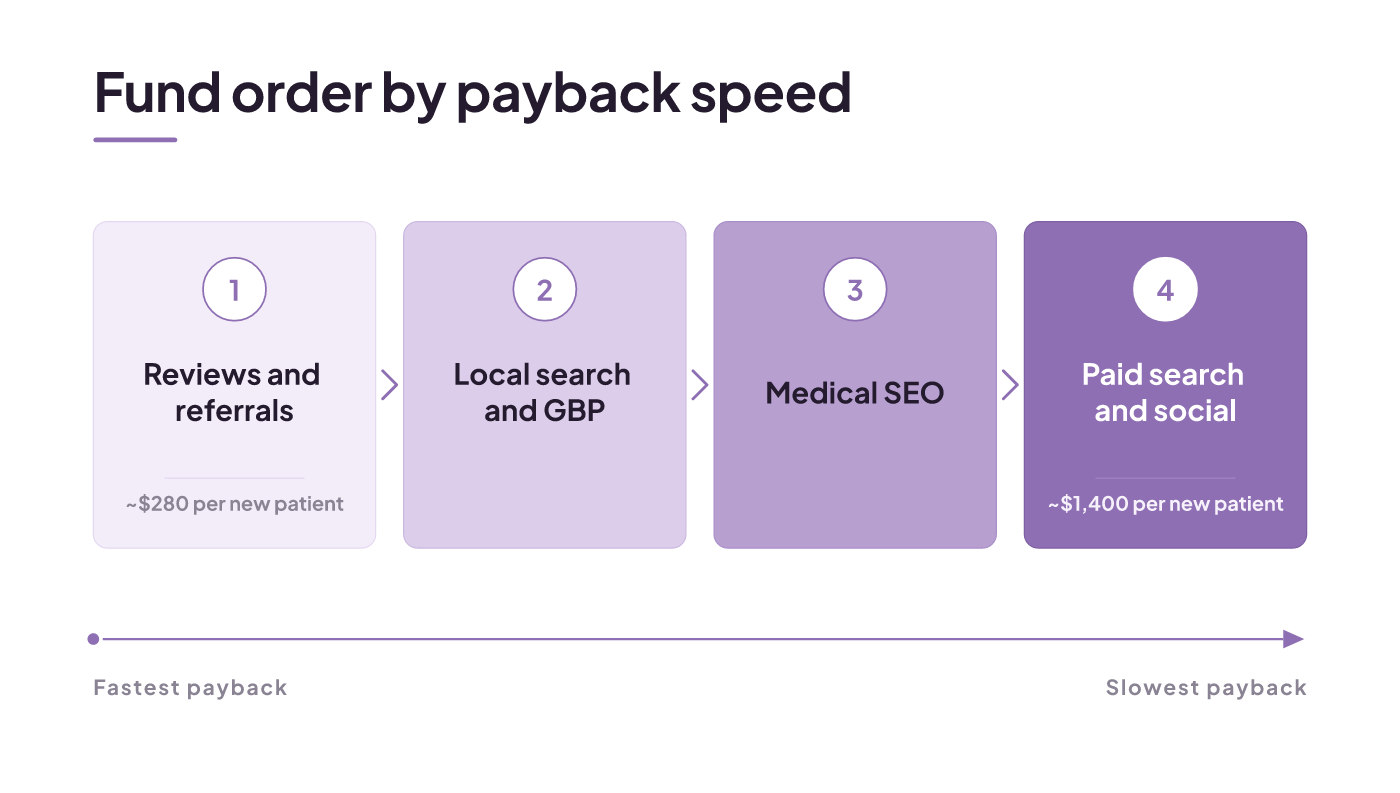
Fund the cheapest reliable channel first, then buy volume once you can afford a longer payback.
First: reviews and referrals. These carry the lowest cost per new patient, and the referral number near $280 is the fastest to recover. Reviews do heavy lifting because up to 60% of people lean on them when choosing a provider, which Phreesia's patient research reports. The wrong call: leaning on referrals alone when you have almost no patient base yet. An empty clinic has no one to refer.
Next: local search and your Google Business Profile. Most Canadians now prefer to book online, close to 6 in 10, so being findable on maps and search is close to free demand. The wrong call: pouring money here in a market where you already rank on page one. At that point you are paying for clicks you would win anyway.
Then: medical SEO. It is slow, but once you rank, each new patient gets cheap. The wrong call: starting SEO when you need patients this month. It rewards patience, not urgency.
Last, for volume: paid search and paid social. Paid buys speed, and speed is worth a longer payback when a new location is empty. The wrong call: running paid as your first move with no tracking, because paid search near $1,400 per patient is the easiest channel to bleed money on unseen.
This order is a starting point from public benchmarks, not a measured result for your clinic. A practice with a strong referral base and one bleeding paid budget should reorder around its own payback, not this list. Our companion guide on which patient acquisition strategies to fund first walks the same order with a Canadian aesthetics lens.
How much a Canadian med spa should budget
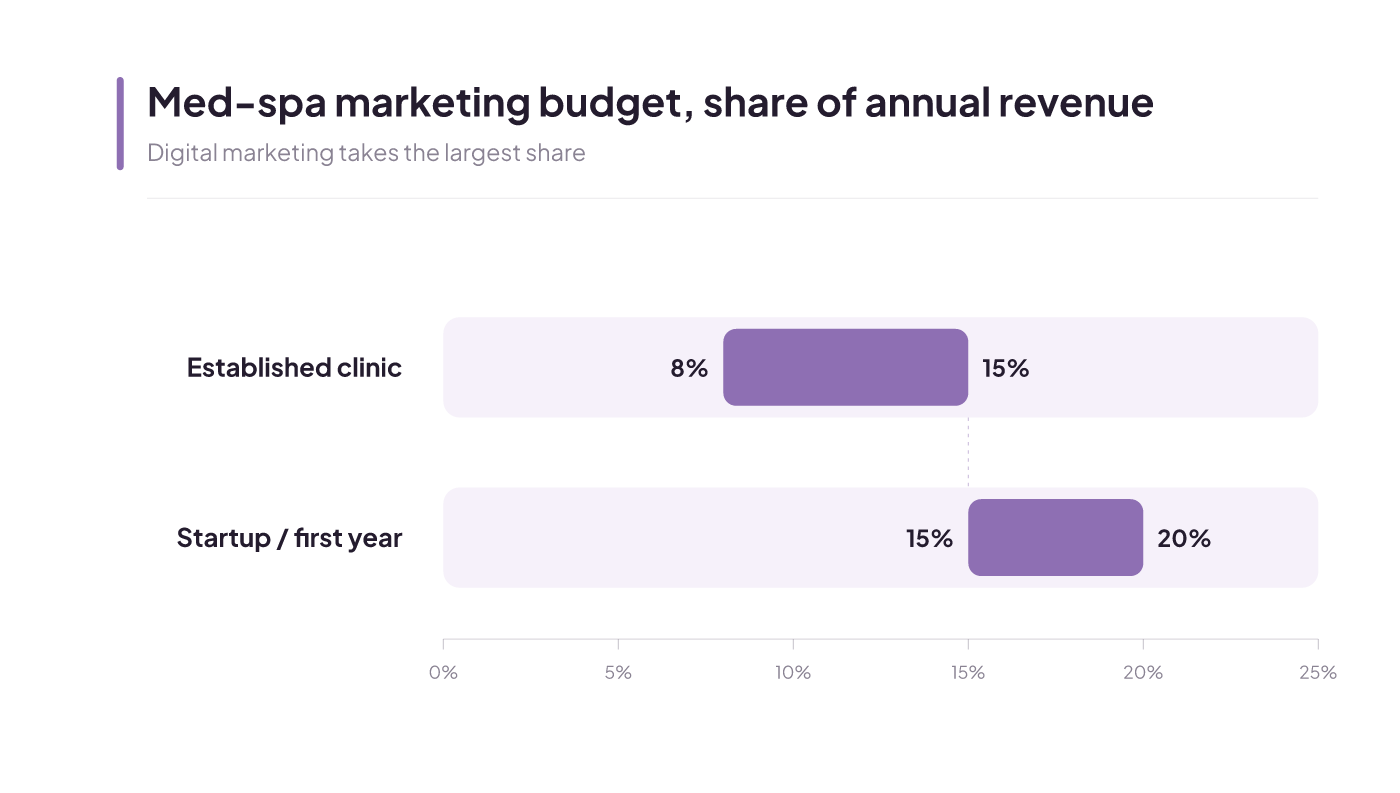
Plan on 8% to 15% of annual revenue for marketing, with digital taking the largest share. If you are a startup or in your first year, budget higher, closer to 15% to 20%, because you are paying to build awareness from zero.
Treat that percentage as a planning range, not a rule to hit. It fits an established clinic better than either edge case. A practice with a deep referral base and patients who rebook can grow on less. A brand-new location fighting for its first bookings often needs the top of the range or more. The number sizes the neighbourhood, not your exact spend, so let your own payback math move you inside it.
For one concrete line item: in Canada, medical SEO commonly runs $500 to $5,000 a month. Smaller single-location clinics sit near the low end. Competitive city markets and multi-location groups sit higher. Size the rest of the budget the same way, then let the payback ranking above decide what each dollar funds first.
The blended-average trap that hides a losing channel
Say your overall cost per new patient looks fine, an even $600 across everyone who booked. You feel good. You should not, yet.
Split that $600 by channel and the picture can flip. Referrals might be pulling patients in at $250 and earning it back in a couple of months. Paid search might be dragging in patients at $1,300 that never earn their spend back inside a year. The profitable channel is hiding the losing one inside the average, and a channel that takes more than a year to pay back is costing you more than it returns. A strong channel can mask a channel you would kill on sight if you could see it alone.
The fix is to compute PAC per channel, not just overall, and adjust from there. The honest snag: splitting cost by channel needs attribution most small clinics haven't set up. So the real first step is often tracking one channel cleanly, end to end, before you try to compare all of them. Clean booking and tracking is what makes this visible at all.
Measure your own numbers before you trust any benchmark
The borrowed cost-per-patient figures here are directional, not med-spa benchmarks. Published per-channel cost and payback for aesthetics specifically don't exist yet, so your own measured numbers beat any benchmark on this page. Here is the short recipe.
- Define a new patient. Use their first paid treatment, not a form fill or a phone tap.
- Pick one channel. Track its spend and the new patients it brought over a set window, say 90 days.
- Divide that channel's total marketing and sales spend by the new patients it won. That number is its patient acquisition cost, the real cost per new patient.
- Check payback. Compare that cost against what the patient is worth, using your average treatment value and how often they rebook. If they earn the cost back inside a year, keep the channel. If not, fix it or cut it.
- Repeat per channel, then reorder your funding by what actually pays back.
Do that and you stop guessing. You walk in with ten things you could do and walk out with the order you fund them in, plus the payback window that tells you to keep or kill each one. When you are ready to match these channels to concrete tactics, see how med-spa lead generation maps to the same ranked order.
Patient acquisition software: a Canadian med spa guide
By the end, a clinic owner can decide whether to buy patient acquisition software now, which category fits their stage, and the two conditions (retention performance and connected data) that determine whether any tool pays off.
Read insight
Med spa lead generation: what to fund first in Canada
By the end, a clinic owner knows the one channel to start with for their stage and budget, what to expect a booked patient to cost, which ad tactics will get rejected before they waste money, and how to convert the leads they get.
Read insight
Patient acquisition strategies for Canadian aesthetics clinics: what to fund first
By the end, a Canadian aesthetics operator has a channel-by-clinic-stage-and-budget funding sequence they can keep, knows which channels to skip when starting out, and understands how to track cost-per-patient honestly instead of chasing le
Read insight