
Key takeaways
- No tool wins for every clinic; your size and charting load decide.
- Judge two axes: rebooking over a 3-to-8-month journey, and records law.
- A lapsed patient can cost $8,000 to $15,000 in lifetime value.
- Canada runs on PIPEDA and PHIPA, not HIPAA.
Why the "best of" guides you found rank themselves
If you are shopping for medical spa booking software, you have probably found two kinds of pages, and both have a problem. The first is a vendor product page. The second looks independent: a "best med spa software" ranking with scores and a winner. Here is what those lists rarely say out loud. One of the most-shared "best medical spa software" guides shares its ownership with the very platform it ranks number one. A guide that judges a product it has a stake in is a sales page wearing a lab coat.
The big review directories are cleaner, but not neutral, and they tell you so themselves. Vendors pay for sponsored profiles to get traffic and leads, and the marketplaces earn referral and sponsored-profile fees from the same vendors they list. Even the ones that verify millions of reviews still run on that money. That does not make their listings fake. It makes them a directory, not decision support. A directory hands you the products and no reason to pick one.
So treat this page the same way. Our rubric is a judgment call too. We sell none of these platforms, but we still chose what to weight. The criteria are spelled out below so you can argue with the scoring instead of trusting it.
What "medical" adds on top of spa booking
Generic spa and salon booking handles three jobs: scheduling, payments, and client management. Medical spa software adds a fourth that changes the whole purchase: a clinical record. That means an EMR for injectable and laser treatment notes, consent capture, and health-privacy handling built for medical data, not just a client's phone number.
The naming around this is a mess. You will see med spa management software, medical spa management software, med spa practice management software, med spa scheduling software, even medical spa scheduling software, all for tools that overlap heavily. The label that matters is whether the tool holds a clinical record on its own.
That line disqualifies a lot of tools ranking for the medical query. Some never held a clinical record at all. They ask you to connect an external EHR and keep your notes there, while the booking tool runs the calendar and the card. That can be fine. It becomes a real problem only when you assumed the booking tool itself would hold the chart, and it does not.
Encrypted records and access controls are the security floor here. Medical-branded platforms advertise HIPAA compliance, and for a US clinic that badge would headline the pitch. A badge is not a decision. For a Canadian clinic the real test sits one layer up, and we will get to it. One caveat before the table: a very low-volume solo injector can run well on a lighter scheduler plus a separate records system. The all-in-one need grows with clinical volume.
Medical spa booking software at a glance
Prices below are 2026 entry points, and they move often, so read them as a starting band, not a quote. Records fitness is marked only where a vendor's own materials support it. Where we could not confirm it, the cell says verify, not yes.
| Platform | Entry price (2026, volatile) | Native EMR | Canadian records handling | Recall / rebooking |
|---|---|---|---|---|
| Vagaro | near $30/mo | Yes: native EMR plus treatment plans | Native EMR present; verify PIPEDA/PHIPA handling for your province | Booking and payments in one; confirm recall depth |
| Square | low entry tier | No: connects an external EHR | Records live in the system you attach, not the booking tool | Payments-led; recall sits outside the clinical record |
| Dedicated EMR platforms | around $150/mo and up | Yes | HIPAA baseline; PIPEDA and PHIPA are your check | Charting-led; recall varies by product |
| General spa/salon tools | Low tier (varies) | Often none | Not built to hold health records | Reminders only |
Across the category, entry pricing runs from about $30 to $165 a month, and the clinically deeper tools sit at the top of that band. Price does not signal medical fitness. The cheapest row and the priciest row can both be the wrong pick for you.
How we scored: the two axes that actually decide it
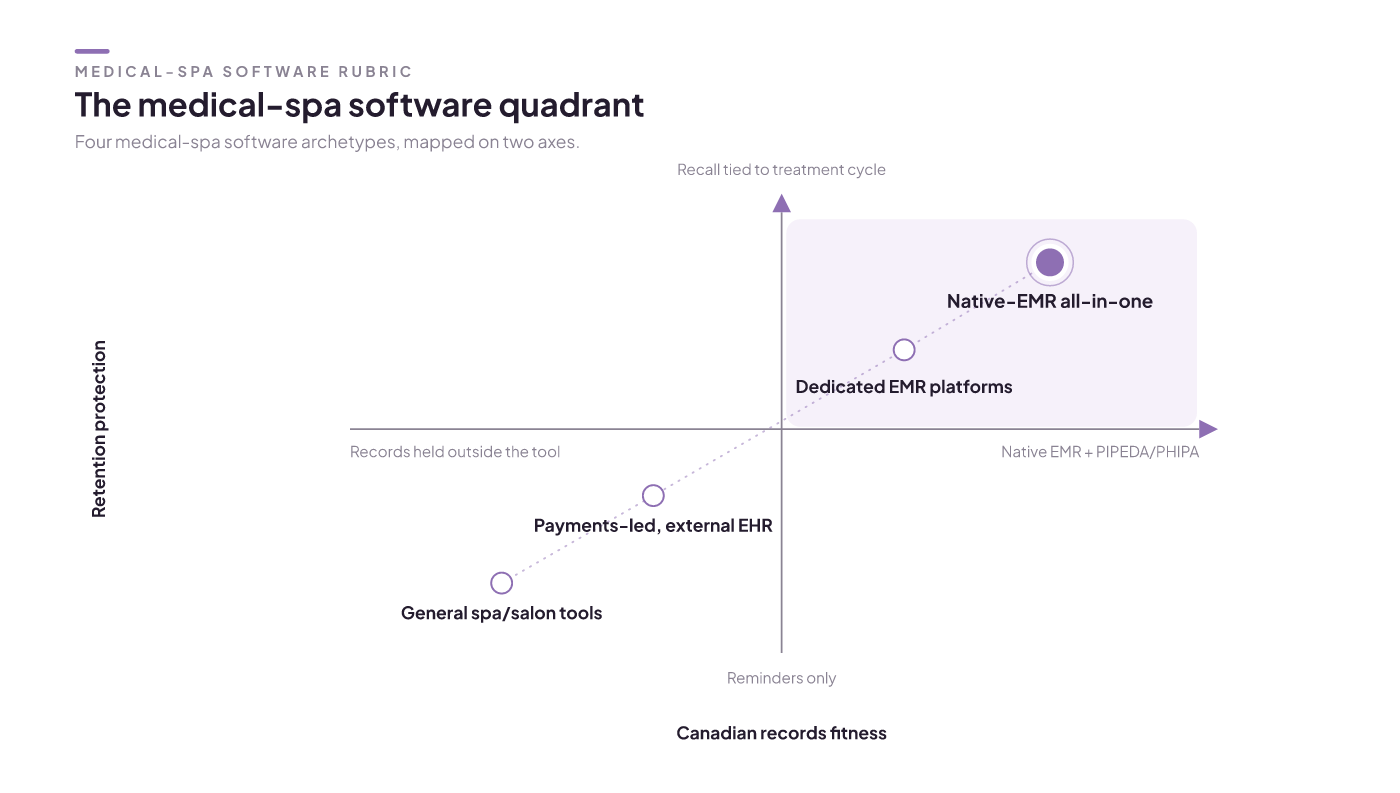
Most rankings score features and starting price. We scored two things those lists skip, because they are what decide whether the software pays for itself.
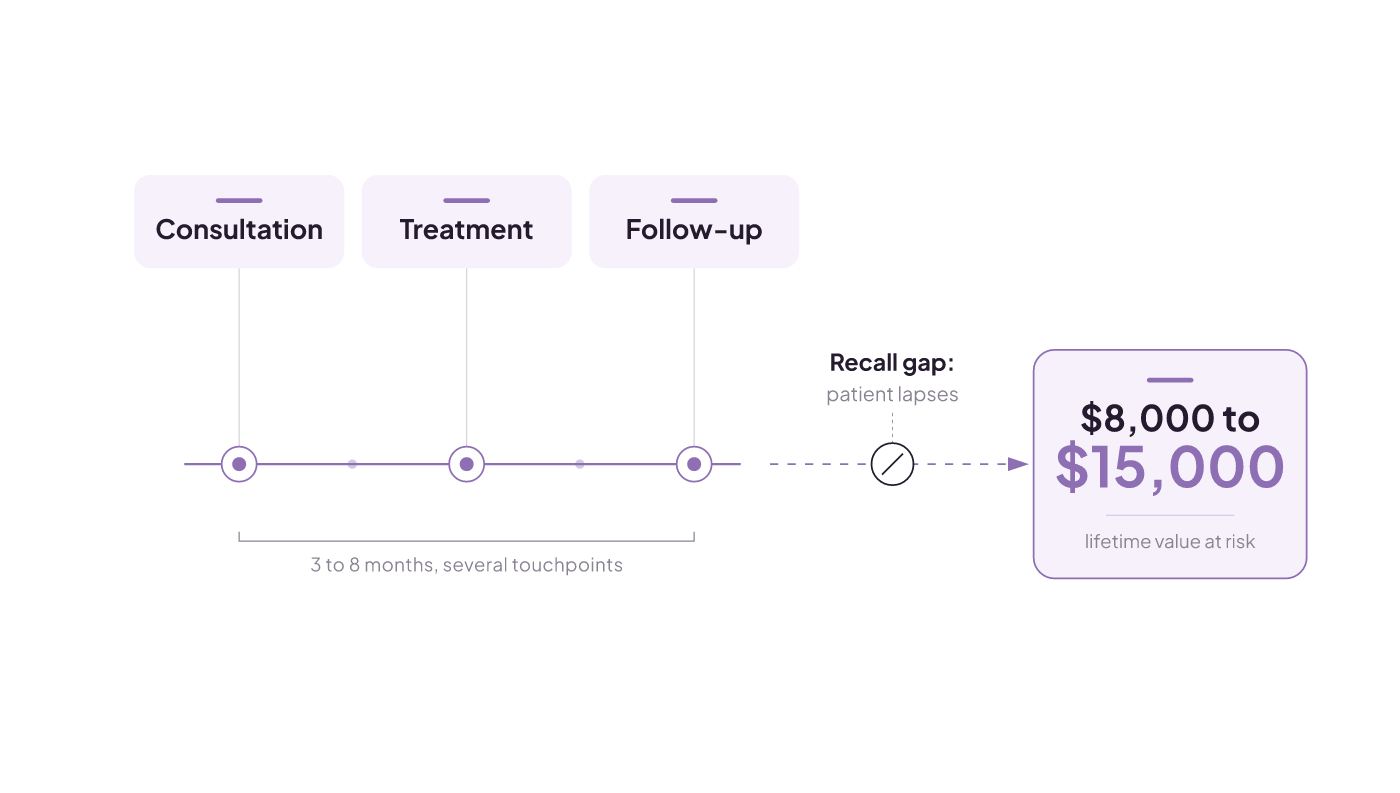
The first is retention across the journey. A med spa relationship is not one appointment. Consultation to treatment to follow-up runs 3 to 8 months across several touchpoints. Over that full relationship, a consolidated patient can be worth $8,000 to $15,000 in lifetime procedural value. So the money is not in booking the first visit. It is in still being on the patient's calendar in month six.
The second axis is legal records fitness in Canada, which gets its own section next. On weighting, we treat these two as roughly equal and ahead of everything else. A tool can carry the longest feature list on the page and still fail on either one. One honest limit: the $8,000 to $15,000 figure is a general range, not your clinic's measured number. Use it as the reason retention matters, not a promise of your results.
The Canadian compliance filter: PIPEDA and PHIPA, not just HIPAA
Here is where most guides misfire for a Canadian buyer. They frame the whole compliance question as HIPAA, which is US law. Your patient data is governed federally by PIPEDA and provincially by health-privacy statutes such as PHIPA, not by HIPAA. A "HIPAA-compliant" badge is a starting point, not an answer to the question you actually have.
PHIPA sets a concrete IT bar the software must clear. Look for unique per-user access, electronic audit logs of every record access, encryption in transit and at rest, and breach notice at the first reasonable opportunity. PIPEDA adds a simpler three-part test you can apply on a demo: get consent before you record, collect only what the record needs, and keep it secure.
Provincial rules vary, so one more caveat. A tool that satisfies PIPEDA federally may still need a data-residency or PHIPA check in your province. That check is on the clinic, not the vendor, so build time for it into the buy.
Which tools actually protect rebooking
Picture the failure mode, because it is the common one. A patient comes in for Botox, leaves happy, and six months pass with no reminder. The relationship lapses, and the clinic never even knows it lost the rebooking. Med spas lose patients to follow-up that falls through the cracks far more often than to poor treatment. Set that against a 3-to-8-month journey and an $8,000 to $15,000 lifetime value, and automated recall stops looking like a convenience. It is revenue protection.
So on the retention axis, the question is not "does it send reminders." It is whether the tool can hold a patient across months of gaps: recalls tied to the treatment cycle, not just a calendar date, and rebooking prompts that fire on their own. A scheduler that only reacts when the patient calls has already lost the ones who won't.
The catch: automation only protects revenue if the front desk configures it and trusts it. The best recall engine still loses the patient at a clinic that quietly switches it off.
Native records versus a bolted-on EHR
The sharpest split in this category is where the clinical record lives. One route ships native EMR and treatment charting inside the booking tool, so the chart and the calendar are one system. The other keeps booking and payments in the tool and sends the record to a connected external EHR.
The difference is who holds the chart. With native records, the platform you booked on is also the platform legally holding injectable and laser documentation. With the bolted-on route, that responsibility sits in a separate system you have to vet on its own terms.
This is a real fork, not a scoring gimmick. The external-EHR route is legitimate when your existing EHR is strong and you want to keep it. It becomes a disqualifier only when you expected the booking tool to hold the chart, and you find out after signing that it never did.
How to vet a platform yourself before you sign
No badge on a pricing page settles this. The clinicians who get it right test a platform against their own professional standards, not the vendor's marketing. One Canadian practitioner chose a records platform because it met and exceeded their own standard of care, and passed on the ones that did not. That is the posture to copy: you own the compliance decision, not the sales rep.
Keep the PIPEDA three-part check in hand on every demo. Consent before recording. Collect only what the record needs. Store it securely. Then push past the badge. Ask to see the audit-log view. Ask where Canadian patient data is stored. Ask what happens to your records the day you leave.
None of this is fast. Most vendors will not hand you audit logs on a sales call. Budget for a real trial and a short privacy review instead of trusting a compliance badge, because the badge is the vendor's claim and the review is your proof.
Where this ranking stops, and what we could not verify
This ranking is opinionated, so here is where it could be wrong. We did not run an independent, per-platform compliance audit against each vendor's own documentation, so records fitness is marked "verify" wherever a vendor's materials did not confirm it. Pricing shifts every quarter, so the 2026 numbers here are a band, not a live quote. And the retention case rests on the general $8,000 to $15,000 lifetime-value range, not measured results from your clinic. Where a claim was not solid, we left it out rather than dress it up. Use this page to shortlist, then verify the last mile yourself.
Picking for your clinic, and where Ownerized fits
Match the tool to your shape. A solo or very low-volume injector can start with a lighter scheduler and a separate records system, and move to an all-in-one only when clinical volume grows. A multi-location clinic should weight native EMR, per-user audit logs, and recall automation heavily, because at that scale a lapsed rebooking worth $8,000 to $15,000 happens quietly and often. With well over a hundred products in the category, shortlist two or three from the table, start trials, and run the PIPEDA check on each.
One thing the software will not do is get patients to your door in the first place. That is a different job. Ownerized is not a booking platform, and if all you need is a scheduler, buy one of the tools above. Ownerized works on the layer before the booking: whether your clinic is the one patients and AI assistants find and recommend when they research a treatment, across search, profiles, reviews, and the content they read before they book. If your booking tool is holding rebookings but new-patient flow is thin, that is the gap it is built to close.
If that is the side you want handled, see what Ownerized does and whether it fits your clinic.
Aesthetician software in Canada: booking app or EMR?
By the end, the reader can classify any aesthetician software into booking-first or full-EMR, run a 7-point checklist against their own clinic, and know which category they should be shopping in, and why the monthly price is the wrong thing
Read insight
List of EHR systems: which ones fit a Canadian med spa
You'll get the real names that top every EHR list and their market-share ranking, an honest read on why that ranking doesn't answer a med spa's question, a capability checklist for aesthetic charting, a practice-type decision table with a C
Read insight
Scheduling software for medical office: a Canadian guide
Leave knowing which 'best scheduling software' rankings are self-serving, what these tools actually cost per month, where the HIPAA/compliance tier trap sits, and which class of tool fits your office type, with Canadian privacy law kept str
Read insight