
Key takeaways
- Aesthetician software splits in two: a booking-first app (scheduling and payments) or a full practice-management EMR (charting, before/after photos with consent, e-prescribe).
- The deciding question: do you offer regulated treatments like injectables or laser?
- Facials and waxing only? A booking app is usually enough.
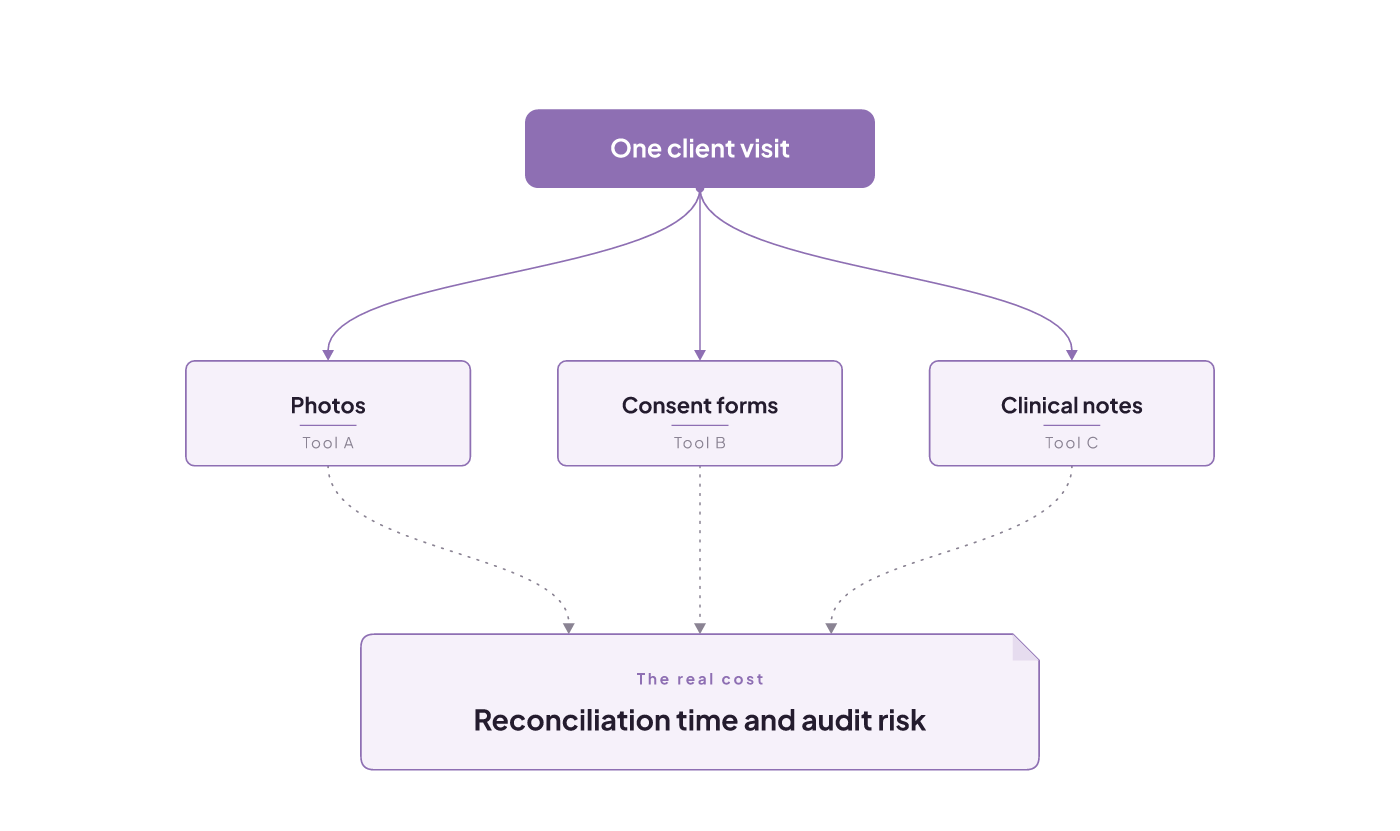
- The real cost isn't the monthly fee. It's your records split across three tools: photos in one, consent forms in another, clinical notes in a third.
You typed "aesthetician software" and got a wall of vendor homepages, each one calling itself the all-in-one answer, plus a couple of Reddit threads that just list tool names. None of them ask the question that decides everything. So let's start there, because getting this one call right saves you from either overpaying for clinical features you'll never touch, or stitching together three apps that leak your records.
What aesthetician software actually covers
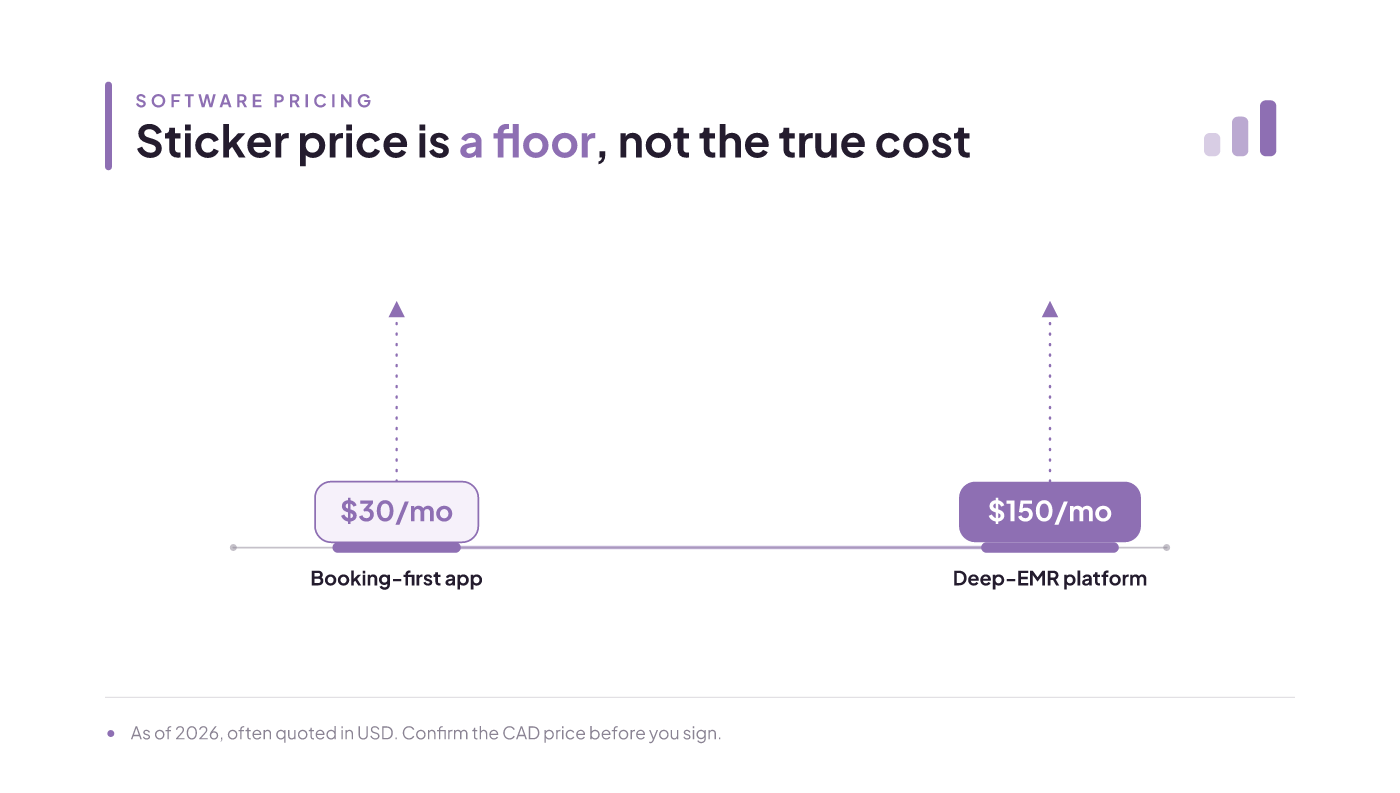
"Aesthetician software" is an umbrella, not a product. Under it sits everything from a $30 booking calendar to a full clinical platform.
To see the deep end of that range, look at what a practice-management platform bundles. Aesthetic Record's app listing describes EMR charting, integrated telehealth, before-and-after photo and video capture, point-of-sale, online booking, inventory and supply-chain tracking, patient loyalty, third-party CRM integration, and KPI reporting. (The listing uses the US "HIPAA-compliant" label. More on why that matters for a Canadian clinic below.)
That is a lot of software. Here's the honest part vendors won't lead with: a solo esthetician doing facials and waxing will use maybe a third of it. More features is not the same as better for you. Vendor listings advertise every feature because they're selling to the whole market, but a tool you half-use is a tool you overpay for and never learn. If you never chart a clinical note, most of that bundle is dead weight you're renting.
The real decision: a booking app or a full practice platform
Every other choice flows from one fork. Are you a booking-first clinic, or a full-EMR clinic?
Here's the trigger you can self-check in one sentence: do you offer injectables, laser, or other regulated treatments? If the answer is no, a booking app almost certainly covers you. If it's yes, you've crossed into territory where charting, consent, and photos stop being nice-to-haves.
The pattern that catches growing clinics is predictable. You start with a booking app because it's cheap and it works. Then you add injectables or laser. Now you bolt on a separate EMR for the clinical side. And suddenly your client photos live in one tool, your consent forms in another, and your clinical notes in a third. Nobody chose that mess. It accumulated.
On the full-platform side, the established names are real and worth knowing: Pabau, AestheticsPro, Aesthetic Record, and Calysta all handle booking, marketing, and retail well. So "Aesthetics Pro app" is not a booking calendar. It sits in the practice-platform tier, built for the clinical clinic, and that is why its price and setup weight are heavier than a solo app needs.
The tradeoff cuts both ways. A full platform costs more and takes longer to set up. If you never touch a regulated treatment, the all-in-one is overkill, and paying for it doesn't make your facials better.
The seven criteria that actually matter
Once you know your category, judge candidates on these seven things. Not the marketing checklist. These are the criteria that decide whether your records stay in one place and stay defensible.
| Criterion | Booking-first app | Full practice EMR |
|---|---|---|
| Secure charting with access controls and audit trails | Rarely | Yes |
| SOAP and treatment-protocol templates | No | Yes |
| Before-and-after photos with client consent attached | Basic or none | Yes |
| E-signature consent forms | Sometimes | Yes |
| E-prescribe | No | Yes |
| Patient portal for booking, intake, and records | Partial | Yes |
| Booking and POS integration, so data isn't entered twice | Yes | Yes |
Read the table as a filter, not a scorecard. More checkmarks does not win. If you do facials and waxing, e-prescribe and clinical charting are irrelevant to you, and a booking app that nails scheduling and payments is the right tool. A facials-only esthetician who buys a full EMR for the audit trail and the e-prescribe row is paying for rows that will never fire. The point is to match the row that bites for your clinic, not to buy every row.
That last row, booking and POS talking to each other, is the one that quietly matters at every stage. When they don't connect, someone re-keys the same client twice a day. That's the small leak that becomes the big one.
What it costs, and why the sticker price misleads
Here are the round numbers, as of 2026. Booking-first tools start near $30 a month. Deep-EMR platforms start closer to $150 a month. Those figures move often, and vendors usually quote them in US dollars, so confirm the Canadian price in CAD before you sign anything.
Now the part that matters more than the spread: the monthly fee is the wrong thing to optimize. The real cost of the fragmented setup isn't the three subscriptions. It's the staff time spent reconciling records across three tools, and the compliance risk when a consent form or a product lot number isn't where an auditor expects it to be. That cost never shows up on a pricing page. It shows up on the day you need one record and it's in the other app.
So the cheapest booking app can be the most expensive choice you make, once you count the hours spent gluing tools together. Optimize for where your records live, not for the sticker.
Is there free aesthetician software?
Sort of, and it pays to know exactly what "free" means here. Searches for "aesthetician software free" and "salon management software free" mostly turn up two things: a free download of a paid platform, or a free tier that stops being free the moment you take real bookings.
Aesthetic Record is a clean example. The app is free to download for iPad and holds a 4.3 out of 5 across 171 ratings in the App Store's Medical category, as of 2026. But a free download is not a free business. Paid tiers, transaction fees, or add-ons usually kick in once you're processing payments and storing client records. Treat "free" as a way to test the interface, not as a plan to run your clinic on for free. If a tool is genuinely free at the scale you operate, it's worth asking what it does with your data in exchange.
The recognizable names, decoded
The Reddit and Facebook threads throw the same names around without a framework: Vagaro, Mangomint, Fresha, Mindbody, Jane, GlossGenius, PocketSuite. Sort them by the fork above and they stop being a jumble. Most of those are booking-first tools built for solo operators and salons, which is exactly why they dominate the "best app for aestheticians" and "best scheduling software for spas" conversations. The practice platforms, Pabau, AestheticsPro, Aesthetic Record, and Calysta, answer a different question, closer to "best EMR for aesthetics." Those four are genuinely strong on booking, marketing, and retail, which is why they stand up as full clinic systems rather than scheduling apps. So "GlossGenius for clients" or a client login is a booking-tier experience by design. A clinic doing regulated work needs the clinical tier underneath it, which is where the Canadian privacy question below comes in.
One thing no comparison can hand you: a staff or client login. Employee and client portal access ("Aesthetics Pro login employee," "GlossGenius for clients login") comes from your own account inside whichever vendor you pick, not from an outside guide. If a page offers you a login shortcut, close it.
Can software make you $100,000 a year?
Short answer: no software sets your income. The right tool removes friction, keeps clients rebooking, and stops you losing an afternoon to record-chasing. That's real, and it helps. But the levers on revenue are your pricing, your retention, and your service mix, and a booking calendar doesn't pull any of them for you. Here's a test that does tell you something concrete: after a client visit, is any record entered twice, or living in a second tool? If yes, you're paying the fragmentation tax every week, the staff hours spent reconciling records across tools, and software is one lever you can actually fix. Buy software to run the clinic well. Don't buy it expecting a number.
How this plays out for a Canadian clinic
Here's where the US-default advice on most of those SERP pages quietly misleads you. The moment a Canadian clinic adds injectables or laser is the exact moment a booking-only setup starts to fragment, photos in one tool, consents in another, clinical notes in a third, and it's also the moment the privacy stakes change.
"HIPAA-compliant" is a US label. It is not a Canadian legal requirement, and a badge saying it tells you little about your obligations here. Canadian clinics answer to PIPEDA and to provincial health-privacy rules, and the concept that matters is the same underneath: secure, consent-tracked charting, with your records stored somewhere you can defend. What you actually want to confirm is where a tool stores your data and how it handles consent, which means asking the vendor directly about data residency and privacy posture. No one can certify a specific product as compliant for you from the outside, and any page that does is guessing, so this is one thing you verify with the vendor yourself rather than take from a badge.
If you're still sorting out the labels themselves, the difference between esthetician and aesthetician shapes which regulated scope, and which software tier, even applies to you.
How to know you chose right, and where to go next
Skip the feature-by-feature scoring for a second and run one test. After a client visit, is any record entered twice, or living in a second tool? If yes, your setup is fragmenting, your staff is quietly reconciling records across apps, and you've probably outgrown your category. If no, the category fits and you can stop second-guessing it.
A note on what this framework does and doesn't do. It tells you which category to shop in. It does not crown a single winning product, because a fair product-by-product ranking needs the vendor demos and free trials you still have to run yourself, on your own workflow. We've leaned on publicly listed feature and pricing detail here, and flagged the pricing and rating numbers as 2026 figures that vendors change without notice.
When you're ready to turn this into a shortlist, read the independent Canada ranking of medical spa booking software. Comparing the clinical tier too? See which EHR systems fit a Canadian med spa, or the wider look at scheduling software for a medical office. Decide the category first. The product is the easy part after that.
List of EHR systems: which ones fit a Canadian med spa
You'll get the real names that top every EHR list and their market-share ranking, an honest read on why that ranking doesn't answer a med spa's question, a capability checklist for aesthetic charting, a practice-type decision table with a C
Read insight
Scheduling software for medical office: a Canadian guide
Leave knowing which 'best scheduling software' rankings are self-serving, what these tools actually cost per month, where the HIPAA/compliance tier trap sits, and which class of tool fits your office type, with Canadian privacy law kept str
Read insight
Medical spa booking software: an independent Canada ranking
An ownership-neutral, disclosed-rubric ranking of medical spa booking software that scores each tool on rebooking/retention across a multi-month journey and on Canadian PIPEDA/PHIPA fitness, and tells you which popular 'best of' guides are
Read insight