
Key takeaways
- The "best scheduling software" lists topping this search are written by the vendors they rank, so treat the ordering as marketing, not neutral advice.
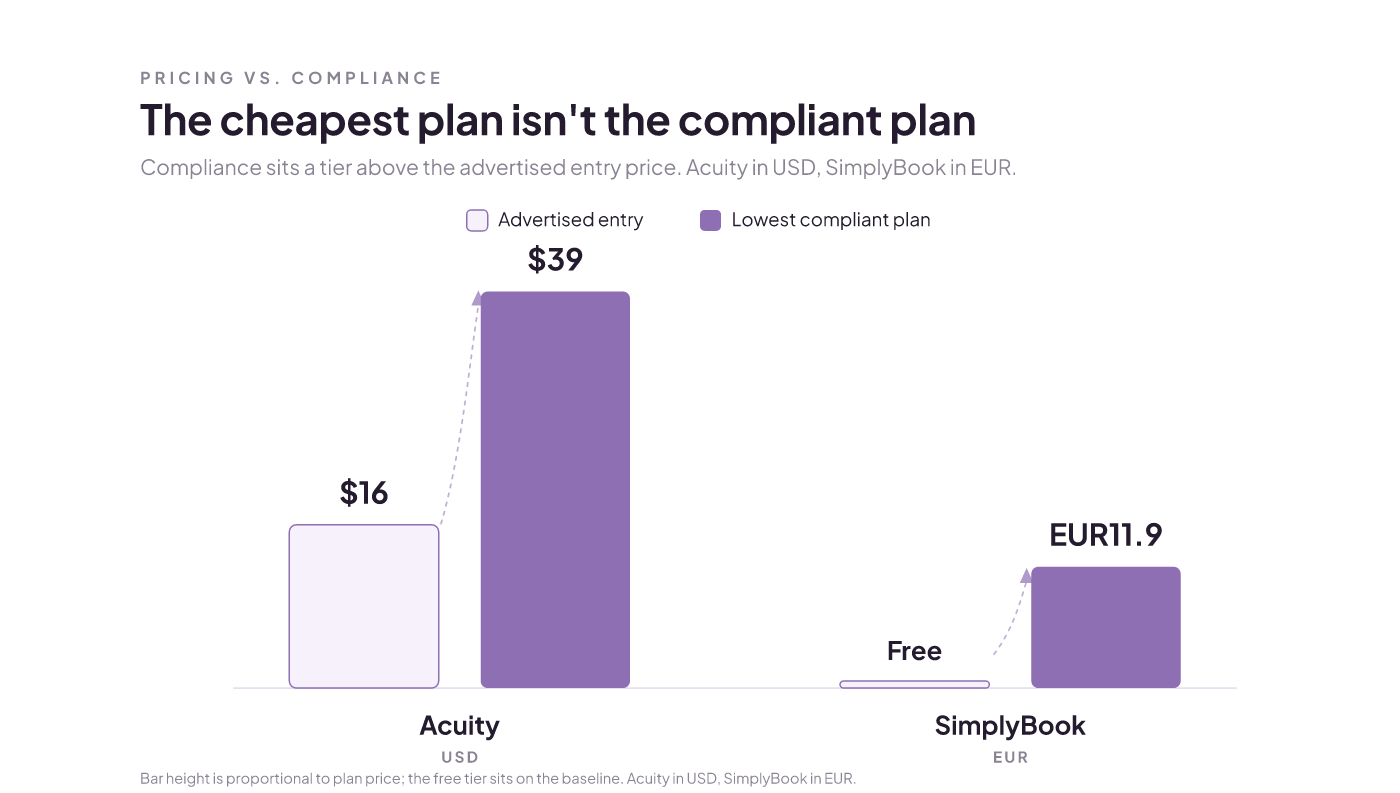
- Entry price is low and knowable where vendors publish it: Acuity's Starter plan is $16 a month billed annually, with no free tier.
- Compliance sits a tier up, not on the cheapest plan. Acuity only signs a HIPAA business associate agreement on Premium, from $39 a month, and a US BAA is not proof of Canadian PIPEDA or PHIPA compliance.
- We did not run these tools through a clinic day. This is built from published pricing, capability, and a publisher-conflict audit, not a first-party lab test.
Why the "best scheduling software" lists can't be taken at face value
You searched scheduling software for medical office and landed on a wall of pages that each crown themselves and hide the price. That is not bad luck. It is the search results working exactly as their authors intended.
Look at who wrote the rankings. The "11 Best Patient Scheduling Software in 2026" list is by-lined by a Digital Marketing Manager at WaitWell, a vendor a genuinely neutral list would be judging. A widely shared "comparison" of scheduling tools states, in its own words, that the page "is published by SimplyBook.me." Even the big directory is pay-shaped: it lists on the order of 300 products and discloses that "providers pay us for sponsored profiles," so the order you see is partly the order that was paid for. Enterprise vendors go the other way and print nothing at all. One well-known scheduling page, AdvancedMD's, offers only "get a live demo" and "get custom pricing."
| The ranking or page | Who publishes it | The conflict |
|---|---|---|
| "11 Best Patient Scheduling Software in 2026" | WaitWell, by-lined by its own Digital Marketing Manager | The author works for a vendor the list is meant to rank objectively |
| A "comparison" of scheduling tools | SimplyBook.me, which the page states outright | The vendor scoring the field is one of the entrants in it |
| Medical-scheduling directory, ~300 products | Capterra | Discloses paid sponsored profiles, so ordering is partly bought |
| A single vendor's scheduling page | AdvancedMD | Shows only "demo" and "custom pricing," so there is no neutral read and no price |
None of this means the named tools are bad. A self-interested ranking can still list a genuinely good product. The conflict tells you one thing only: do not trust the ordering. Trust the facts you can check yourself, which is what the rest of this guide gives you.
What purpose-built scheduling adds over a calendar or your EHR
A fair question before you spend anything: do you need medical scheduling software at all, or will a plain calendar and a reminder app do? For a low-volume solo office, the generic calendar can genuinely be enough. Paying for clinical tooling you won't use is a real waste, so don't let a ranking talk you out of the simple option.
Purpose-built software earns its price when the schedule gets complicated. It handles appointment types with different durations, availability across several providers at once, insurance and billing fields, and secure patient messaging a consumer calendar was never built for. The piece that matters most is the write-back. A good tool pushes a booking into your practice-management system or EHR, so the front desk works one calendar instead of keying a separate booking tool by hand. A booking widget that can't do that is a calendar in a nicer coat.
Scheduling software for medical office: real monthly price bands
Two vendors publish real numbers, so start there. Acuity has no free tier, and its cheapest Starter plan runs $16 a month billed annually, or $20 billed monthly. SimplyBook does offer a free tier, with paid plans that begin around 11.9 euros a month on Basic and climb to 49.9 euros a month on Premium. The enterprise names do not publish at all. AdvancedMD routes you to a demo and a custom quote before it will name a figure.
| Tool | Entry price | Free tier | HIPAA / BAA available on |
|---|---|---|---|
| Acuity | $16/mo USD (Starter, billed annually) | No | Premium, from $39/mo USD |
| SimplyBook | Free, or ~11.9 euro/mo (Basic) | Yes | Basic and up, from ~11.9 euro/mo |
| AdvancedMD | Not published (demo/quote) | Not published | Not published |
Read the band as a floor, not a full bill. Only two vendors show their hand, and they show it in US dollars and euros, not Canadian dollars. Real cost climbs with seats, integrations, and usage, and the gated vendors will land well above these entry numbers once they finally quote you.
The HIPAA-tier trap, and what a Canadian office actually has to satisfy
Here is the trap the price tables can hide. Compliance does not come with the free plan. SimplyBook keeps HIPAA off its free tier and turns it on as an option once you are on a paid plan, from the Basic tier at 11.9 euros a month up. Acuity goes further: it makes you buy Premium, from $39 a month billed annually, before it will sign a business associate agreement. So Acuity's $16 Starter and SimplyBook's free tier are both off-limits the moment you actually need compliance, and the advertised entry price is not the price a compliant office pays.
Now the part every US-written page skips. A BAA is an American document. It signals that a vendor takes security seriously. It is not proof the tool meets Canadian law. In Canada, patient health data sits under PIPEDA federally and under provincial health-privacy statutes, like Ontario's PHIPA, with counterparts in other provinces. Those laws set their own rules on consent, access, and where data may be stored. A Canadian office has to check the tool against them directly. A US HIPAA tier does not tick that box for you, and treating it as if it does is how offices end up out of step with the law they actually answer to.
Reminders and no-shows, sized honestly
The economic case for reminders is real, and it is mostly American. In the US, no-shows cost healthcare providers an estimated $150 billion a year, at roughly $200 per missed visit and about a 23% average no-show rate. There is no equivalent national Canadian number, but the mechanism travels cleanly: an empty slot is lost revenue and a patient pushed further down the waitlist.
Whether automated reminders fix it has been looked at properly. A 2023 study in the Journal of Patient Experience evaluated an automated reminder system for reducing missed appointments. It does not hand a general medical office a single headline reduction percentage, so treat automated reminders as a proven lever to test, not a guaranteed number to bank.
The bigger gap is that most offices barely use what they buy. In a July 2025 MGMA Stat poll, 71% of practices reported fewer than a quarter of their patients self-scheduling. The demand these tools are sold to capture is mostly still sitting on the table. The upside is real. In most offices it goes unrealized.
Which class of tool fits which office
Match the tool to the office, not to a "best overall" badge. The mapping below is built from published capability and price, so it narrows your field rather than crowning a winner. The one constant is compliance: any office touching health data is pushed off the free and cheapest plans, because a signable BAA lives a tier up, on Acuity Premium from $39 a month or a paid SimplyBook plan, never the $16 Starter or the free tier.
| Office type | What it needs | Realistic price tier |
|---|---|---|
| Solo practitioner | Low cost, plus compliance if it touches health data | Not the free plan: HIPAA needs a paid SimplyBook tier (Basic+, from ~11.9 euro/mo) or Acuity Premium (from $39/mo) |
| Multi-provider private practice | Multi-provider availability, appointment types, two-way PM/EHR write-back | Mid tier at minimum, often a PM-integrated tool |
| Walk-in / urgent care | Booked patients plus a walk-in queue, waitlist and cancellation backfill | Purpose-built queue tools, price usually quoted |
| Multi-location group | Multi-branch scheduling and write-back across sites | Enterprise, usually behind a demo and quote |
The trap to notice: a solo office that handles health data can't run on Acuity's $16 plan or SimplyBook's free tier, because compliance lives a tier up. And a multi-location group's real requirement, two-way write-back across sites, is exactly the feature the quote-gated enterprise tools sell and won't price in public.
The questions that actually decide your shortlist
Three questions settle most of these before a sales call does.
Does it write back to your exact system, both ways? A booking that writes back into your practice-management system or EHR is what lets the front desk work one calendar instead of keying a separate tool by hand, and integration depth is the line between a real fit and a calendar bolted on. Published material won't confirm your specific EHR, so this is the one thing you must test live in the demo.
Will they name a price? For the gated vendors, the demo is where the number finally appears. Go in knowing the two published entry bands above, so you can tell whether their quote is competitive or just opaque.
Should you shortcut with a directory? The big directory lists around 300 products and orders them partly by who paid, so treat it as a filterable catalogue, not a recommendation. It gives you names to check, not a decision.
How we built this, and where it stops
A decision guide that hides its own method is no better than the rankings it critiques, so here is ours. We did not run these tools through a clinic day. There is no first-party bake-off here, no scores, and no secret rubric. Every price, tier, and conflict above comes from the vendors' own published pages and one peer-reviewed study, read in mid-2026. Prices move, so confirm the current figure before you commit. The two published bands are in US dollars and euros, not Canadian dollars, so read them as a foreign-currency floor, not your final bill. The office-type mapping comes from published capability and price. It narrows the field. It is not a substitute for testing the one integration that matters against your own system, and the Canadian privacy check is still yours to run.
Your next step
Your next move is small and specific. Before you book a single demo, shortlist two tools that publish a real price and show clearly which tier unlocks compliance. Then make the gated vendors compete for that same information when you do get them on a call.
Ownerized does not sell scheduling software and does not crown one here, which is the whole reason this page could stay neutral. Its work is on the signals patients check before they book, a different job from picking your calendar. If you run an aesthetic clinic rather than a general practice, booking and visibility overlap far more, and Ownerized's work on med-spa booking software is closer to your case. Otherwise, see what Ownerized actually does if it's useful, and take your two-tool shortlist into the demos.
Aesthetician software in Canada: booking app or EMR?
By the end, the reader can classify any aesthetician software into booking-first or full-EMR, run a 7-point checklist against their own clinic, and know which category they should be shopping in, and why the monthly price is the wrong thing
Read insight
List of EHR systems: which ones fit a Canadian med spa
You'll get the real names that top every EHR list and their market-share ranking, an honest read on why that ranking doesn't answer a med spa's question, a capability checklist for aesthetic charting, a practice-type decision table with a C
Read insight
Medical spa booking software: an independent Canada ranking
An ownership-neutral, disclosed-rubric ranking of medical spa booking software that scores each tool on rebooking/retention across a multi-month journey and on Canadian PIPEDA/PHIPA fitness, and tells you which popular 'best of' guides are
Read insight