
Key takeaways
- In Canada, the two spellings are one regulated profession, same license and scope.
- What you may legally do depends on the treatment and province, not the title.
- "Medical esthetician" means added training, not a separate license.
- This is the Canadian answer; US rules differ.
Esthetician vs aesthetician: the short answer
Search the phrase and most pages, especially American ones, will tell you that an aesthetician does clinical, medical work while an esthetician cleans and pampers skin at a spa. For a Canadian reader, that answer is wrong.
In Canada, esthetician and aesthetician name the same trained skincare profession. The difference is spelling, not job duties, license, or scope of practice. When "aesthetician" sounds more clinical, that is marketing language, employer preference, or regional habit, not a separate credential.
That does not mean the word is meaningless. Clinics and schools do reach for "aesthetician" to signal a more medical role, so the spelling carries real market weight. It just does not carry a different license. If you pick a program or a provider based on the spelling alone, you are reading a marketing signal as if it were law.
Why the internet says one spelling means medical
Two things drive the confusion.
First, the work really has split into two buckets. Aesthetic services now divide into medical and non-medical categories, and as injectables and medical-grade treatments have gotten popular, so has the worry over what someone can legally do without a medical license. That split is real. It just describes the treatment, not the title on the practitioner's certificate.
Second, the rulebook is a patchwork. Who may perform an advanced treatment like microneedling changes sharply from one jurisdiction to the next. Ask the same question in two places and you get two answers, both correct for their own region. Writers then flatten that mess into a tidy "aesthetician equals medical" line because it reads cleanly. It is just not true as a matter of licensing.
You can see the confusion land on real people. Prospective students routinely ask whether a "medical esthetician course" is a second license or an add-on to a regular esthetician credential. It is a fair question, and the internet answers it badly.
How Canada actually regulates it, province by province
Here is the part US-framed pages miss: Canada has no single national esthetician credential. Provinces set the education requirements and regulation. So the honest answer to "what can an esthetician do" is "it depends on your province," and the gap between provinces is wide.
Take two ends of it.
In Ontario, esthetician training programs sit under legally binding policy directives issued through the Ontario Career Colleges Act, 2005. Under subsection 53(2), those directives are legal requirements, and every career college must comply. Training is standardized by force of law.
British Columbia is the opposite. Aesthetics and cosmetic skin treatments there are not governed by a formal provincial licensing body at all. Unlike nursing or medicine, no mandated standard dictates who may practice. Same country, and one province binds training by legal directive while another has no aesthetics regulator to speak of.
Two provinces are not thirteen. This is a sample, not a full national map, and rules change. Before you enrol or book, confirm the current rule with your own province's regulator rather than trusting a blog, including this one.
What actually sets the limit: procedure depth and supervision
If the title does not set the boundary, what does? Two things: how deep the treatment goes, and who supervises it.
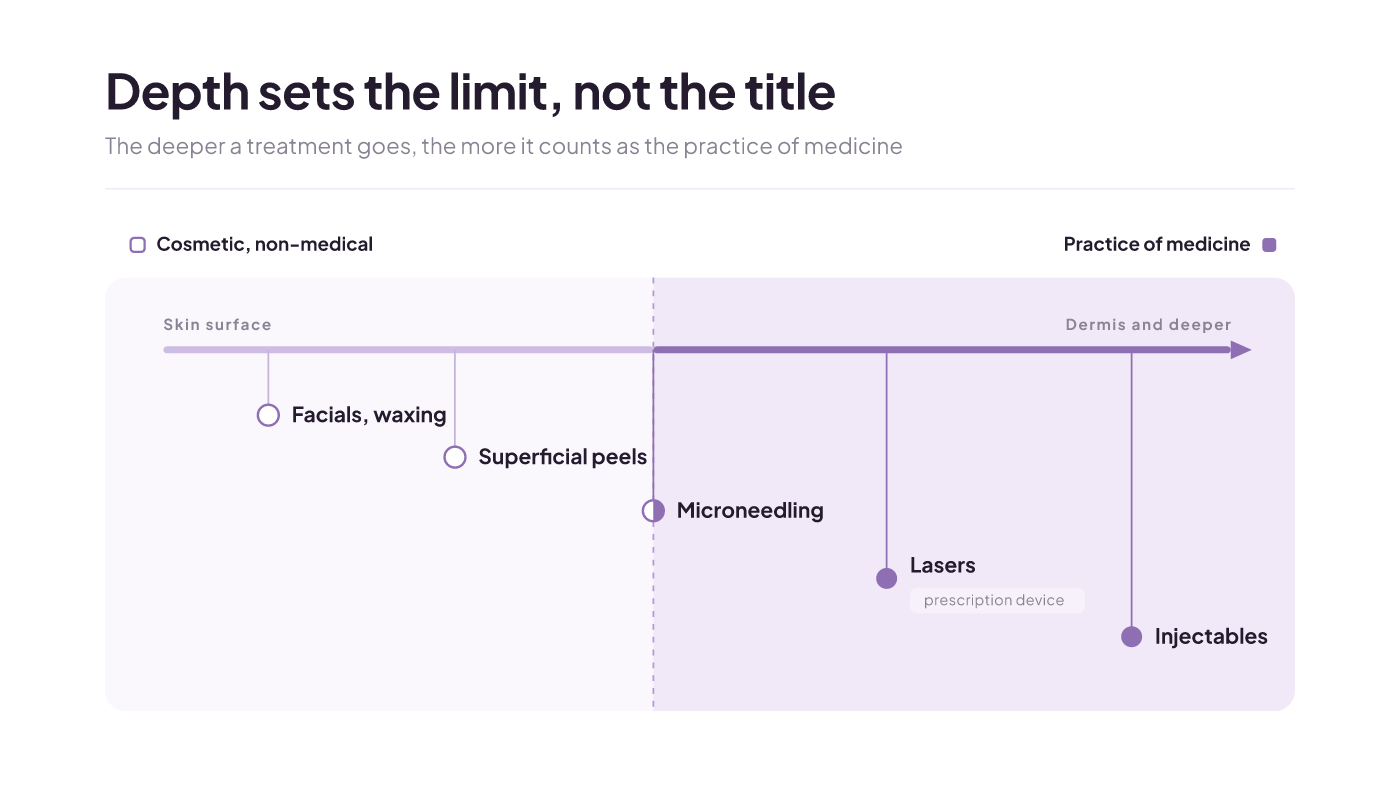
Depth is the cleaner test. Superficial treatments like laser hair removal are often treated as non-medical appearance enhancement, while anything reaching the dermis or deeper is regulated as the practice of medicine. A surface glow-up is cosmetic. Cutting into living tissue is medicine. Most of the real fights happen at the fuzzy line between them.
Devices push a treatment across that line fast. Most aesthetic lasers are Class IIIb or Class IV prescription medical devices, so operating one is the practice of medicine. An esthetician works on the surface of the skin, and a weekend certificate does not expand what a license permits. The certificate proves you took a course. It does not rewrite your scope.
Injectables make the point sharper. Take neurotoxins like Botox. In parts of the US, an aesthetician who injects them on the strength of a certificate and five years of experience is still a compliance failure, because cosmetic intent does not make a medical act non-medical. The skill is real. The legal authority is not.
The exact spot where "surface" becomes "medical" shifts by jurisdiction and by device. That is why depth-and-supervision is the right question to ask, not a single universal cutoff you can memorize.
Is "medical esthetician" a separate license? No, it's added training
This is the question that trips up most students, so let's settle it.
A medical esthetician is a traditional esthetician who took extra training to work in clinical, medical-grade settings. It is an advanced role layered on the base license, not a distinct third credential you apply for. The base skincare license is the same one underneath.
What changes is the job, not the license. Job duties, pay, and the education path differ between the two roles, so it is a genuine career decision to plan out. It is just not a decision between two spellings.
On pay, be careful with the numbers you see online. A reliable current Canadian range for esthetician versus medical esthetician is hard to pin down, so treat pay as varying by role, setting, and region rather than by which spelling you use. The clinical role generally sits higher because the work is more specialized, but chase a real local figure before you bank on it.
Pick by the treatment, not the title: a decision table
The keeper rule is simple. Decide by the treatment you want to perform or receive, then confirm the license and supervision your province attaches to it. The spelling on the title tells you nothing about the credential.
| Treatment | Cosmetic or medical | License and supervision it usually needs | Does spelling matter? |
|---|---|---|---|
| Facial, cleansing, extractions | Cosmetic (surface) | Standard esthetician training | No |
| Waxing, brows, lashes | Cosmetic (surface) | Standard esthetician training | No |
| Superficial chemical peel | Usually cosmetic at surface depth | Esthetician training; deeper peels move toward medical oversight | No |
| Microneedling | Depends on depth and province | Varies by jurisdiction; often supervision once it reaches the dermis | No |
| Laser treatments | Medical (prescription device) | Medical oversight; the device is prescription-class | No |
| Injectables (neurotoxins, filler) | Medical | A medical professional or medical delegation and supervision | No |
Read this as a decision aid, not legal advice. For anything on the borderline, especially microneedling, lasers, and injectables, verify the exact supervision rule against your own provincial regulator before you act.
If you're comparing to the US
Cross-border readers should not import US framing into a Canadian plan, but the US contrast is worth knowing.
In the US, licensing is state-by-state, not national. As of 2026, esthetics programs run roughly 250 to 1,200 clock hours depending on the state, and moving a license across state lines means meeting each board's reciprocity or endorsement rules. So a license earned in one state does not automatically travel.
Two cautions. This is US practice only, so a Canadian reader should not apply those hour ranges or the state-board framing to their own path. And the fragmentation is the whole point: the US answer to "who can do this treatment" genuinely changes at the state line, which is exactly why single-answer articles mislead a Canadian reader.
Before you act: how to confirm your province's rules
This guide gives you the framework. It cannot replace your province's current rulebook, which changes and varies more than any single article can track.
So do three things. Decide by the treatment, not the spelling. Ask who supervises anything that reaches the dermis or uses a prescription-class device. Then confirm the specifics with your provincial regulator or licensing body, since a rule that holds in Ontario may not hold in British Columbia.
If your next question is about running or working in a Canadian med spa, the operational side matters as much as the license: how a clinic handles booking and patient scheduling and keeps its medical office workflow tight shapes the day far more than which spelling sits on the door.
Patient acquisition software: a Canadian med spa guide
By the end, a clinic owner can decide whether to buy patient acquisition software now, which category fits their stage, and the two conditions (retention performance and connected data) that determine whether any tool pays off.
Read insight
How to measure patient retention rate at your clinic
You'll leave able to calculate your patient retention rate the right way for an aesthetics clinic: the exact formula, a worked example, which window and cohort to pick, what to exclude, how to pull the inputs from your PMS, and how to tell
Read insight
Answer engine optimization (AEO): a guide for clinics
By the end you'll know what AEO really is, why the training-data mental model most guides use is wrong, which answer surface to prioritize for a local Canadian business, and which tactics are worth your time versus which are unproven.
Read insight