
Answer engine optimization (AEO) is the work of getting your business named inside an AI answer that a patient reads instead of a page of blue links. If you run a clinic in Canada, you have already felt the shift. A patient asks ChatGPT or Google's AI Overview a question, reads a finished answer, and never clicks a website. This guide skips the definition loop most articles get stuck in. It hands you a decision instead: what AEO really is, the one myth to drop, which answer surface to chase first, and which tactics actually have evidence behind them.
One honest note up front. AEO is early, and a lot of the tactic advice online is repeated, not tested. So this guide leans on what can be shown over what merely gets said a lot.
Key takeaways
- AEO is structuring your content so AI tools cite and recommend your clinic in their answers, not rank a link. Zero-click search, where someone gets the answer without visiting any site, is now the dominant way people search, so clicks alone undercount your demand.
- You don't need to be in an AI's training data to be cited.
- Target the surfaces where a local clinic can actually get recommended, and don't waste effort on the ones that name almost no local businesses.
- AEO is still early and most of the tactic advice online is repeated rather than tested, so weigh what can be shown over what merely gets said a lot.
What answer engine optimization AEO actually is
Answer engine optimization is structuring your content so AI models like ChatGPT can understand it, reference it, and recommend your brand when someone asks a question. That is the plain definition, and nearly every guide agrees on it. If a definition is all you came for, you can stop here.
The value is in what comes next. A whole category of tools now tracks how your brand shows up in AI answers across ChatGPT, Google AI Mode, and Perplexity: where you get mentioned, and where a competitor gets named instead of you. That tracking is the point. AEO is measured by whether the answer engine picks you, not by where a page sits in a list of links.
How AEO differs from SEO
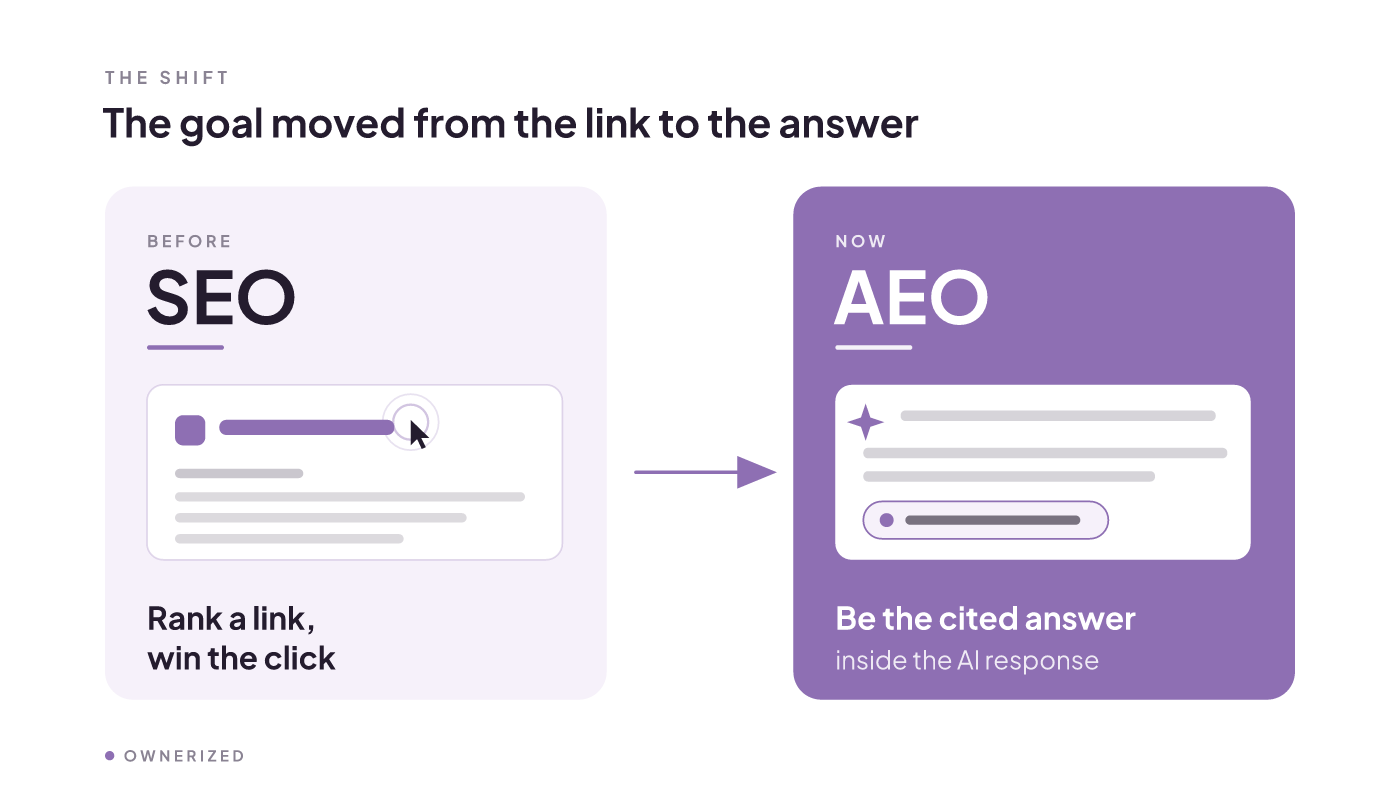
The core difference is the goal, and that is the whole of it. SEO works to rank your page as a link and win the click. AEO works to make you the answer the engine cites or recommends in the first place, which is exactly what that definition points at: content an AI can understand, reference, and recommend when a patient asks. Same question, different finish line.
These are not rivals. The foundations that help SEO still help AEO: a page a crawler can read, a clear structure, and content a reader trusts. AEO shifts the emphasis toward being quotable. It does not throw away the basics. If your site is a mess for Google today, it will be a mess for ChatGPT too.
Why this matters now: the zero-click shift
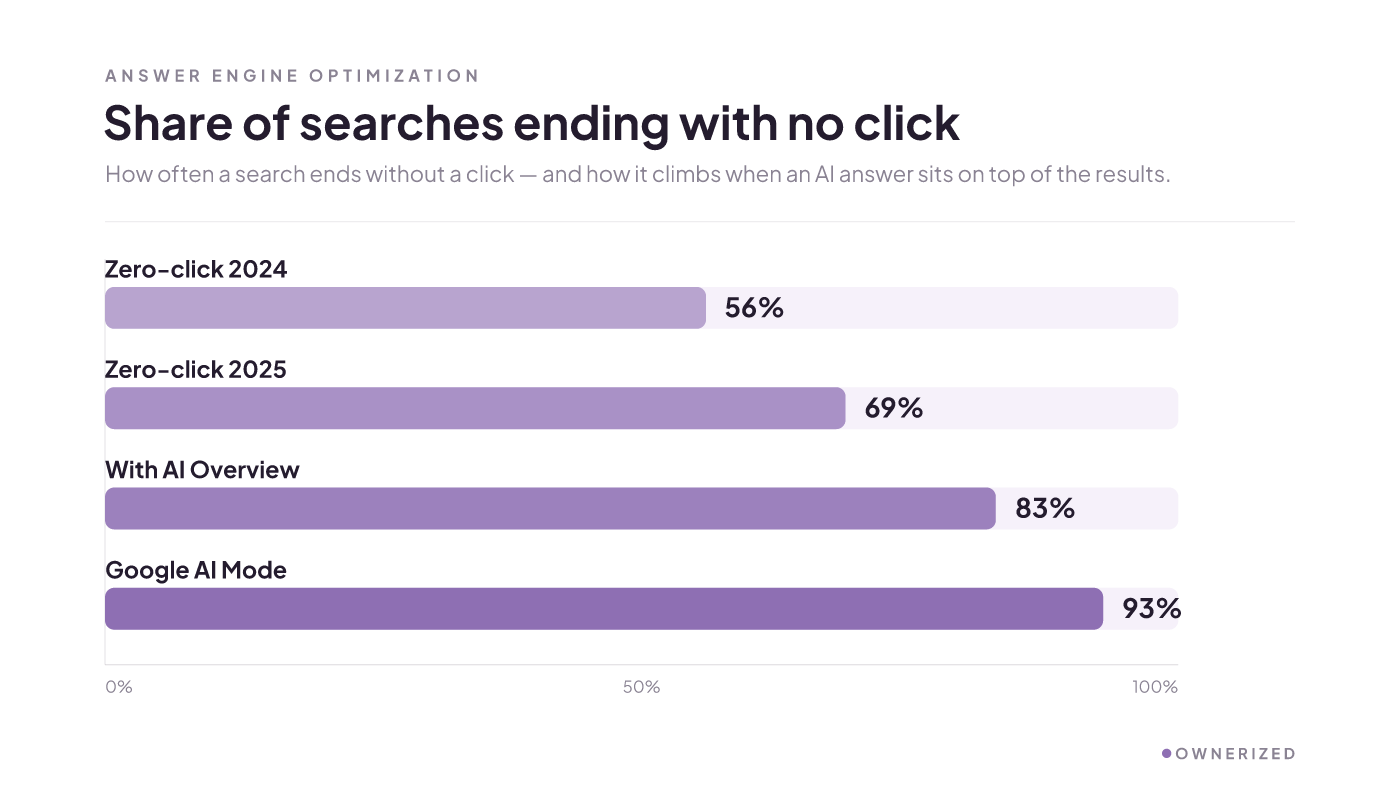
Here is the change in numbers. Zero-click search, where someone searches and never clicks through to a site, has gone from an edge case to the main way people search. AI Overviews and tools like Perplexity and ChatGPT Search now pull from many sources and write the answer on the results page itself.
The share of zero-click Google searches rose from about 56% in 2024 to about 69% in 2025. When an AI Overview sits on top of the results, roughly 83% of those searches end with no click to any site. In Google's newer AI Mode, that figure reaches about 93%. Put another way, for every 1,000 US Google searches in 2024, only about 360 sent a click to the open web.
The scale is large and still growing. Google AI Overviews reach around 2 billion monthly users, and ChatGPT handles around 2 billion queries a day. Third-party forecasts project hundreds of billions in US search revenue shifting toward AI-powered search by 2028, and traditional search volume falling about 25% by 2026.
One caution for Canada. These figures are mostly US measurements, and the exact Canadian numbers are not established. Read them as the direction of travel, not as a Canadian scoreboard.
The training-data myth, corrected
You will read that to get cited by an AI, your content has to be baked into the model's training data. That is the wrong model, and correcting it changes what you actually do.
These engines do not answer from memory alone. Google AI Overviews, ChatGPT, and Perplexity retrieve and cite live web content, and when someone asks a question they synthesize an answer from the multiple sources they pull at that moment. The citation comes from that retrieval step, not from a training run. So the practical takeaway flips: you do not wait to be absorbed into a model to get named, you make your page easy to retrieve and worth quoting the moment the question is asked.
That is also why being quotable beats being famous. The system chooses sources at query time based on what answers the question well. What this guide cannot hand you is a first-party worked example: a specific post-cutoff page we watched get cited, with the retrieval logged. So treat the correction as how these systems work, which is well established, not as a case study we ran.
Which answer surface to prioritize first
Not every AI surface is worth the same effort for a local clinic. They are wildly different about which local businesses they will name. Recent 2026 figures make the gap concrete: AI assistants recommend a far narrower set of local businesses than Google's local pack.
| Google local pack | Gemini | Perplexity | ChatGPT | |
|---|---|---|---|---|
| Local businesses it recommends (2026) | ~35.9% | ~11% | ~7.4% | ~1.2% |
| Reach for a local clinic | Widest | Moderate | Moderate | Narrowest |
| Priority for one location | First | Second | Second | Later |
Read the table as a priority order, not a scoreboard. Google's local pack still recommends far more local businesses than any AI assistant does, at about 35.9%, so your Google Business Profile and local pages stay first. Gemini and Perplexity sit in the middle, naming roughly 11% and 7.4% of local businesses, so they earn attention once your Google footing is solid. ChatGPT names so few local businesses, about 1.2%, that it is a stretch goal, not your opening move.
Be clear on what this ranking is. It is reasoned from published selectivity figures, not from our own count of how often aesthetics clinics get cited on each surface. That per-surface, per-vertical count is the harder proof, and it is not captured yet.
Tactics worth your time, and the ones nobody has proven
Two practices have real support, and both are just good content habits. First, structure the page so a machine can read it. Clear headings, bullet points, and schema.org structured data help AI systems parse a page and pull meaning out of it. Second, front-load the answer. Put the core answer in the first 40 to 60 words of a section, then add the detail. An engine can lift a clean, complete answer far more easily than one buried in paragraph five.
Here is the honest part. No guide, including this one, has run a controlled test of which tactic actually causes a citation. So treat these as reasonable and evidence-adjacent, not proven levers. Any tactic that promises guaranteed citations is selling certainty nobody has. And none of this is about tricking retrieval. It is about writing the clearest, most useful answer on the page, then making it easy to read. If you want the method laid out step by step, Ownerized's AEO training walks through it.
How to measure AEO when clicks fall
When clicks stop telling the whole story, you measure different things. Track three: brand mentions inside AI answers, referral traffic that arrives from AI tools, and how often you get cited across the major platforms. Rankings and sessions still matter, but on their own they now miss a growing share of demand.
There is a conversion signal worth knowing. Visitors who arrive through AI search convert at about 4.4 times the rate of traditional organic visitors, on average. Do not bank on that headline, though. It is a wide cross-industry average, running from about 1.3x in low-consideration ecommerce up to 23x in B2B SaaS. A single-location clinic sits nowhere near the top of that range, so plan for a lift, not a miracle.
The measurement tools here are newer and less settled than the content basics, so expect the category to keep changing. For a starting read, you can see where your clinic currently shows up in AI answers before you spend a dollar on tactics.
AEO for a single-location Canadian clinic
This is the question the top results dodge: how does AEO tie to local SEO when you have one location? Here is a first-move sequence that follows from the selectivity data.
Start with the surfaces where a local business can actually get named. That means a strong Google Business Profile and local pages first, because Google's local pack still recommends far more local businesses than any AI assistant does. Then write clear, citable answers to the exact questions your patients ask: what a treatment costs in your city, whether it hurts, how long recovery takes, who is a good candidate. Keep those answers consistent across your site, your profile, and your booking pages. Mixed signals give an engine a reason to skip you.
Be honest about what this is. It is reasoned guidance from the published data, not a first-hand result from a Canadian clinic we ran, with a measured change in AI mentions or booked inquiries. That first-party proof is the piece still missing, and naming it is fairer than implying we have it. This groundwork is what makes a clinic findable across AI surfaces, and the playbook above is where the work starts.
Keep it Canadian. Price your examples in Canadian dollars, point to your real city, and answer the questions a patient in Toronto or Calgary would actually type.
What this guide can't yet prove
A few edges, stated plainly so you can trust the parts that are solid.
- No controlled test here shows which tactics cause a citation. The tactic advice is reasonable, not proven.
- There is no first-party count of how often aesthetics clinics get cited on each surface. The priority order rests on published local-recommendation figures, not our own vertical data.
- The scale and revenue figures are third-party projections, not measurements. The selectivity figures are from 2026.
None of that sinks the core moves. It just marks where the ground is firm and where it is still soft.
Your next step by situation
Pick the branch that fits you.
If you have never checked how you show up in AI answers, start there. You cannot improve a number you have not measured, and brand mentions, AI referral traffic, and citation frequency are the numbers that matter now. Check how your clinic shows up in AI answers and you will know where you actually stand.
If you have measured it and want help doing the work, that is what an AEO partner is for. See how to run answer engine optimization in Canada with a team instead of alone.
Either way, the move this quarter is the same. Stop optimizing only for the click, and start being the answer.
AI visibility checker: read the score, pick the right one
By the end you can tell the two kinds of 'AI visibility checker' apart, know why no single tool's score is portable, pick the right category for your situation, and reproduce the core check by hand for free.
Read insight
Answer engine optimization certification: is it worth it?
By the end, the reader knows there is no accredited vendor-neutral AEO certification yet, can name what each ranking program actually is, and holds a four-criteria scorecard to judge any AEO cert they are offered.
Read insight
How to choose an answer engine optimization agency in Canada
By the end, the reader can vet any AEO agency, including us, with a verification protocol, an attribution-isolation test for self-reported numbers, and a way to match agency type to their actual bottleneck.
Read insight