
Key takeaways
- AI answers pass no referral data, so demand a fixed-prompt citation snapshot.
- Retainers run about $2,000 to $50,000 USD a month for similar work.
- Match the agency to your bottleneck, not to a "best of" list.
- This is a buyer's framework from public data, not our own case study.
What an answer engine optimization agency actually does
An answer engine optimization agency works to make your brand the source that AI engines cite when they write an answer. That means ChatGPT, Gemini, Perplexity, Copilot, and Google's AI Overviews. The goal shifts from ranking a blue link to getting quoted inside the generated answer.
Here's why it matters now. Most Google searches end without a click, and only a minority of AI citations come from page-one results. So ranking well no longer guarantees anyone sees you.
Every agency covers this part. It's the table-stakes pitch, not where you make your call. Move fast past it.
Why the 'best AEO agency' lists can't answer your real question
Search "answer engine optimization agency" and you get roundups. Most share one habit: the company that wrote the list sits at number one. The ranking runs on criteria the author picked, scored the way the author scores.
The deeper problem is measurement. These same lists admit that AI answers rarely pass referral data. Agencies estimate impact by triangulating log files, answer snapshots, and branded-search lift. So any lift number you're shown is an estimate, not a tracked outcome.
That doesn't make the lists useless. They're a fine way to build a shortlist. They just can't verify the one thing you're buying.
The verification protocol to write into your contract
Since no one can hand you tracked referral traffic, you write the proof method yourself, into the contract.
Start with a fixed set of prompts. Pick 20 to 40 real buyer questions in your category. Run them across the engines that matter to you before any work starts. Save the result. That's your baseline: who gets mentioned, who gets cited, and where you show up.
Then measure the same prompts on a schedule. Pair that with branded-search lift, the rise in people searching your name directly.
Score each snapshot across six things: mentions, citations, answer position, sentiment, competitor share of voice, and source quality. Those six are what a serious agency should already report.
Be honest about the limits. This is still an estimate. Snapshots take real labour, and prompts drift as the engines change. But a fixed baseline you own beats a headline number you can't check.
How to audit a self-reported case-study number
Case studies love a big number. Say one claims a 200% jump in new users after an AEO engagement. The number isn't the problem. The missing method is.
Ask one question: how did you isolate AEO from everything else running that quarter? Most brands doing AEO are also doing SEO, PR, paid ads, and email at the same time. A jump in new users could come from any of them.
A good agency answers plainly. It names the fixed-prompt baseline, shows the branded-search lift, and gives you a confidence range. A weak one just repeats the headline louder.
You're not demanding perfect proof. Perfect isolation doesn't exist. You're demanding a credible method and an honest range.
Match the agency type to your bottleneck
"Best" is the wrong question. The right one is simpler: what's actually broken? There are three common failure modes, and three kinds of shop.
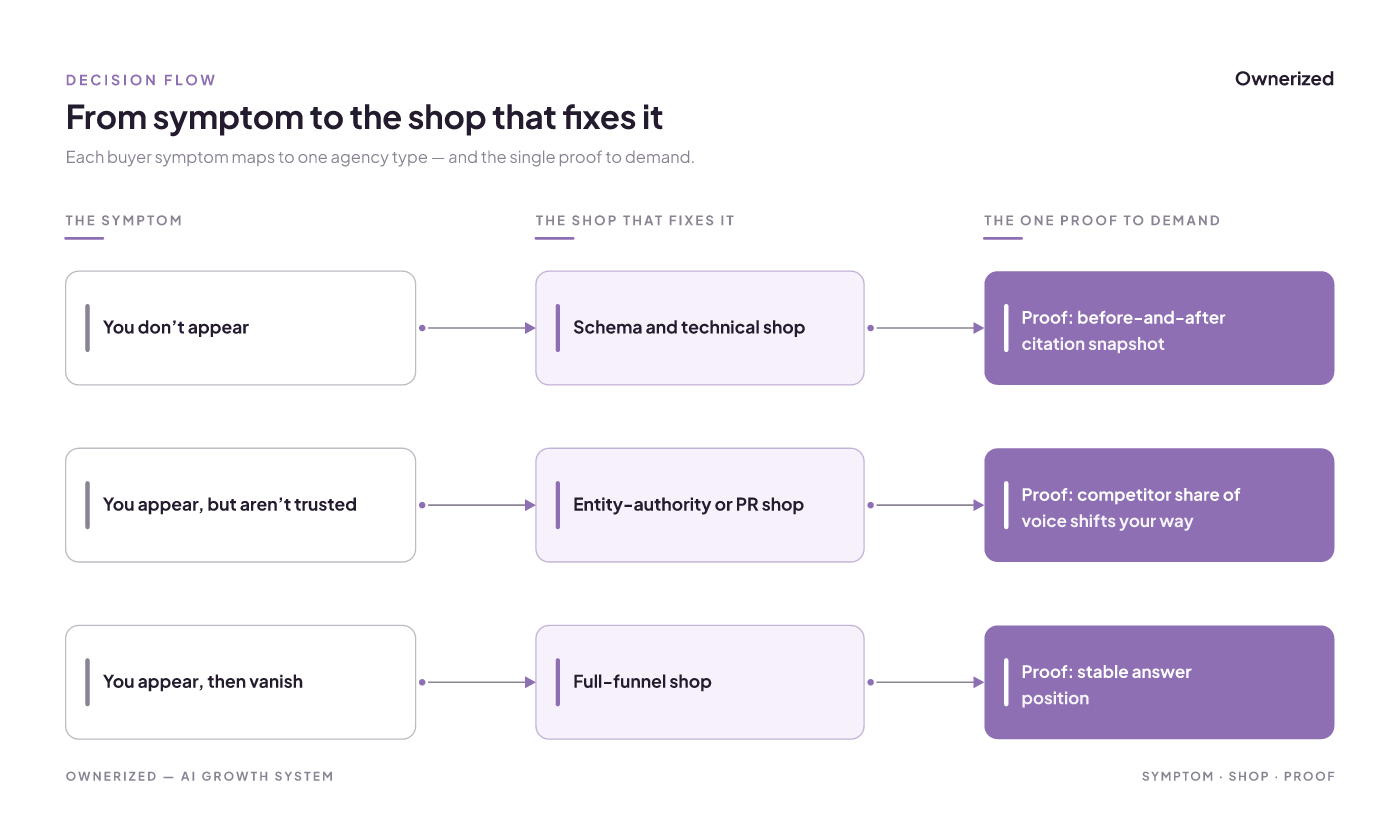
You don't appear at all. The engines don't read you as a clean, structured source. That's a discoverability problem. You want a schema and technical shop that fixes structured data, semantic HTML, and how your pages are built. Proof to demand: a before-and-after citation snapshot on your fixed prompts.
You appear, but you're not trusted. The engines mention you, then cite competitors as the real authority. That's a trust problem. You want an entity-authority or digital-PR shop that builds citations and mentions across sources the engines already trust. Proof to demand: competitor share of voice moving in your favour.
You appear, then vanish. Your visibility swings week to week. That's a consistency problem. You want a full-funnel shop that keeps content, structure, and authority aligned over time. Proof to demand: stable answer position across repeated snapshots.
These types overlap, and some shops genuinely do all three. Treat this as a diagnosis, not a rulebook.
Cost, timeline, and the agency vs in-house call
The price range is wide and a little absurd. Across the market in 2026, retainers run from about $2,000 to $50,000 USD a month for work that reads the same on paper. That 14x spread isn't a quality gap. It's different cost models stacked under one job title, and buyers rarely learn which model they're paying for.
For Canadian buyers, one flag first. These are USD figures from a fast-moving global market. Budget in Canadian dollars, convert at today's rate, and treat every number as a range to pressure-test, not a fixed quote.
| Model | Cost (USD) | Time to first signal | Time to consistent lift |
|---|---|---|---|
| Full-service agency | ~$48,000 to $180,000 over 6 months | ~5 weeks | ~12 weeks |
| In-house team | ~$215,000 to $350,000 per year | Longer to ramp | 6 to 12 months |
| Hybrid (guidance + your team) | ~$48,000+ for strategy | Depends on your team | 4 to 6 months to build capability |
On timing: done well, the first citation signals can show up in about five weeks. A steady lift in AI-driven traffic more often takes around twelve weeks. Domain authority, content relevance, and steady execution all move that clock.
Red flags to catch before you sign
None of these is an automatic no. Each is a question a good agency answers without flinching.
- A headline percentage with no isolation method behind it.
- No fixed-prompt baseline captured before the work starts.
- Coverage of only one engine when your buyers use several.
- Reporting that skips the six dimensions: mentions, citations, answer position, sentiment, competitor share of voice, and source quality.
- A promise of tracked AI-referral traffic. That data mostly doesn't exist, so anyone promising it is guessing or bluffing.
Ask each one out loud. The answers tell you more than any case study will.
Your next step by situation
Hire an agency when your bottleneck is real, your budget clears the low end of that USD range, and you need results across several engines within a quarter or two.
Go hybrid when you have a capable marketing team but no AEO method yet. You pay for the strategy and keep execution in-house, building the skill while the work happens.
Run it in-house when your need is small or single-engine. If you're chasing visibility in one engine on a tight budget, an agency retainer is probably the wrong call. A sharp in-house owner with a fixed-prompt tracker can cover it.
Whichever way you go, the move is the same: write the verification protocol into the contract before you sign. Use it to vet any agency, including us. If you want to see how we approach AI-answer visibility, Ownerized is built around it.
Answer engine optimization (AEO): a guide for clinics
By the end you'll know what AEO really is, why the training-data mental model most guides use is wrong, which answer surface to prioritize for a local Canadian business, and which tactics are worth your time versus which are unproven.
Read insight
AI visibility checker: read the score, pick the right one
By the end you can tell the two kinds of 'AI visibility checker' apart, know why no single tool's score is portable, pick the right category for your situation, and reproduce the core check by hand for free.
Read insight
Answer engine optimization certification: is it worth it?
By the end, the reader knows there is no accredited vendor-neutral AEO certification yet, can name what each ranking program actually is, and holds a four-criteria scorecard to judge any AEO cert they are offered.
Read insight