
Key takeaways
- AI visibility checkers count how often AI assistants name your brand.
- The term hides two products: mention trackers and page-readiness scanners.
- A single tool's score isn't portable. It points you at what to fix next, not where you rank.
- You can reproduce the core check by hand, for free.
You typed your domain into a free AI visibility checker, got a number between 0 and 100, and now you're stuck. What does it measure? Should you trust it? A second checker gave your brand a different number, so which one is right?
Here is the short version. The tools disagree because "AI visibility checker" is really two products sharing one name, and because each one asks the AI assistants a different set of questions. Once you see that, the number stops being a verdict. It becomes a rough signal you can confirm yourself.
What an AI visibility checker actually measures
One of these tools measures how often and how prominently AI assistants name, cite, or recommend your brand when someone asks a buying question. The surfaces that matter right now are ChatGPT, Perplexity, Google's AI answers (Gemini and AI Overviews), and Claude.
This is not your Google ranking. Your clinic can sit at position one on Google and still never come up when a patient asks ChatGPT for the best options in your city. That gap is the whole reason AI visibility gets measured on its own.
One caution before you read too much into any score. A mention is not a click, a lead, or a booking. These tools measure presence in an answer, not whether that presence brought you a patient. Presence is the start of the funnel, not the end of it.
One name, two different tools
Here is the part no ranking page tells you. Two tools can both call themselves an "AI visibility checker" and measure completely different things.
The first kind queries live AI assistants. It runs a set of prompts through ChatGPT, Perplexity, Gemini, and Claude, then counts how often your brand shows up in the answers. That is a mention tracker.
The second kind never talks to an AI assistant at all. It scans your site for one readiness signal you can see yourself: whether crawlers like GPTBot, ClaudeBot, and PerplexityBot are allowed in your robots.txt. That is a page-readiness scanner.
Both are useful. They answer different questions. Buy the wrong one and you get a confident score for a question you never asked. And some tools carry the "AI visibility checker" name while never querying an assistant at all. They only scan your robots.txt to see whether the crawlers are allowed in. Same label, completely different job.
| Tool | What it does | Category |
|---|---|---|
| Ahrefs AI Visibility Checker | Queries several AI platforms and counts brand mentions | Mention tracker |
| Semrush AI Search Visibility | Scores your mentions against the competitor median | Mention tracker |
| Ubersuggest (Neil Patel) | Counts brand mentions across many AI prompts | Mention tracker |
| indexly | Counts mentions and flags competitor-gap prompts | Mention tracker |
| loamly | Runs 50 buyer prompts across four models | Mention tracker |
| amivisibleonai.com | Checks whether AI crawlers are allowed in robots.txt | Page-readiness scanner |
A fair warning on the table. A few tools straddle both jobs, and not every vendor publishes its full method. The sort above is by each tool's stated approach, so where a vendor keeps its method private, leave its category as unknown until it shows the work.
Why two checkers give your brand different scores
Most mention trackers build the headline number the same way. A 0-100 score reflects how often your brand appears in AI answers compared with the median number of mentions for your competitors. Score high and you are named more than the middle of your field. Score low and you are named less.
Now the catch. That score depends on the prompt set, and every vendor uses a different one. One tool runs 50 buyer prompts. Another asks a handful. Some lean harder on one assistant than another. Change the questions and the platforms, and you change the answer. That is why the same brand can look strong on one checker and middling on another. Neither is lying. They asked different questions and did the math against different competitor sets.
So no single tool's number is a shared metric the way a Google position is. It is one vendor's reading, built from one vendor's questions. A single score points you at what to fix next. It does not tell you where you rank in some league table, and no other tool would score you the same way. Treat it as directional, not as a KPI you report on.
What a good score looks like, and what a number can't tell you
There is no industry-standard "good" number. A 60 means nothing on its own. The only version of the score that means something is your own, tracked over time against your own baseline. Up and to the right is good. A snapshot is just a snapshot.
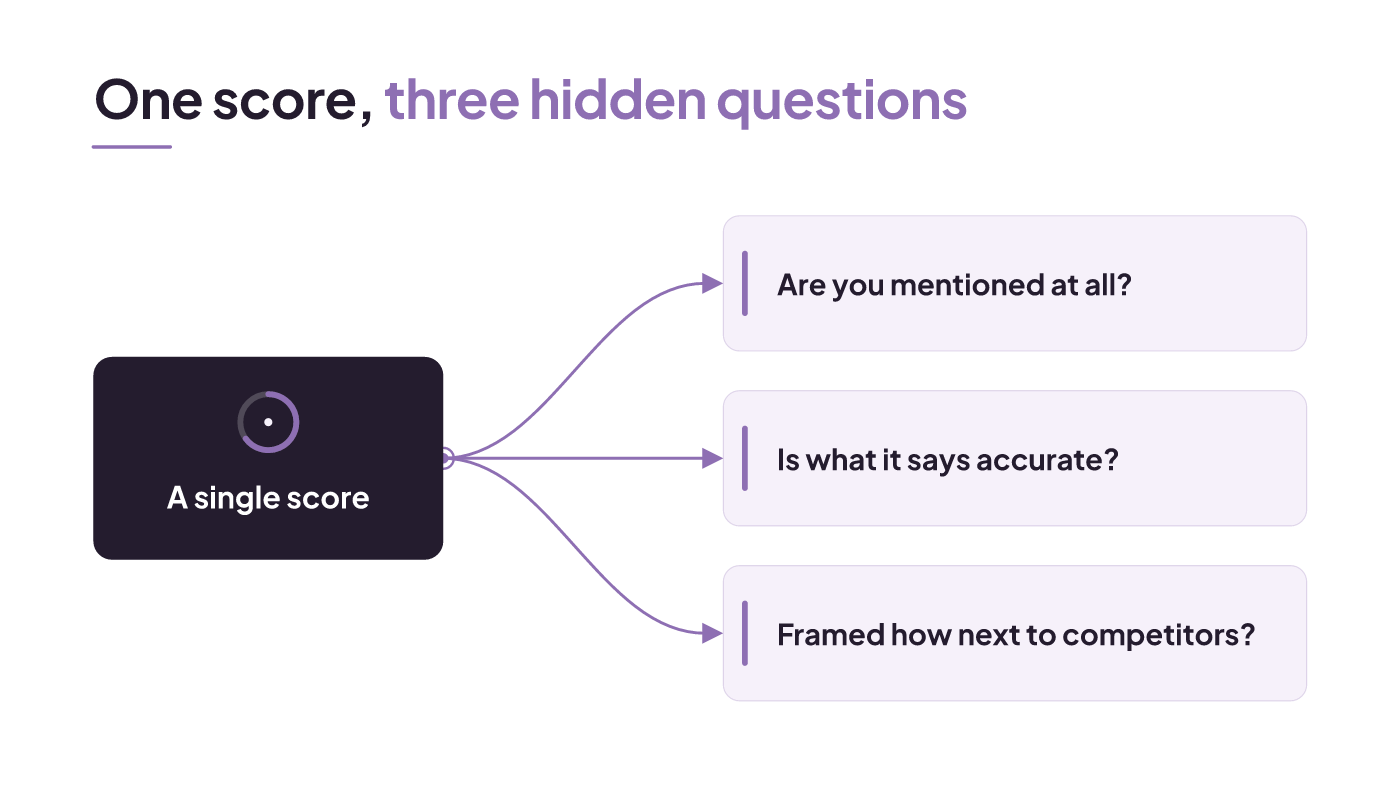
A single number also collapses three different questions into one:
- Are you mentioned at all?
- Is what the AI says about you accurate?
- How are you framed next to your competitors?
You can score a respectable 55 while an assistant recommends you for the wrong treatment, or names you politely right after it calls a competitor the top choice. The number hides all of that. If you only read the score, you miss the part that actually costs you bookings.
The free pre-check before any score: can AI crawlers read your site?
Before you pay for anything, spend five minutes on the cheapest check there is. Page-readiness scanners charge for one thing you can look at yourself: whether AI crawlers are even allowed on your site.
Open yoursite.com/robots.txt in a browser. Look for GPTBot (OpenAI), ClaudeBot (Anthropic), and PerplexityBot (Perplexity). If any of them is blocked, you have handed yourself a structural reason to be invisible, and it is a quick fix with your web person.
Be honest about what this proves, though. Allowing the crawlers does not put you in the answers. It only clears the door so you have a chance. It is necessary, not sufficient. But a blocked crawler is a silent own-goal worth ruling out before you spend on a monthly tool.
How to check your AI visibility by hand, for free
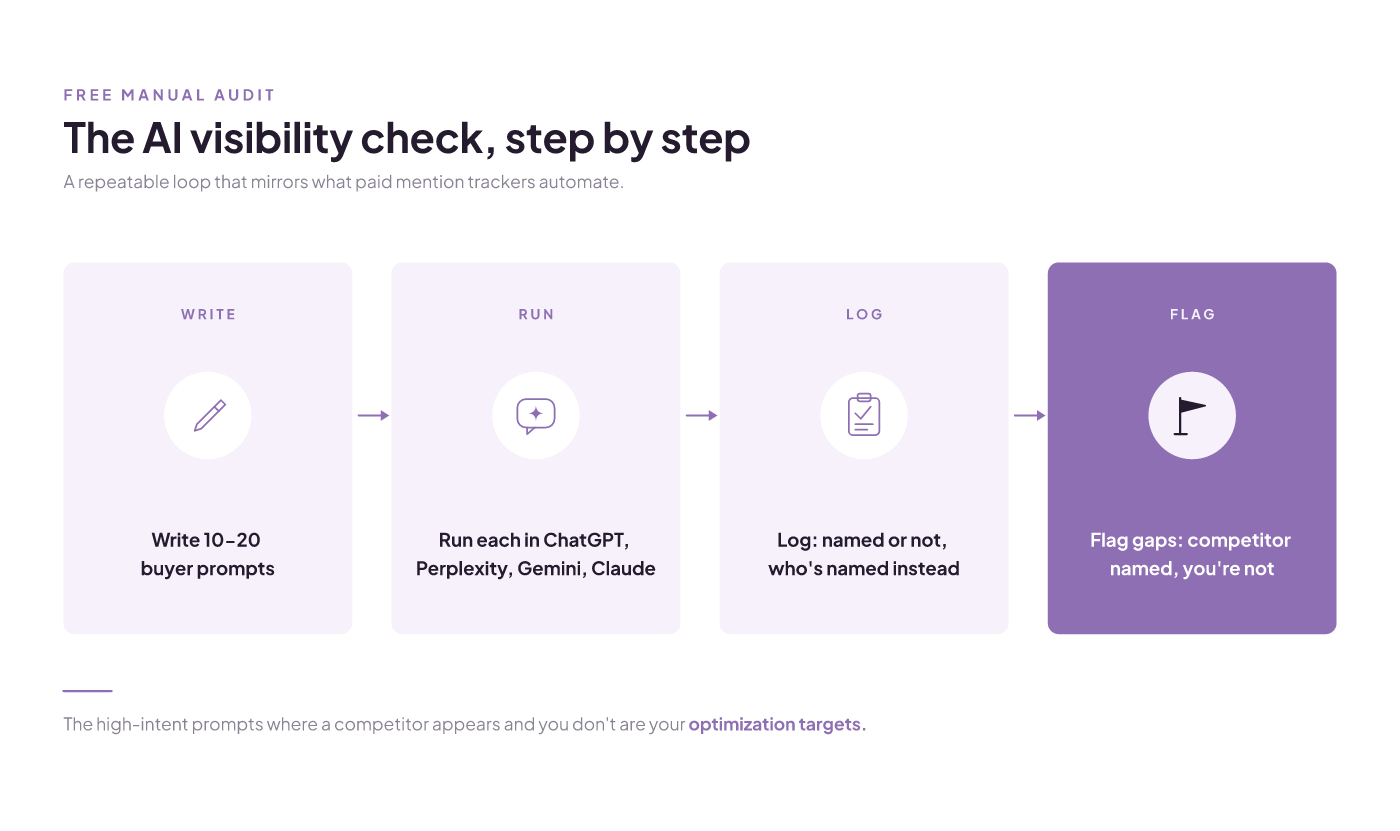
Every mention tracker automates the same simple loop. You can run it yourself. It is slower, but it is free, and you read the real answer text instead of a black-box score.
Here is the starter protocol:
- Write down 10 to 20 real buyer prompts a Canadian customer would type. Think "best [treatment] clinic in [your city]," "is [treatment] worth it," "[treatment] near me."
- Run each prompt through ChatGPT, Perplexity, Gemini, and Claude. Use a fresh chat each time so past questions don't skew the answer.
- For every answer, log two things: were you named, and if not, who was named instead?
- Flag the high-value prompts where a competitor shows up and you don't. Those are your gaps.
That last step is the whole point. The paid tools sell exactly this: the list of prompts where competitors get cited and you are absent. You can build the same list by hand for the price of an afternoon.
The honest limit: this does not scale. Twenty prompts across four assistants is manageable. Two hundred is not. And a worked before-and-after on a real clinic, with the numbers, is the kind of proof that belongs here and that a quick spot-check won't give you. For a small owner, though, the by-hand version answers the only question that matters this month. Are you in the room or not?
Which checker fits you
Match the tool to the job, not the other way around.
Solo owner or single clinic. Start with the free manual check above. For one location, paying USD $24 and up every month for a black-box score is rarely worth it before you have even read what the assistants say about you. Do the by-hand version first. Budget in Canadian dollars only once you have a reason to automate.
Multi-location clinic. Now a mention tracker earns its keep. When you have five locations and a dozen high-intent prompts per market, the manual loop stops scaling, and an automated tracker that watches mentions over time pays for itself. You want the mention-tracker category, not a page scanner.
Team with an SEO or marketer. You can go further. Pair a mention tracker for the ongoing signal with the manual read for the nuance a number can't show: accuracy and framing. Paid tools run from about USD $24 a month up to enterprise-custom pricing, so scope the tier to how many markets and prompts you actually track.
Whatever the segment, the number is the cheap part. Reading the actual answers is where the decisions live.
Is this just Google rankings? And how often should you re-check?
No, it is not Google rankings, and that is exactly why it is worth measuring on its own. A brand can rank first on Google and still be missing from every AI answer, because assistants build replies from sources and signals that don't map cleanly onto the old rank report. Strong Google SEO helps, but it does not guarantee you a seat in the AI answer.
How often to re-check? There is no console that pings you when something changes, so any cadence is a judgment call, not a proven interval. A monthly rhythm is a sensible starting point for most clinics: often enough to catch a slide, rare enough that you are not chasing noise. Checking again a day later rarely earns its time, so hold to your monthly pass unless something big changes.
What to do first after your check
Skip the urge to fix everything. Do one thing.
Take your gap list and pick the single highest-intent prompt where competitors are named and you are not. Something a ready-to-book patient would actually ask. Then fix the content behind it: a clear, genuinely useful page that answers that exact question better than what the assistants cite now. One prompt, one page, done well.
Then leave it alone for a while. Skip the next-day re-check. Come back in a few weeks, run your manual check again, and see whether you have entered the answer.
If you would rather have this run and read for you, this is the work Ownerized does for Canadian clinics: the same-day check, the gap list, and the content that closes it. You can also see the AEO methodology we certify against, or how it ties into lead generation for med spas. You don't need any of that to start, though. Run one free check this week.
Answer engine optimization (AEO): a guide for clinics
By the end you'll know what AEO really is, why the training-data mental model most guides use is wrong, which answer surface to prioritize for a local Canadian business, and which tactics are worth your time versus which are unproven.
Read insight
Answer engine optimization certification: is it worth it?
By the end, the reader knows there is no accredited vendor-neutral AEO certification yet, can name what each ranking program actually is, and holds a four-criteria scorecard to judge any AEO cert they are offered.
Read insight
How to choose an answer engine optimization agency in Canada
By the end, the reader can vet any AEO agency, including us, with a verification protocol, an attribution-isolation test for self-reported numbers, and a way to match agency type to their actual bottleneck.
Read insight