
Key takeaways
- Start with your Google Business Profile plus one paid channel, not all eight.
- Boosted before/after posts get rejected. Fix the creative before you spend.
- No trustworthy Canadian cost-per-patient number exists. Track your own from day one.
- Speed of follow-up decides whether a lead books.
If you run a med spa in Canada, you have probably read three or four med spa lead generation guides this month. They name the same eight channels. They tell you to switch on all of them at once. None of them tells you which channel to fund first for a clinic your size, what a booked patient will cost, or why your boosted Instagram posts keep getting rejected.
This page answers those three questions. It turns the usual channel menu into a decision you can keep: what to start with by clinic stage and budget, which ad tactics will get blocked before they waste money, and how to turn the leads you do get into booked appointments. A short takeaways block can't hold every clinic's nuance, so the real call happens in the table below.
Why med spa lead gen is harder than lead gen for a normal local business
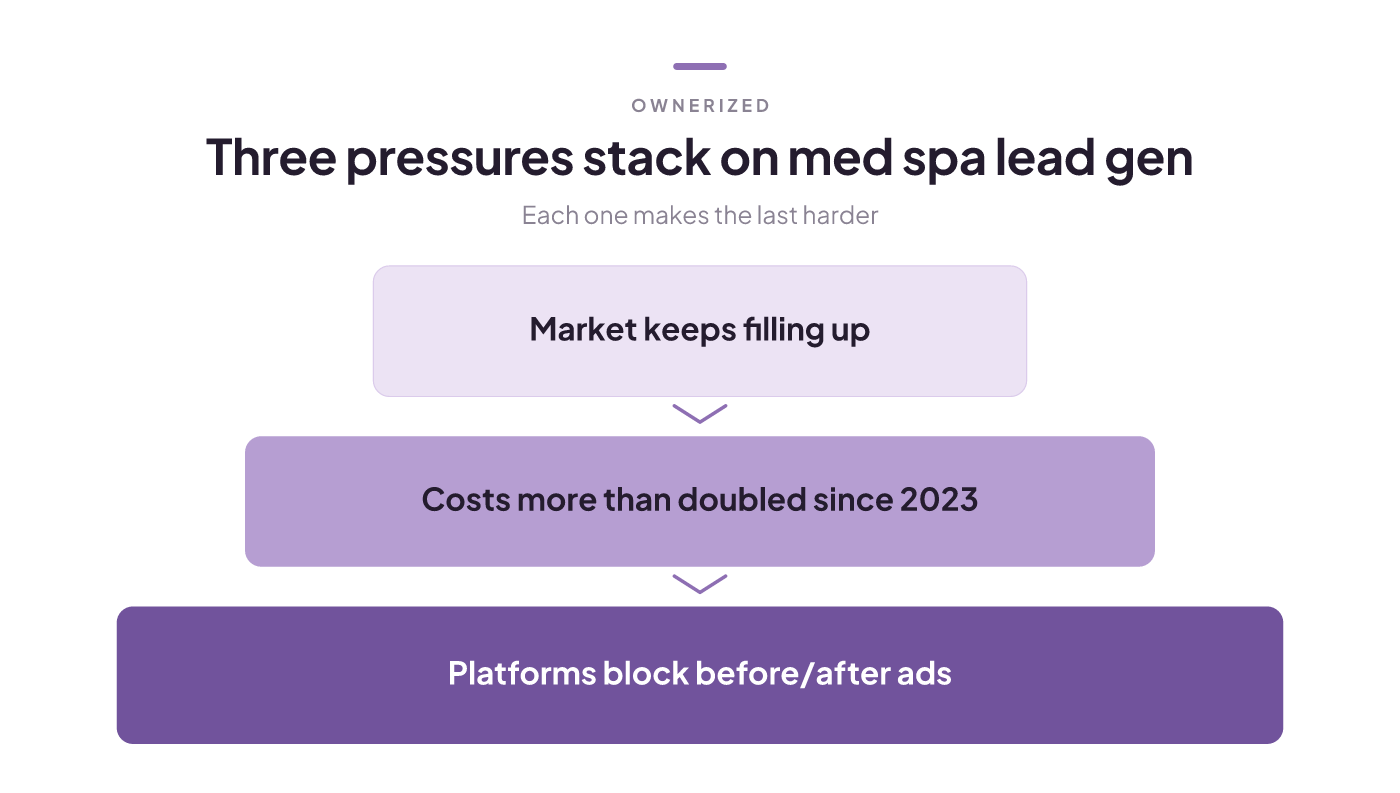
A plumber's lead gen is hard because of competition. A med spa's is harder because three problems stack on top of each other.
First, the market is crowded and still filling. In the US, where the sector is measured closely, there are roughly as many med spas as McDonald's locations, with projections near 13,000 by 2026. Canada's market is smaller and far less counted, so read that as a picture of where a mature market ends up, not a Canadian tally. Either way, the local field around you is thicker every year.
Second, it costs more to buy a patient than it used to. Across aesthetic practices, patient acquisition costs have more than doubled since 2023, by the American Med Spa Association's read. That is a US figure, but the direction holds in Canada: the cheap wins from a few years ago now return less. Spraying budget across every channel burns cash faster than it books patients.
Third, the tactic every listicle pushes hardest runs straight into platform rules. Meta and Google both restrict before/after photos, claims about results, and certain treatment categories. So the boosted before/after post that all the generic advice recommends is often the one that gets rejected. More on that below, because it is where most wasted spend hides.
Pick your first channel by clinic stage and monthly budget
Here is the honest shortcut. The highest-converting med spa lead sources are Google search, patient referrals, and a well-kept Google Business Profile. What you fund first depends on your stage and what you can spend, not on running the full list. The clinics growing fastest right now are not the ones spending the most. They are the ones investing in the right channels in the right order, with messaging that passes platform review.
| Clinic stage | Rough monthly budget | Start here | Add next |
|---|---|---|---|
| Solo, brand-new | Tight, self-funded | Google Business Profile, set up and optimized yourself, plus one paid search channel | A before/after gallery on your own site, and a simple referral ask |
| Growing, single location | Room for steady ad spend | Google Search ads with compliant creative | Local SEO, email follow-up, review generation |
| Established, multi-provider | Larger, measured budget | Tighter follow-up and a CRM, with paid layered on | Meta and organic social, plus a steady review engine |
Two rules hold across every row. A solo clinic on a tight budget funds its Google Business Profile plus one paid channel, never all eight. And no clinic should turn on paid ads until the creative can pass review. This matrix is a sensible default built from how these channels behave, not a result validated against a first-party dataset of clinic outcomes. Treat it as a starting sequence and adjust it as your own numbers come in, not a guarantee.
Where each channel wins and where it lets you down
Every channel has a failure mode. Fund the one whose weakness you can live with at your stage.
Your Google Business Profile is the best free lead source most clinics own, and it feeds your reviews and map ranking. The catch is speed. It rarely produces a booking the week you fix it. It rewards months of steady reviews and accurate details.
Paid search puts you in front of people already looking for your treatment. It is the fastest way to test demand. Its weakness is the same compliance trap as social: non-compliant creative gets rejected, and every rejection costs you time and momentum.
Paid social, Meta and TikTok, is where before/after content lives and dies. Great for reach, brutal on medical claims. This is where the boosted-post advice quietly falls apart.
Referrals convert better than almost anything, because trust is already there. But they cap out at the size of your existing patient base. You cannot scale past the people you have treated.
There is no reliable published time-to-first-lead by channel, so the order above is judgment, not a measured timeline. The point stands: pick the channel whose slow part or hard part you can absorb right now.
The ad-compliance trap that kills boosted-post advice
This is the section the listicles skip, and it is the one that saves you the most money.
Cosmetic and medical advertising sits in one of the most restrictive creative environments in digital marketing. A single word in your ad copy can trigger a rejection or a complaint. Google runs a dedicated Healthcare and medicines advertising policy that cosmetic advertisers have to meet, and it reaches buyers using its larger ad tools too. Meta restricts the same territory: before/after imagery, results claims, and some treatment categories.
Here is what tends to get flagged, so you can screen creative before you spend:
- Before/after photos used as the main proof.
- Claims about results ("removes wrinkles," "guaranteed," "clinically proven").
- Certain treatment categories that platforms limit outright.
There is an evidence standard under all of this. In the US, the Federal Trade Commission treats "evidence" for a health claim as peer-reviewed clinical data, not patient anecdotes or your own internal numbers. That is a US illustration of the principle, not Canadian law. Canada has its own layers, and these are areas to confirm rather than facts to take from a marketing page: your provincial medical college's advertising standards, the anti-spam rules that cover clinic email, and the Competition Bureau's line on deceptive claims. The exact clauses shift, so confirm the current rules that apply to you, along with the latest Meta and Google policy, before you run creative. The safe move is simple: describe the treatment and the experience, skip the results claim, and keep dramatic before/after shots off paid placements.
What a booked patient actually costs, and why no one publishes the number
You want a number. So does every owner. Here is the honest answer: no one publishes a trustworthy Canadian cost-per-booked-patient figure you can plan against, and what you would pay moves with your treatment mix, your local competition, and the channel you run.
What is not in doubt is the direction. Patient acquisition costs across aesthetic practices have more than doubled since 2023, so any older per-patient figure you dig up is already stale before you can apply it. The cheap acquisition of a few years ago is gone, and a borrowed benchmark from that era will only mislead you.
We could hand you a tidy dollar range per channel. We won't, because inventing one would be worse than admitting the reliable number isn't published yet. The better move costs you nothing: track your own cost-per-booked-patient from day one. Count what you spent on a channel, count the patients who booked from it, and divide. Within a couple of months you will have the one number that actually applies to your clinic, which beats any borrowed benchmark.
Once a lead comes in: speed and follow-up decide whether it books
You can win the whole lead-gen game and still lose the patient in the first hour. Most med spas leak revenue every day to missed calls, slow follow-up, and tools that don't talk to each other.
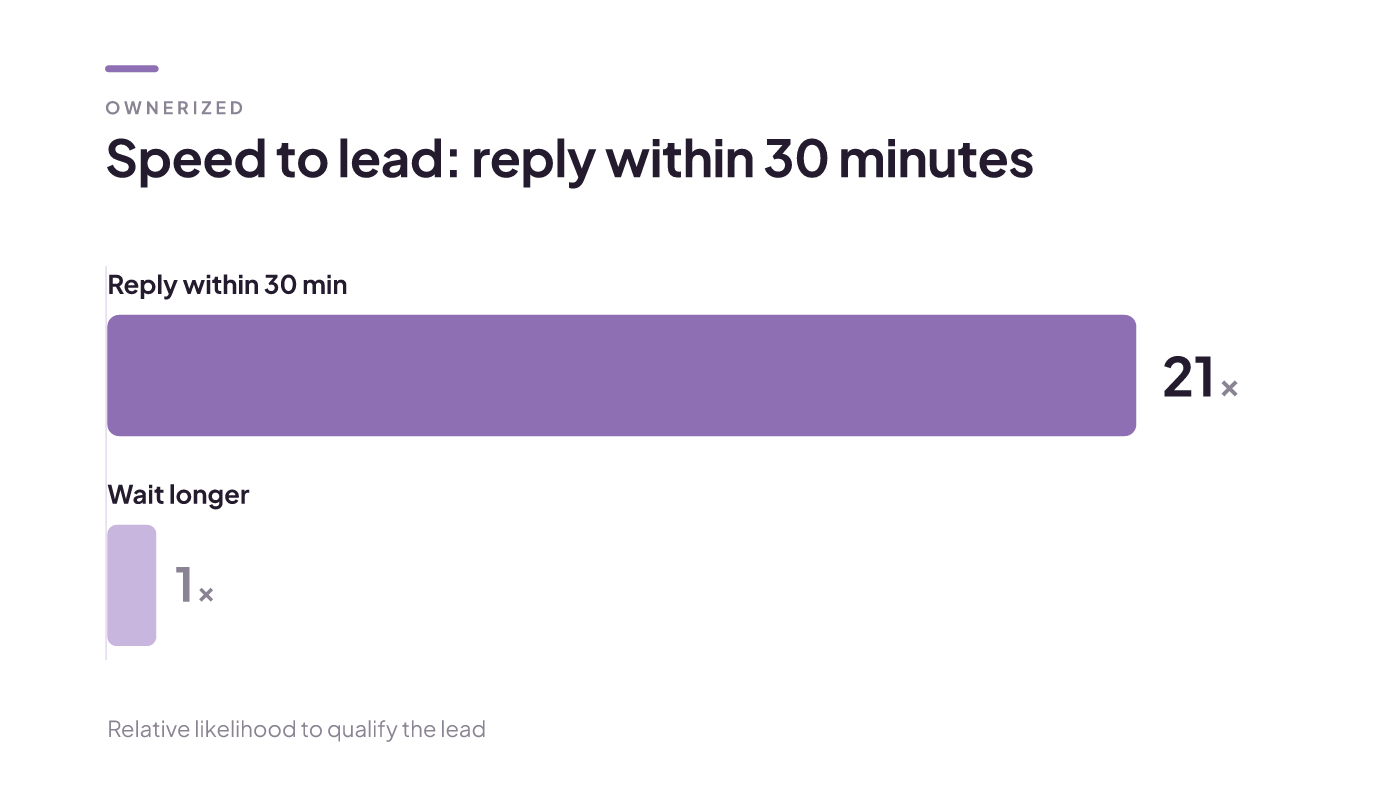
Speed is the lever. One widely cited sales benchmark: respond within 30 minutes and you are about 21 times more likely to qualify the lead than if you wait longer. That figure is a general sales stat, not a med-spa-specific one, but the shape is right. A lead that fills your form at 9 a.m. and hears back at 9:10 books far more often than the one you call back tomorrow.
Do you need a CRM to manage this? Not to start. A disciplined manual follow-up process beats an unused CRM every time. What a CRM adds later is visibility a booking app can't give you. Scheduling software for a medical office fills the calendar, but it doesn't tell you who is booking, why they come back, or when they drift away. A CRM does, and it automates the follow-up that turns interest into a booked appointment. If your calendar is full but your rebooking is soft, that visibility is what you are missing. Pairing it with the right medical spa booking software closes the loop from first contact to confirmed slot.
Reviews belong in this loop too. Med spa review generation isn't a separate campaign. It is the habit of asking every happy patient for a review at the moment they are happiest, which then feeds the Google Business Profile that started the whole cycle.
Your next move by where the clinic is today
Match your next step to where you actually are.
If you are a brand-new solo clinic on a small budget, set up and optimize your Google Business Profile yourself first. It is free, it is the highest-leverage thing you own, and you do not need to hire anyone to do it. Ask your first patients for reviews. Only then test one paid channel.
If you are a growing single-location clinic, layer in one paid channel, almost always Google Search, with creative built to pass review. Keep your follow-up tight while you do it.
If you are an established multi-provider clinic, your gains are in conversion, not more channels. Tighten speed-to-lead, add a CRM, and hold your ad creative to the compliance bar so you stop losing spend to rejections.
For the owner who has decided what to fund but doesn't want to build and run the pipeline themselves, this is where Ownerized comes in. Ownerized is an AI growth system for aesthetic clinics. It strengthens the signals AI and search check before a patient books: your website content, reviews, business profiles, treatment pages, local SEO, and booking flow. It starts with a free AI visibility audit scored across nine pre-booking surfaces, then a monthly plan, with no long contracts. To be honest about it: if you are a solo clinic that can set up its own Google Business Profile first, do that before you hire anyone. When you are ready to have the system built and run rather than assembled channel by channel, that is the point to talk to Ownerized. If you would rather sequence your own spend first, start with the patient acquisition strategies guide.
Medical spa lead generation stops being a guessing game the moment you fund one channel on purpose, keep your creative compliant, and measure your own cost. That is the whole plan. The rest is discipline.
Patient acquisition software: a Canadian med spa guide
By the end, a clinic owner can decide whether to buy patient acquisition software now, which category fits their stage, and the two conditions (retention performance and connected data) that determine whether any tool pays off.
Read insight
Healthcare marketing patient acquisition, ranked by payback
You will leave knowing what patient acquisition is, and a way to rank your channels by CAC payback instead of a to-do list of tactics — scoped to a Canadian med spa's economics.
Read insight
Patient acquisition strategies for Canadian aesthetics clinics: what to fund first
By the end, a Canadian aesthetics operator has a channel-by-clinic-stage-and-budget funding sequence they can keep, knows which channels to skip when starting out, and understands how to track cost-per-patient honestly instead of chasing le
Read insight