Key takeaways
- Every answer engine optimization certification ranking for this term is issued by a software vendor or sold on a course marketplace, not by an independent standards body.
- A course directory of 37 AEO courses lists only one career certificate.
- The visible badges are vendor lead-gen, not recognized credentials.
- This market shifts monthly, so treat any single count as a moving snapshot and re-check before you enroll.
- Use the four-criteria scorecard below before you pay or enroll.
You searched for a credential and found a wall of course ads. Here is the part every ranking page leaves out: every "certification" ranking for this term is issued by a software vendor or sold on a course marketplace, not by an independent body. No outside authority has set a standard for answer engine optimization certification and stamped any of them as a recognized credential. So the real question is not "which cert is best." It is "how do I judge any AEO cert someone tries to sell me." This page hands you that scorecard.
There is no accredited answer engine optimization certification yet
Start with what a certification is supposed to mean. A credential works because an outside authority, one that does not profit from your enrollment, says the holder met a standard. That is what makes a designation portable and worth putting on LinkedIn.
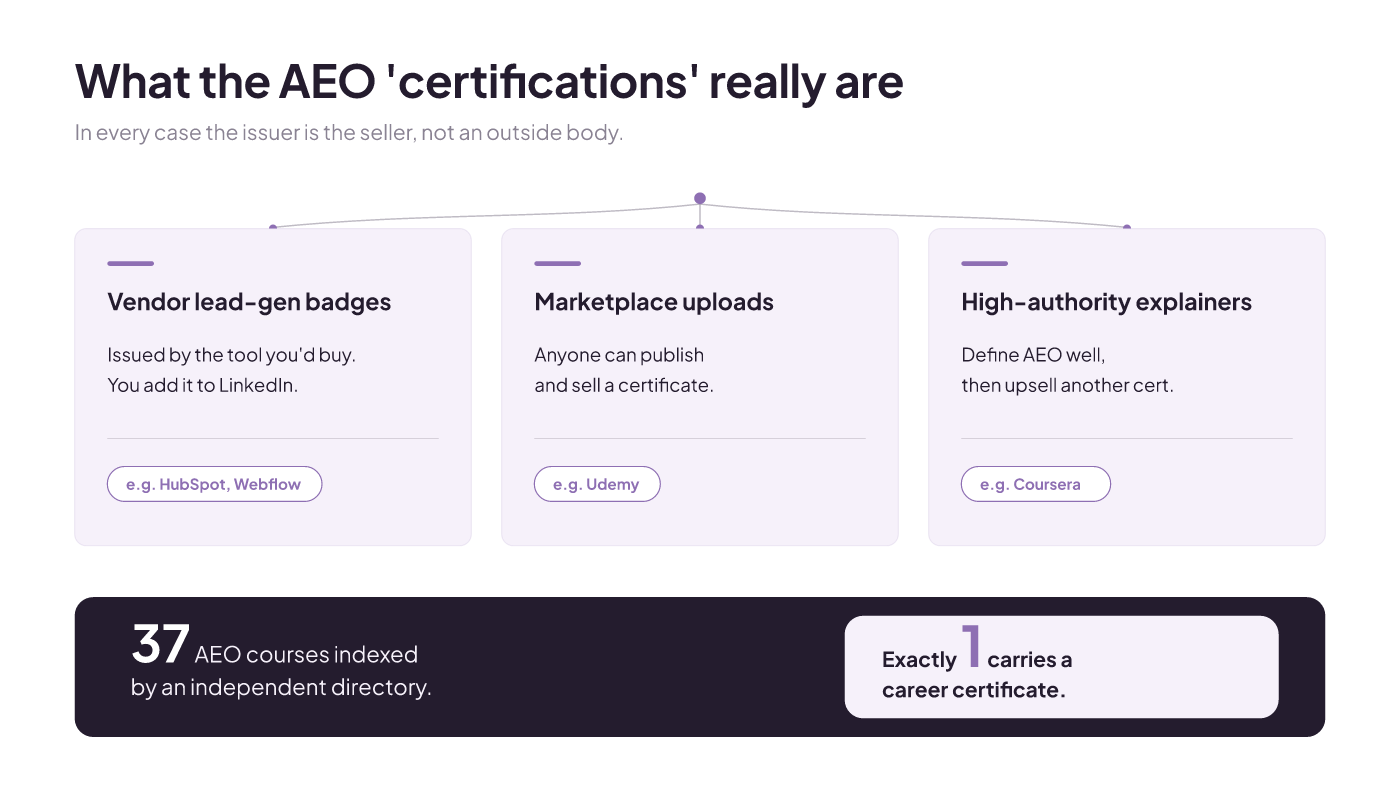
Look at what actually ranks for this term and you find something else. A widely used course directory that indexes AEO programs lists 37 courses and counts exactly one carrying a career certificate, and even that one is not a vendor-neutral AEO credential. The directory does not judge them. It tells you to read reviews and decide, the same shrug the roundups give you.
Sort the "certifications" ranking for this term and they fall into three buckets. First, vendor lead-gen badges, issued by the software company whose tool you would be buying, for you to add to your profile. Second, marketplace uploads, where anyone can publish a course and sell a completion certificate. Third, high-authority explainers that define AEO well, then point you at an unrelated marketing certificate instead. In every case the issuer is the seller, not an outside body.
That is the whole verdict. No independent authority has set a standard for this field yet, so there is nothing here a buyer would recognize as an accredited, vendor-neutral credential. AEO is barely two years into mattering, and accreditation lags fast-moving fields by years.
One honest caveat. "Not accredited" is not the same as "worthless." A vendor course can still teach real fundamentals. The badge just signals less than you think it does.
The AEO programs ranking for this term, at a glance
Prices and curricula change monthly, so treat every cell as current-as-of and verify before you enroll. The proof-of-outcome column is blank on purpose: no program on this list publishes data showing it produced AI citations.
| Program | Issuer type | Credential type | Cost (verify current) | Names 2026 AI behaviour? | Proof of outcome |
|---|---|---|---|---|---|
| HubSpot Academy AEO Fundamentals | Software vendor | Vendor badge for LinkedIn | Not verified | Yes, includes GSC and GA4 measurement | Not published |
| Webflow University AEO | Platform vendor | Course, Webflow-specific | Not verified | Technical foundations scoped to Webflow | Not published |
| Udemy AEO Mastery | Marketplace upload | Completion certificate | Marketplace listing, verify | Last updated 4/2025 | Not published (3.4/5, 39 ratings) |
| Coursera "What is AEO?" | Course platform | Upsells an unrelated Google certificate | Verify current | Defines AEO clearly | Not published |
| Class Central directory | Independent directory | Indexes others, does not certify | Directory, browse only | Aggregates 37 courses | Not published |
Read the table as a map of what you are actually buying. The vendor badges teach you and capture your details. The paid upload is thin and stale. The high-authority name sends you somewhere else. None of them can show a result.
Four criteria that separate a credible AEO cert from marketing fluff
This is the keeper. Score any AEO certification, including one that is not on this page, against four questions. A program that fails the first one rarely earns a pass on the rest.
- Who issues it, and are they a recognized authority? If the issuer is the same company whose tool you would buy, the badge is marketing, not accreditation. Ask who audits the standard. Today, for AEO, the honest answer is nobody.
- Does the curriculum name how AI answers work in 2026? A current course talks about AI Overviews, zero-click results, and where AI engines pull their citations from. A stale one still teaches meta tags and keyword density.
- Can anyone show it produced citations? Ask for a before-and-after: pages that started getting cited in AI answers after the method was applied. No ranking program provides this. Neither can we yet, and we will say so again below.
- Does the cost beat learning AEO free? The fundamentals are widely published. If the paid path does not add a real result or a credential a specific employer demands, the free route wins.
Notice which criterion nobody passes. Proof-of-outcome is empty for everyone, ours included, until someone runs a first-party citation-lift test and publishes it. Any program that implies otherwise is overclaiming.
Why AI-answer visibility is the real prize a cert is chasing
A certificate is only worth your afternoon if it teaches the problem you actually have. Here is the problem.
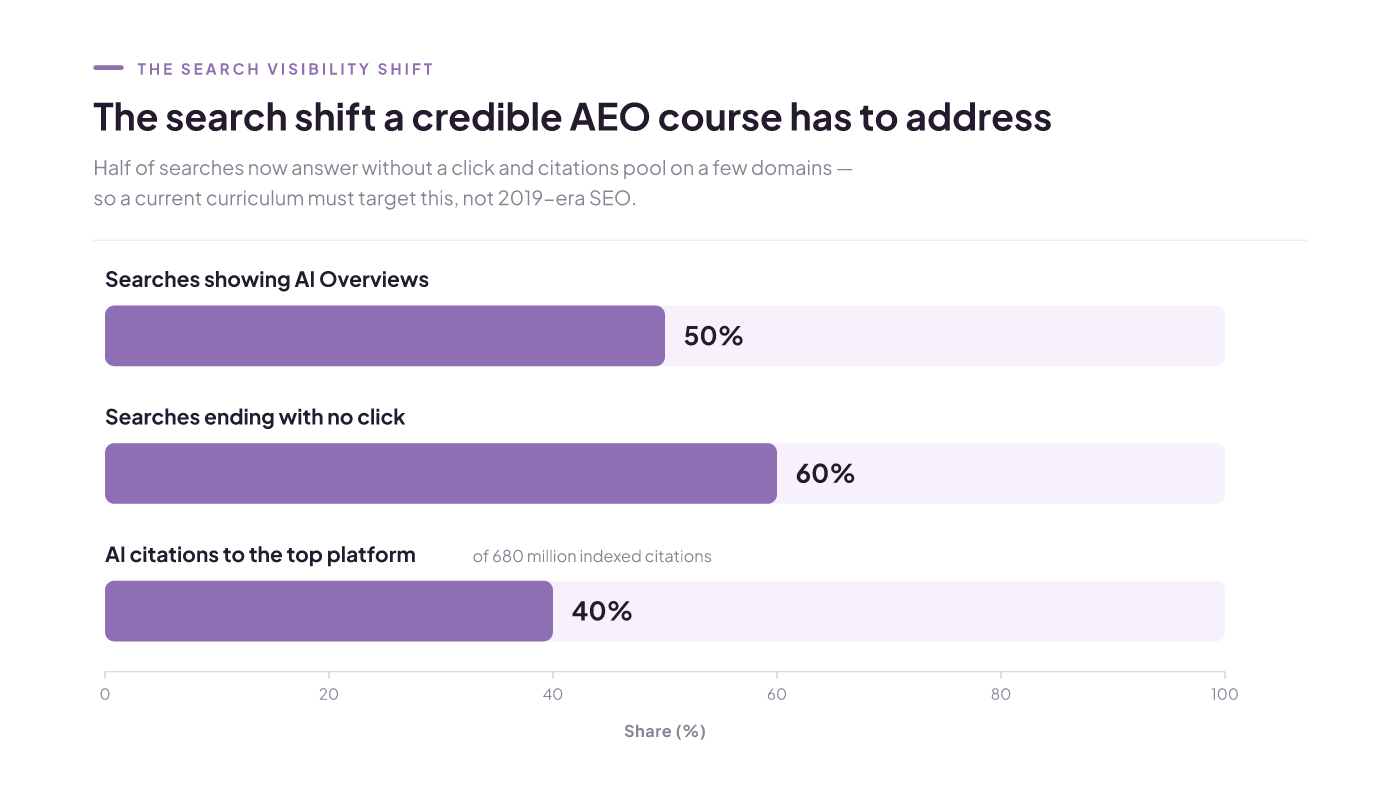
Search stopped being a list of links you click. Answer engines now assemble an answer and cite a few sources, and AEO is the practice of structuring your content so you are one of the sources they name. AI Overviews now show up on roughly half of all searches. Close to 60% of searches end without a click at all. For a clinic, that means a prospective patient can research a treatment, get an answer, and never see your website.
Now the hard part. Citations do not spread evenly. A consolidated index of 680 million AI citations found a single platform captured about 40% of them. The rest concentrate on a small set of domains.
That cuts both ways. It is exactly why AEO matters, and exactly why no certificate can promise you a spot in that cited set. The tactics help. The ceiling is real. A course that pretends the ceiling does not exist is selling you comfort.
Who should get certified, and who should skip it
The rubric turns into a plain call once you know who you are. This is practitioner judgment, reasoned from what each program teaches, not a first-party study.
If you own a clinic and plan to outsource AEO, a badge does almost nothing for you. You are not the one doing the work. The afternoon is better spent learning enough to judge the person or agency who does.
If you are an in-house marketer, a free fundamentals cert is worth the afternoon. You will learn the measurement basics, and the badge is a fine resume line. Just do not expect the market to treat it as a standard, because it is not one.
If you run an agency, clients care about demonstrable outcomes, not a LinkedIn credential. Case studies and citation examples sell. A badge does not. Build the proof the certs cannot show.
Jurisdiction does not change any of this. The programs are the same global vendor courses no matter where you sit, issued by the vendors themselves, so a Canadian clinic owner faces the same non-credentialed market as everyone else.
You can learn AEO free, and the credential is a separate question
Here is the split the whole SERP misses. The skill and the badge are two different purchases, and you should decide on each one separately.
The most visible free "certifications" teach the same fundamentals the paid ones do: building a content strategy and measuring impact in Google Search Console and GA4. They are useful. They are also lead capture. When a software vendor gives you a credential at no charge, you hand over your details and become a warm lead for the tool. That is the price, and it is fair to name it plainly rather than call free a clean win.
So the badge only earns its slot when a specific employer or client asks for it by name. The skill, on the other hand, is worth having no matter what, and you can get it without paying anyone.
Common objections, answered straight
"Isn't any cert better than none?" Not when the badge signals nothing. Putting an unrecognized credential on your profile can read as padding to someone who knows the field has no accredited standard.
"But this one says it is industry-recognized." That phrase is a vendor self-claim with no outside body behind it. The check is the directory count: 37 courses, one career certificate. If the industry recognized these, the count would not look like that.
"The market will accredit eventually." Probably, and that is the one thing that could flip this verdict. AEO is barely two years into mattering, and accreditation lags fast-moving fields by years. When a real standards body launches a recognized credential, this answer changes. Until then, judge by the scorecard, not the label.
What to do next
If you want the skill, take a free fundamentals cert, then run it through the four-criteria scorecard before you pay for anything more. That is the honest DIY path, and for a lot of marketers it is the whole answer.
If you own a clinic, the credential question is often the wrong one. Your real job is AI-answer visibility: being the clinic an answer engine names when a patient asks about a treatment you offer. That is work, not a badge. Ownerized does that work for Canadian aesthetics clinics, strengthening the website content, profiles, reviews, and structure AI checks before it recommends anyone. If you would rather have AEO handled than certified, see how Ownerized approaches AEO, or read more on patient acquisition for clinics. If you genuinely want the credential for your own resume, you do not need an agency, and we will not pretend you do. Either way, start from what AI already sees about your clinic.
Answer engine optimization (AEO): a guide for clinics
By the end you'll know what AEO really is, why the training-data mental model most guides use is wrong, which answer surface to prioritize for a local Canadian business, and which tactics are worth your time versus which are unproven.
Read insight
AI visibility checker: read the score, pick the right one
By the end you can tell the two kinds of 'AI visibility checker' apart, know why no single tool's score is portable, pick the right category for your situation, and reproduce the core check by hand for free.
Read insight
How to choose an answer engine optimization agency in Canada
By the end, the reader can vet any AEO agency, including us, with a verification protocol, an attribution-isolation test for self-reported numbers, and a way to match agency type to their actual bottleneck.
Read insight