

Key takeaways
- A content plan covers creation, publishing, promotion, and measurement.
- Every asset needs a strategic objective.
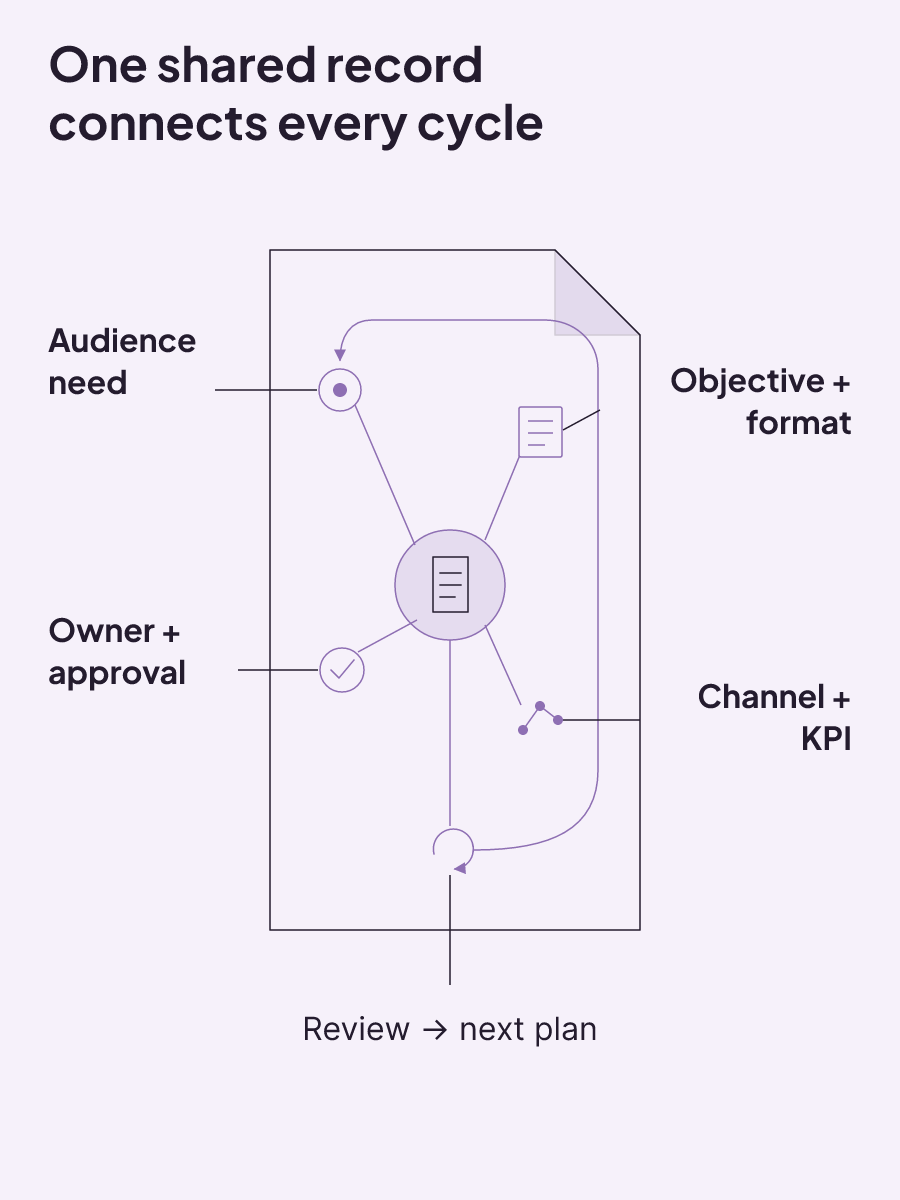
- Keep the decisions and execution details in one shared operating record.
A useful sample content marketing plan settles more than topics and dates. It tells your clinic team why an asset deserves attention, who will move it forward, where it will appear, who approves it, and how you will judge it after launch. In other words, it turns an idea into assigned work. A well-built plan can cover the audience, goals, messaging, formats, workflows, timelines, and success measures in one place. That shared record is what keeps a calendar from becoming a list of good intentions. A content marketing plan also connects the full lifecycle: creating, publishing, promoting, and measuring content.
How is a content plan different from content strategy?
Your strategy sets the long-term direction. Your content plan assigns the work that will carry that direction into the market. A marketing strategy defines the value proposition, key goals, and market position, while the marketing plan details the actions and tactics used to execute it.
For a clinic, the strategy might say that the business wants to be known for clear patient education and a dependable path from discovery to consultation. That statement gives the team a goal and a position. It does not yet tell a writer what to draft on Monday, tell a reviewer when feedback is due, or assign a channel and budget. The action plan handles that layer by translating strategy into specific activities and tasks.
This distinction helps when every department has a request. A treatment team may want education pages. The front desk may want answers for recurring booking questions. Leadership may want work tied more directly to growth. Companies with several objectives have to prioritize and balance them, often in line with the wider company strategy. Not every request can lead the schedule at the same time.
Start by identifying the clinic's greatest growth barrier. Funnel focus and budget depend on that context. If discovery is the barrier, the plan may put more resources toward awareness work. If prospective patients are comparing options but not moving forward, consideration or decision content may deserve more attention. These are planning choices, not universal prescriptions.
That is also why a content plan should not copy the strategy into a spreadsheet and stop. The strategy answers, "Where are we going?" The plan answers, "What are we making, what will it require, and who is responsible?" If you are aligning this work with a broader acquisition effort, our guide to patient acquisition strategies can help frame the business problem before you assign assets.
Sample content marketing plan: a completed clinic decision table
These illustrative rows are not client work or measured results.
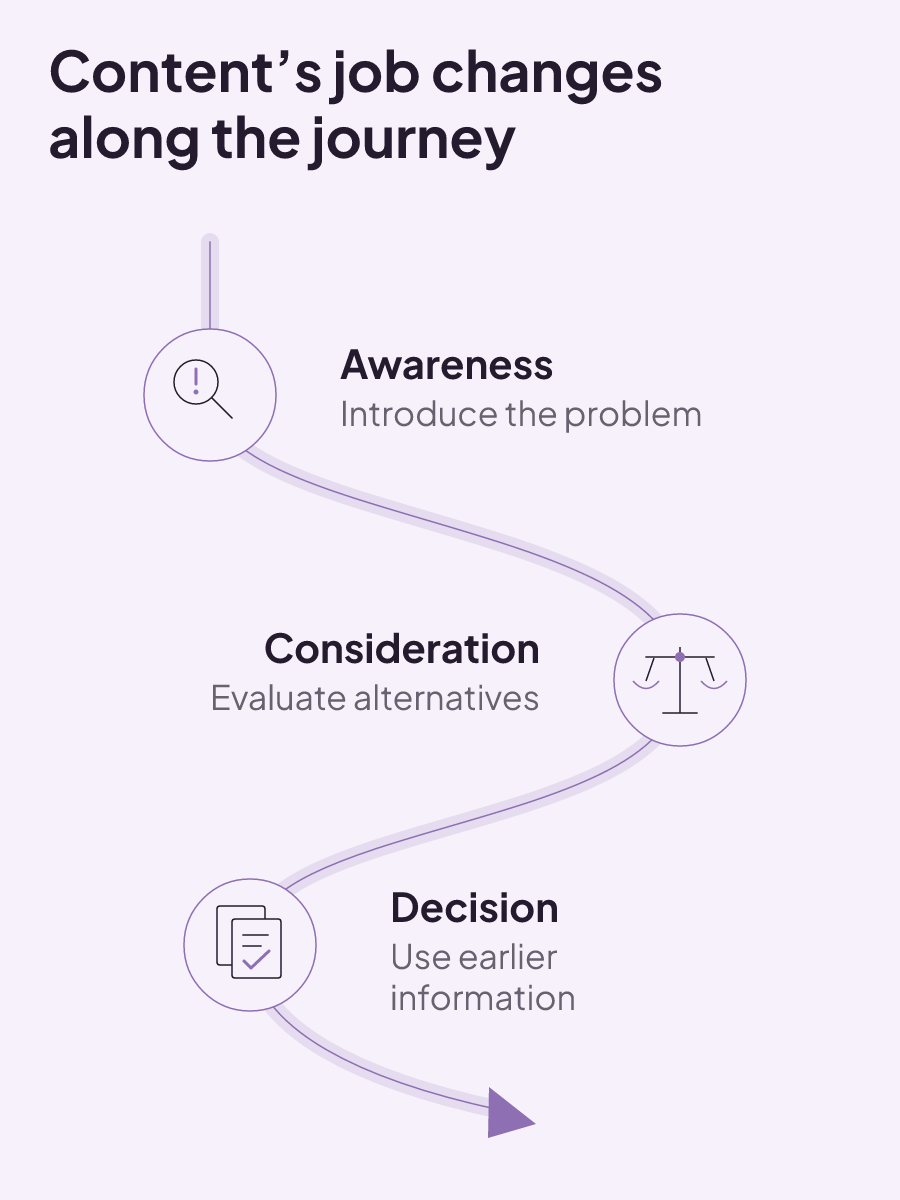
The three journey stages serve different reader situations. At awareness, marketing introduces a customer to a brand or product in relation to a problem. At consideration, the customer evaluates it against alternatives. At decision, information gathered earlier can influence a purchase decision. Journey-informed planning also considers messaging, content, budget, partnerships, and customer needs at each phase.
| Audience question and journey stage | Objective and format | Owner, timing, resources, and approval path | Distribution, KPI, and review point |
|---|---|---|---|
| "How can our clinic attract more of the right inquiries?" Awareness | Customer education through an article on patient acquisition | Marketing lead owns the brief. Writer drafts in week 1. Clinical or compliance reviewer checks relevant claims in week 2. Allocate writing, design, and review time before work begins. | Publish on the website, adapt for social posts, and include in email. Track website traffic and time on page. Review after the first reporting cycle. |
| "Which approach fits our clinic's growth barrier?" Consideration | Help the reader compare approaches through a decision guide | Marketing lead owns the project. Subject reviewer comments by the stated deadline. Final approver signs off before the launch date. Reserve the people and budget needed for writing and review. | Publish on the website and distribute through email and social channels. Track engagement, social sharing, and lead generation. Review in the next planning cycle. |
| "What should we do next?" Decision | Support a purchase decision with a service explainer and clear action | Service owner supplies the inputs. Writer prepares the page. Assigned reviewers handle feedback in one location, followed by final sign-off. Allocate production and review resources. | Publish on the website and equip the team with the same approved asset. Track lead generation and conversions. Review after the agreed measurement period. |
The approval column matters for a med spa because the business combines a clinical practice with documentation and compliance obligations and a service business shaped by bookings, retention, and margins. A content approval workflow defines who reviews, when approval occurs, and how feedback is handled. The sample therefore treats approval as production work, not a final courtesy check.
What should your team make first?
Make the asset that answers a meaningful audience need and supports a clear goal. Audience planning begins with the audience's interests, challenges, and goals. Market research, analysis of current customers, and buyer personas can help define that audience more sharply. Without that work, a busy calendar can still miss the people your clinic wants to reach.
Use those audience inputs to narrow the problem before choosing a format. Market research may reveal a broad concern. Current-customer analysis can show whether that concern also appears among people the clinic already serves. A buyer persona can keep the team focused on the interests, challenges, and goals of the intended reader. These inputs help you decide whether an idea deserves an asset, needs a tighter audience, or should remain in the backlog.
Turn the audience insight into a goal that is clear, measurable, specific, attainable, and time-bound. "Publish more educational content" is too loose to settle a priority. An illustrative planning decision could be: create one article for clinic owners who need to understand patient acquisition, publish it by the assigned launch date, and measure website traffic and lead generation during the stated review period. The example names the audience need, the asset, the timing, and the measures. It does not promise a result.
Now compare that row with the other candidates. An idea with no owner, goal, or review point is not ready merely because the topic sounds useful. A clear roadmap helps the team decide which projects deserve focus and which should wait. Waiting is not the same as discarding. It means the clinic can preserve a worthwhile idea without allowing it to compete with assigned work.
This is where operator judgment belongs. If your strongest audience insight points to an early-stage problem, an educational article may lead. If the more urgent barrier sits closer to a purchase decision, a service explainer may take priority. The plan should record the chosen project and the reason it earned resources. That makes the tradeoff visible when another request arrives.
The calendar assigns dates, owners, and resources
Once a project earns priority, the calendar needs more than a publication date. An action-plan timeline should include milestones, deadlines, and launch dates. Roles and responsibilities should be assigned to the people doing the work, and the plan should set a budget for each activity and allocate resources accordingly.
Consider the awareness article from the sample. Its row could assign the marketing lead to finish the brief as the first milestone. The writer then receives a draft deadline, the reviewer receives a feedback deadline, and the publisher receives a launch date. The same row reserves writing, design, and review time. If the activity needs outside support, that resource and its budget belong beside the work.
This structure exposes a common scheduling problem early: a launch date can look realistic even when nobody has time to draft, design, or review the asset. Named responsibilities make the load visible. The owner is accountable for moving the row, but each contributor still needs a defined task and deadline.
Check capacity before confirming the launch date. List the milestones, assign the person responsible for each one, and reserve the budget or staff time the activity needs. If the designer is already committed or the reviewer cannot meet the deadline, change the timing or resource allocation while the work is still being planned. This is the practical value of putting responsibility and resources beside the dates.
Use the calendar as the schedule for approved priorities. Keep strategy, briefs, and source material linked to it, but do not ask a date field to carry the whole plan. The calendar tells the team when work happens. The decision table tells them why the work exists and what completion requires.
How should social media fit the content plan?
Social media is one execution layer inside the wider plan. It should not become a separate stream that competes with the website, email, events, or sales content for attention. Those formats can work together, with each one doing an assigned job.
A content plan for social media can sit inside your annual planning. Its calendar can track post status and platform while storing graphics, links, or comments. That makes the daily work easier to manage without turning the social calendar into the clinic's whole strategy. A social media content calendar can support annual planning, and a practical calendar can track status, platforms, graphics, links, and comments.
For the awareness article, publish the full explanation on the website. Adapt its key point for social posts, then use email to direct interested readers to the full asset. Distribution can also include newsletters, guest posts, and industry forums.
Adaptation is part of the assignment. Content should be shaped for the channel where it will be distributed. That does not mean inventing a disconnected idea for every platform. It means the row should specify the main asset and the channel-ready pieces required to distribute it. The owner can then plan the graphics, links, comments, and status changes as actual production tasks.
Be precise about the channel deliverable. "Promote on social" leaves the owner to make several decisions after the deadline is set. Naming the platform, post status, graphic, link, and comment location turns distribution into visible work. The same discipline applies to email, the website, an event, or a sales asset. Each channel gets the version suited to it, while the assets work toward the same strategic objective.
This approach also keeps measurement attached to the asset's objective. A social post may have its own engagement data, while the broader asset row can carry the website or lead measure selected for the campaign. The plan can hold both without letting one visible social number stand in for the whole business goal.
Approval has an owner, deadline, and sign-off path
Approval becomes a bottleneck when everyone can comment but nobody owns the decision. Upfront review by leadership and other stakeholders can reduce ad-hoc requests and last-minute pivots. The plan should name the responsible reviewer before production starts.
A compact approval path might read: the content owner submits the draft, the subject reviewer returns comments by the assigned deadline, feedback stays in one shared location, and the final approver completes a sign-off checklist before publication. Approval practices can assign roles, set deadlines, centralize feedback, and use sign-off checks. For a regulated organization, the route can also include legal and compliance reviewers before publication.
The workflow should scale with the content type. A short social adaptation may not need the same route as a page containing clinical or regulated claims. The plan can record the correct reviewers for each asset instead of sending every item through one heavy process.
Centralized feedback matters because scattered comments are hard to resolve. The owner needs one place to see requested changes, the person responsible for each change, and the sign-off state. A defined social content approval process can include legal and compliance review when the organization requires it. Once approval is part of the row, reviewers can plan their time before the deadline arrives.
How does the plan improve after launch?
The plan improves when the selected key performance indicator feeds the next planning cycle. Timelines, owners, workflows, and key performance indicators let teams measure content performance and demonstrate value. The review point tells the owner when to bring that evidence back to the plan.
Available measurement categories include website traffic, time on page, engagement rate, social shares, lead generation, and conversion rates. Choose the measure that matches the asset's objective. An awareness article may use website traffic and time on page. A decision asset may use lead generation or conversions. Those choices are examples, not claims that a given format will produce a result.
The review should produce a planning decision. Feedback loops use performance data from each content cycle to improve future planning and execution. If an asset draws traffic but does not support the selected goal, the team has a reason to examine its objective, format, distribution, or place in the roadmap. If a distribution channel shows useful engagement, the next cycle can account for that information. The data informs the decision; it does not replace operator judgment.
Plans should also be updated when market conditions, business objectives, or competitive dynamics change. A fixed calendar cannot anticipate every change. A review point gives the clinic a defined moment to reconsider priorities instead of reacting to every new request in real time.
Keep the reporting language plain. Record the objective, the chosen measure, the result, and the decision for the next cycle. Our marketing attribution guide can help you choose a key performance indicator that belongs with the business question behind the asset.
Open a blank sheet and build your first three asset rows with the decision table. Assign the audience question, objective, owner, channel, approval path, key performance indicator, and review point before you add more topics.
ROI tracking: calculate the return and label what the number proves
ROI tracking is credible when every cost is counted and each result is labeled as observed, attributed, or experimentally incremental.
Read insight
Healthcare social media marketing: choose channels, controls, and handoffs
Healthcare social channels fit different patient needs; use a question-risk-handoff matrix to set review, response, and contact ownership.
Read insight
Local SEO report: what to measure and what to do next
A useful local SEO report compares a small KPI set, records completed work and movement, and ends with the business action and next step.
Read insight