

Key takeaways
- Search serves relevant indexed pages for a query.
- Ranking metrics do not fully describe how your clinic appears in AI answers.
- Track AI inclusion, share of voice, citation share, positioning, and prompt stability directly.
For a clinic operator, the useful SEO vs GEO question, often written as geo vs seo, is not which label wins. It is whether your reporting can show two different kinds of visibility without blending them into one vague score. Search reporting follows what happens as pages are discovered, indexed, and served. AI visibility reporting observes whether generated answers mention your clinic, cite it, place it among other brands, or describe it incorrectly. Those are different observations, so a ranking report and a one-off AI answer leave important gaps.
SEO vs GEO at a glance: two visibility scoreboards
A search ranking report and an AI visibility report answer different questions. Traditional ranking metrics do not fully describe brand positioning in AI-generated answers. AI visibility includes both how a brand appears and how consistently it is positioned, not simply whether its name appears once. Your clinic can appear in an answer while its consistency and position remain separate observations.
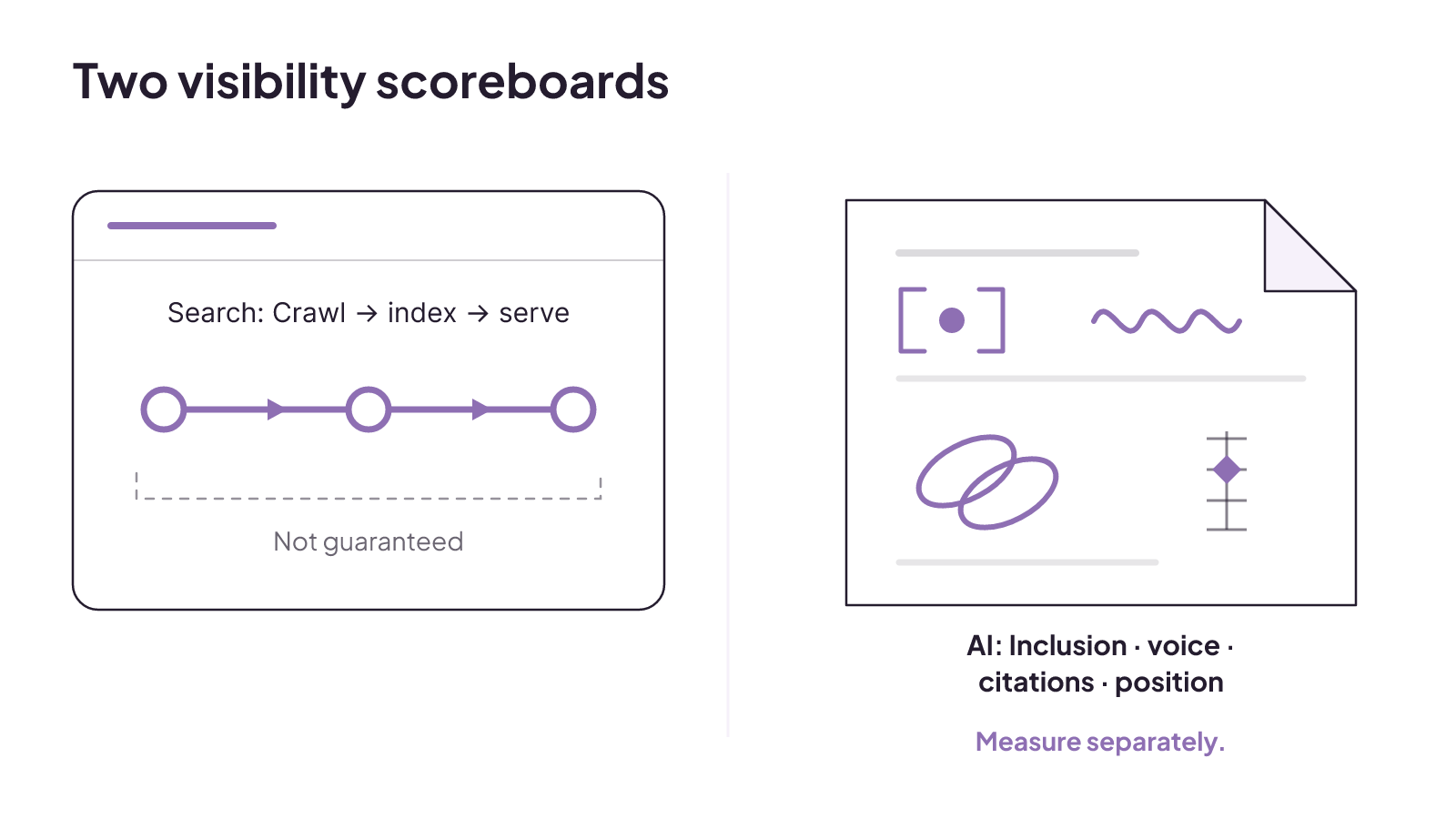
| Scoreboard | Field | What it records | Operating limit |
|---|---|---|---|
| Search | Crawling | An automated crawler discovers and downloads page text, images, and videos from the web. | Discovery and download can occur, but crawling is not guaranteed. |
| Search | Indexing | The search system analyzes page content, determines its relevance and canonical status, and stores it in the search database. | A discovered page is not guaranteed to be indexed. |
| Search | Serving | The search system matches a query with indexed pages and displays relevant results while considering the user's location and device. | Indexed content is not guaranteed to be served for a query. |
| AI visibility | Inclusion rate | The percentage of relevant, high-intent test prompts in which an answer engine recommends a brand. | The relevant, high-intent prompts tested define the measurement base. |
| AI visibility | Share of voice | A brand's proportional presence in generated responses compared with direct competitors, expressed as a percentage of total brand mentions. | The comparison uses total brand mentions across the direct competitor set. |
| AI visibility | Citation share | The percentage of cited references associated with a brand or its owned content within generated answers. | The value is based on cited references in the answers measured. |
| AI visibility | Average positioning | Where a brand typically appears when a generated response includes multiple brands. | It applies to responses that contain more than one brand. |
Keep each field independent instead of rolling all seven into one visibility score. A change in inclusion rate does not establish a change in citation share or average positioning because those fields record different observations. Use the same discipline for search: record the state you observed without treating it as a promise about the next state. Payment does not secure crawling, indexing, or ranking, and content is not guaranteed to be crawled, indexed, or served. A mixed reporting period then stays legible. Leadership can see which observation moved and which did not, while the team keeps the conditions needed to repeat the check.
The reporting period also needs its own label. Search serving can consider a user's location and device. AI-generated brand lists can vary with prompt wording, location, model version, cited sources, and date. A report that preserves those conditions gives the operator a clearer record of what was observed. It does not turn either scoreboard into a guarantee.
If the term itself is getting in the way, our AI visibility glossary entry gives you a focused reference. The operating point is simple: keep search states and AI-answer observations visible as separate fields, even when they sit in the same report.
Search foundations still have their own job
Search work starts with content that is useful to people. Helpful, people-first content takes priority over material created only to gain search rankings. Evaluate content for originality, completeness, and value, while also considering outside feedback. Content should show expertise, use clear sourcing, and earn trust.
For clinic content, assess originality, completeness, and value as separate qualities. Consider external feedback as part of that assessment. Make expertise visible, source factual material clearly, and keep the finished page trustworthy. Those qualities come before content made only to gain search rankings.
This gives content approval a useful shape. A draft can cover a subject at length and still need a clearer source. Another can cite its sources but leave the main subject incomplete. Originality, completeness, value, expertise, sourcing, and trust each deserve an explicit check. The final decision should reflect all of them, not keyword placement alone.
High-quality content can earn search visibility whether it is human- or AI-generated. Using AI to manipulate search rankings violates search spam policies. Using AI to create helpful content is acceptable.
What structured data can and cannot tell you
Structured data helps the search engine understand a page. It can be implemented in JSON-LD, Microdata, or RDFa, and it can result in rich results.
The implementation still needs testing. Validate structured data with the Rich Results Test. Then assess its impact by comparing pages with structured data against pages without it. Validation checks the implementation. The page comparison assesses impact. A valid result and an impact comparison answer separate operational questions.
Keep those records attached to the pages tested. Note which pages contain structured data and which do not. The comparison can then reflect the implementation that was actually present. The Rich Results Test remains the validation tool; the page comparison remains the impact check.
Structured data does not erase the crawling, indexing, and serving boundaries in the first scoreboard. None of those states is guaranteed. The narrower point is that structured data helps the search engine understand page content and can result in rich results.
For an operator, the work has three visible parts. Judge the content on originality, completeness, value, expertise, sourcing, and trust. Validate structured data with the Rich Results Test. Compare pages with and without structured data to assess impact. An AI mention result records a different surface and does not replace those search checks.
Our medical SEO glossary entry is available when you need a plain-language reference for the search side of this work.
How does local search change the picture for clinics?
Local search adds a geographic operating layer. Local SEO includes work intended to establish a business's relevance and authority within a target area. For a clinic, that makes the business profile a concrete part of search visibility, alongside pages that may be crawled, indexed, and served. A local SEO audit reference describes that geographic scope.
A business must first add or claim its search business profile and then verify it to appear across Search, Maps, and related services. Once verified, the profile can be updated with an accurate address, hours, contact information, and photos. Those details help customers find the business and understand it. The profile can also be used to improve local ranking.
That gives you a practical profile review without turning it into a promise. Confirm that the business has added or claimed the profile. Confirm that verification is complete. Then maintain the address, hours, contact information, and photos as accurate business details. These are direct profile controls. A profile's ability to improve local ranking does not turn it into a ranking guarantee.
Reviews have a firm operating boundary as well. Only reviews that violate the platform's policies are eligible for removal from Maps and Search. A disappointing review and a policy-violating review are not automatically the same thing. Removal eligibility depends on a policy violation.
What belongs in the local search record
Keep the claim and verification status visible. Maintain the address, hours, contact information, and photos as accurate profile fields. Record local ranking as its own search measure. These items describe the business profile and its place in local search.
The review record needs equal precision. A review's eligibility for removal rests on whether it violates the platform's policies. The rule does not authorize removal based only on an operator's disagreement with the review.
An AI inclusion rate answers another question: the percentage of relevant, high-intent test prompts in which the clinic is recommended. Average positioning records where the clinic appears when generated answers include multiple brands. Those measures can sit in the same dashboard as profile status and local ranking, but they need their own names and values.
Why is one AI prompt run not enough?
One AI answer is a snapshot. Generated brand lists can change with the wording of a prompt, the user's location, the model version, the sources cited, and the date. A single result cannot show whether the same pattern holds across commercially important questions or across repeated measurement.
Prompt tracking monitors and analyzes how a brand, product, or topic appears for specific prompts across AI search engines. A controlled prompt library makes that observation consistent. It measures whether answer engines mention, recommend, cite, rank, or misdescribe a brand across buyer questions that matter commercially.
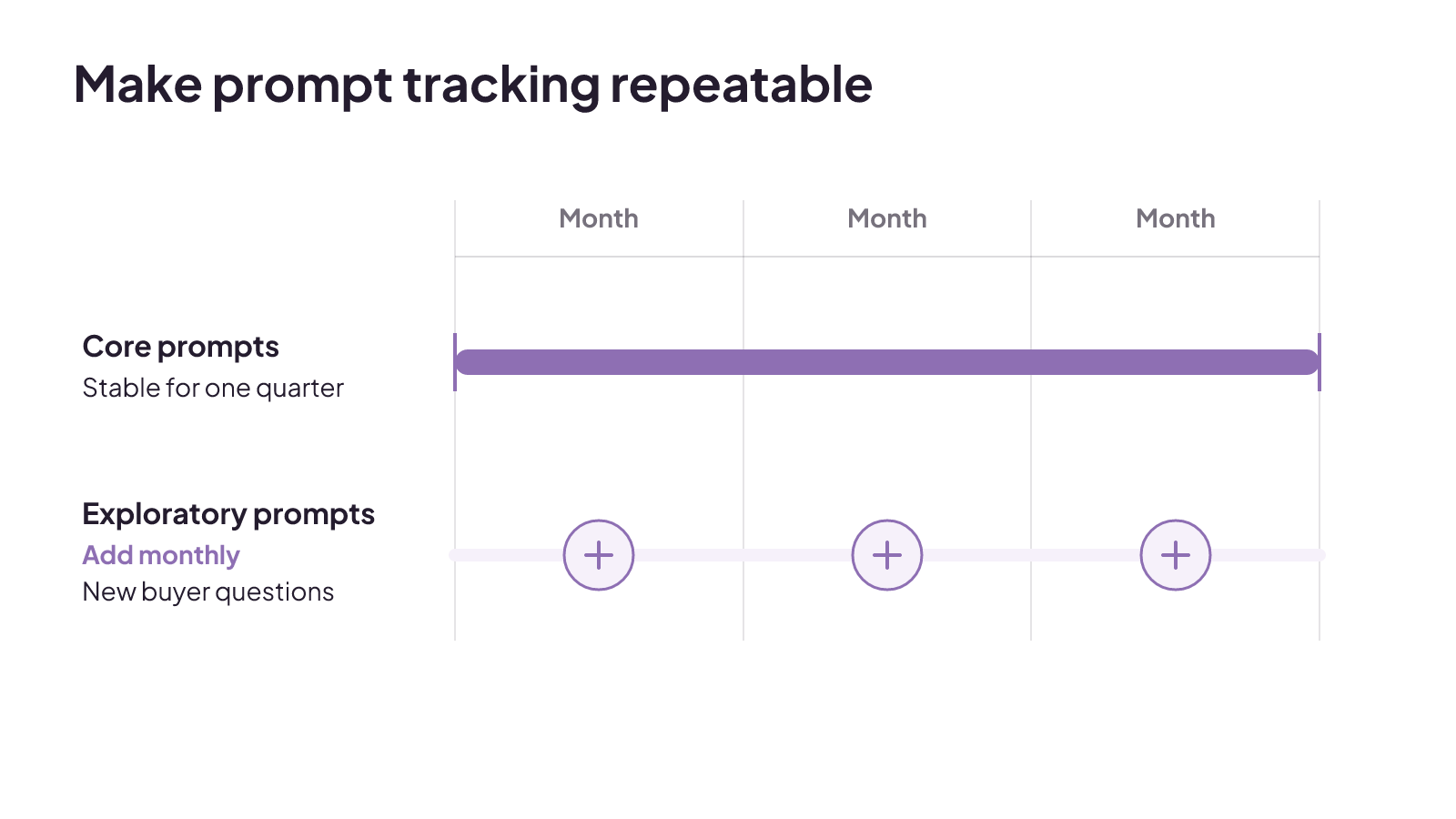
The library needs two lanes. Keep the core reporting prompts stable for at least one quarter. Add exploratory prompts monthly for new buyer questions, launches, competitors, markets, or sales objections. The stable prompts form the reporting set. The monthly additions form an exploratory set for subjects that were not part of the original reporting group.
What belongs with each prompt result
Keep the exact prompt wording with every result. Record the location, model version, cited sources, and date as well. AI-generated brand lists can vary across all five conditions. Attach those conditions to the answer produced in each run.
Label each prompt as part of the core reporting set or the monthly exploratory set. The core set remains stable for at least one quarter. The exploratory set can add new buyer questions, launches, competitors, markets, and sales objections each month. The label identifies a repeated core observation or a newly added line of inquiry.
Commercial importance defines the prompt library. Each prompt should address a buyer question that helps measure whether an answer engine mentions, recommends, cites, ranks, or misdescribes the brand. Record those five outcomes separately. When an answer is wrong, capture it, classify the issue, improve the relevant information, and test the same prompt again.
The resulting record can show more than a copied answer. It can identify the prompt and measurement set, retain the conditions of the run, and label the observed outcome. Inclusion rate can then use the relevant, high-intent prompts in which the brand is recommended. The other observations remain available for share of voice, citation share, average positioning, or the correction loop.
This structure also preserves honest changes in the library. Monthly exploratory prompts can respond to a launch or a new market while the quarterly core remains stable. A new buyer question gets measured without silently rewriting the set used for the recurring report.
This is where AI mention tracking becomes more useful than collecting interesting screenshots. A governed prompt set is a measurement system; one prompt run is a screenshot. The difference is not the polish of the report. It is whether the prompts are controlled well enough to compare what appears over time.
The controlled library records mentions, recommendations, citations, rankings, and misdescriptions. When an AI answer is wrong, the correction loop begins with the answer and its citations. Recommendations belong in the inclusion-rate calculation.
Wrong AI answers need a correction loop
When an AI answer is wrong, preserve the evidence before changing anything. Record the incorrect claim, save the answer, and capture the citations shown with it. Then classify the issue, improve the relevant owned or third-party information, and rerun the same prompt.
Use the full six-step sequence: record the incorrect claim; save the answer; capture its citations; classify the issue; improve the relevant owned or third-party information; and rerun the same prompt.
The saved answer preserves what the engine produced. The captured citations preserve the references attached to it. Classification identifies the issue being handled, and the information update addresses the relevant owned or third-party material. The repeated prompt creates the follow-up observation.
A stable prompt library gives the team the same prompt for the retest. The broader clinic AEO guide explains the answer-engine context when you're ready to carry this measurement discipline into your clinic's visibility work.
AI visibility for a plastic surgery practice: what to measure and what proof matters
AI visibility for plastic surgery involves answer-engine exposure plus specialty proof on procedures, safety, credentials, and clinical photos.
Read insight
AEO vs GEO: the practical difference and where SEO fits
AEO targets direct answers, GEO targets generative citations, and SEO supplies their shared foundation; a task matrix clarifies where each fits.
Read insight
Marketing vs advertising: what comes first and where each fits
Marketing sets the strategy, while advertising pays to distribute messages, so goals and customer needs determine what you fund first.
Read insight