

Key takeaways
- AI answers may draw on reviews, directories, and third-party content.
- Administrative AI carries a different risk profile from AI used in clinical decisions.
- Smaller, templated agency engagements can start in the low four figures per month.
AI visibility for a plastic surgery practice starts with a simple observation: did an answer engine surface the practice for a relevant patient question? That appearance sits alongside the public material patients use to compare surgeons, including reviews, photos, procedure information, and third-party content. A practice can therefore be easy to find in ordinary search yet still need a separate view of its presence in generated answers. AI visibility gives that presence a name. The practical work is to observe the answer, examine the public clinic facts beneath it, and keep plastic-surgery details accurate and specific.
What does AI visibility mean for a plastic surgery practice?
AI visibility means that your practice appears when an answer engine responds to a relevant patient question. That appearance may include a reference or link that a patient can follow. For example, ChatGPT can search the web and return timely answers with links to web sources.
The discovery path is broader than your own website. Prospective plastic-surgery patients increasingly see curated answers built from online reviews, directories, and third-party content. Those sources can affect what a patient encounters before reaching a surgeon's site.
Traditional search engine optimization may no longer be enough for a private practice to remain visible as AI-generated search changes discovery. Your search position still matters, but it does not show whether the practice appears in an AI answer. AI mention tracking focuses attention on that distinct appearance.
That leaves an operator with two observable questions. First, can patients find the practice through familiar search results? Second, does the practice appear inside a generated answer to a patient-style question? A traditional rank cannot answer the second question. A generated answer can also point to sources beyond the practice website, so reviews, directories, and third-party material remain part of the visibility picture.
Four evidence layers keep the visibility question in scope
| Evidence layer | What belongs there | Concrete observable item | Scope |
|---|---|---|---|
| Answer-engine monitoring and reporting | Weekly patient-style prompt monitoring across ChatGPT, Gemini, and Perplexity, plus local competitor visibility, mention rate, and share of voice | Whether a med spa appears for a fixed patient-style prompt and how often it is mentioned | Our med-spa AI-visibility offering |
| Public visibility foundations | Treatment pages, machine-readable site structure, clinic profiles, third-party citations, and consistent clinic facts | A clinic profile correction or a factual mismatch across public sources | Our med-spa AI-visibility offering |
| Plastic-surgery consultation information | Pricing ranges, financing, recovery time, travel, medical clearance, and when surgery may not be appropriate | A consultation FAQ that answers a specific patient question | Plastic-surgery practices |
| Multichannel clinic discovery | Search results, reviews, websites, referrals, and social media | The surfaces a patient reviews before booking | Dental practices |
What do plastic-surgery patients compare before booking?
Plastic- and cosmetic-surgery patients compare surgeons, before-and-after galleries, reviews, and pricing before they book consultations. These surfaces deserve separate attention because each contains information a prospective patient may use during research.
Photography has a deeper role in this specialty than ordinary marketing imagery. Clinical photography documents preoperative and postoperative changes, helps visualize surgical approaches, and supports outcome evaluation. Before-and-after photos can also help potential patients visualize results and build trust in an elective medical practice.
The quality of that visual record depends on consistency. Strict standardization in plastic-surgery photography supports uniformity and helps reduce potential bias. For an operator, that makes the gallery more than a collection of attractive images. The clinical photo process and the public-facing gallery both need attention, even though they serve different purposes.
The other comparison surfaces remain concrete. A surgeon profile identifies the person being considered. Reviews contribute outside perspectives. Pricing information addresses a financial question. The gallery lets patients examine visual examples. Together, these are the materials patients may compare before a consultation, not proof that an answer engine will recommend the practice.
A gallery also has two distinct jobs. In clinical use, photography records change, helps visualize surgical approaches, and supports the evaluation of outcomes. In public marketing, before-and-after images can help a potential patient picture results and build trust. Standardization belongs to the clinical-photo process because uniform capture helps limit bias. Visibility does not remove that need for a consistent record.
Clinical photos carry privacy and authorization duties
The marketing value of before-and-after photos does not remove their privacy obligations. Photos used by elective medical practices can count as protected health information. They can also be subject to HIPAA rules, Federal Trade Commission regulations, state privacy laws, and state licensing-board requirements.
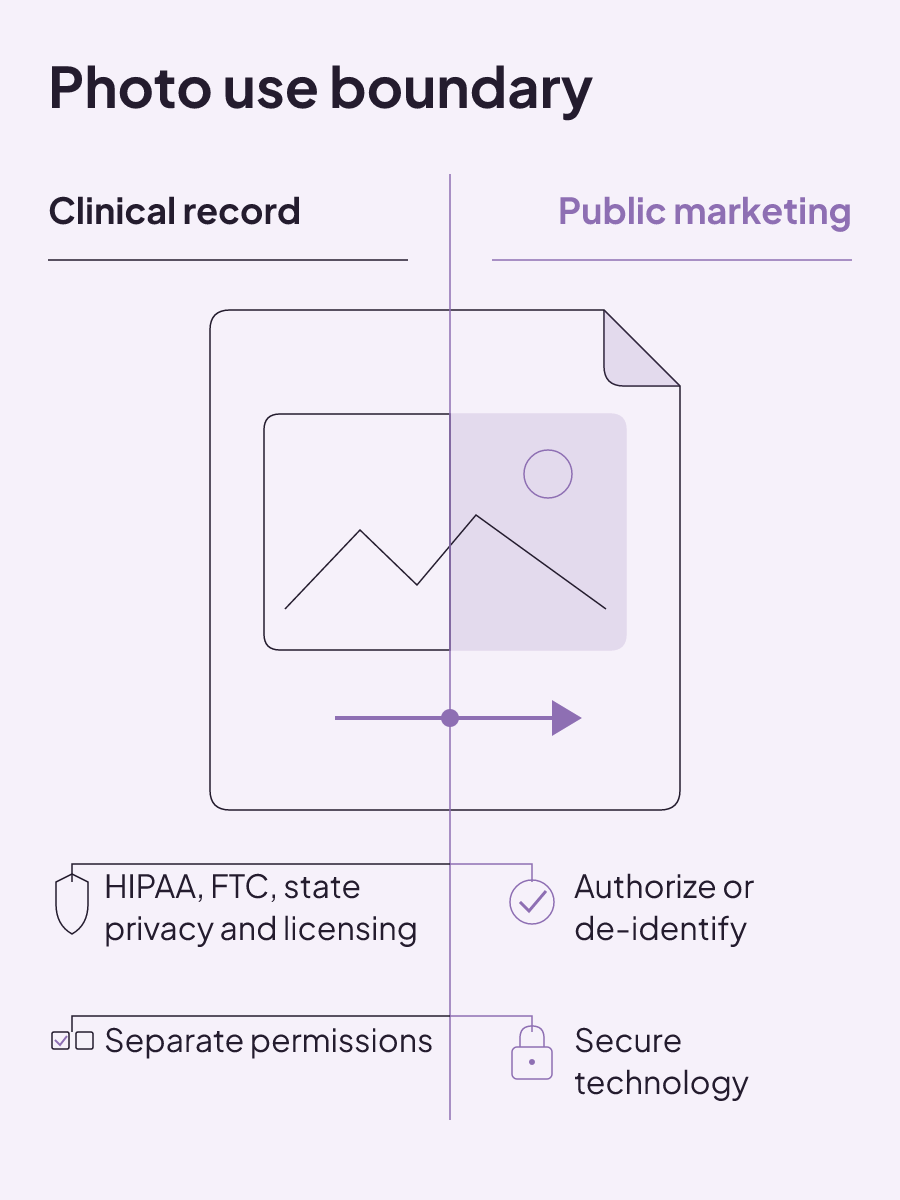
Four boundaries deserve clear treatment:
- Regulatory coverage: Before-and-after photos can fall under federal health privacy rules, consumer-protection regulation, state privacy law, and licensing-board requirements.
- Different permissions: Consent to treatment and HIPAA authorization serve different purposes. One should not be assumed to replace the other.
- Marketing use: Photos and other digital material that can reveal identity require precise authorization or rigorous de-identification for marketing use.
- Technology: Plastic surgeons must use secure technology to protect the confidentiality and privacy of clinical photos that constitute protected health information.
This is where a gallery decision becomes an operational and compliance decision. A useful photo can still carry protected information, and treatment consent does not settle authorization for marketing. The practice also has to account for the technology holding the clinical photographs. Qualified compliance review is appropriate for HIPAA, privacy, and authorization passages because the applicable requirements can include several regulatory categories.
The boundary follows the use of the image. Clinical photography can document care and outcomes, while public marketing exposes the image to a different audience. If a photo or digital artifact can reveal identity, marketing use requires precise authorization or rigorous de-identification. Secure technology remains necessary for clinical photographs that constitute protected health information. These duties sit beside the visual value of a gallery, not after it.
Social content depends on the audience's age
For plastic surgeons, social media can support patient engagement, peer-to-peer education and learning, and outreach to the broader public.
Effective social-media marketing depends on matching both the content and the platform to the specific age of the intended audience. The useful planning question is therefore not simply whether the practice should post more. It is who the content is meant to reach and whether the platform fits that age group.
That age fit should shape the channel choice before production starts. Patient-facing content, professional education, and public outreach need not use identical material. Research on social media in plastic surgery supports both the range of roles and the importance of matching the approach to the audience's age.
A clear audience choice keeps the content tied to its purpose. Patient engagement speaks to prospective or current patients. Peer education and learning serve professional exchange. Public outreach reaches a broader group. The supported selection factor is age: effective content and platform choices depend on the age of the people the surgeon wants to reach.
Plastic-surgery content needs procedure, safety, and credential detail
Useful plastic-surgery education is current, specific, and consistent with the practice's own facts. It explains candidacy, risks, alternatives, and postoperative care. Those topics answer material patient questions that a broad service description leaves open.
Safety pages have another concrete job. They can cover anesthesia, accredited facilities, implant decisions, revision planning, complications, and postoperative support. That inventory gives the practice a way to examine whether important safety subjects have a clear public home.
Credentials require equally precise language. A surgeon who performs plastic surgery may advertise being certified even when that board certification is not in plastic surgery. The field of certification is therefore a meaningful detail, not something an operator should compress into a generic certification label.
This specialty content sits beneath plastic surgery marketing. It gives patients specific material about procedures, safety, and the surgeon they are evaluating. It also gives answer engines source-backed language they may repeat. Keep those facts aligned with the practice's owned information so the public explanation remains consistent.
The content inventory also makes gaps visible. A procedure page can explain candidacy, risks, alternatives, and postoperative care. A safety page can hold information about anesthesia, accredited facilities, implant decisions, revision planning, complications, and postoperative support. A credential page can state the actual field of board certification. Each page then answers a concrete comparison question instead of relying on a broad claim about quality.
What does dental practice marketing show about clinic discovery?
In dental practice marketing, positive patient experiences support word-of-mouth recommendations and stronger online reputation signals.
Education also begins before an appointment. Dental practices can answer common treatment questions through blogs, videos, and FAQs, which helps build trust before the first visit. These formats give a practice several ways to provide useful answers without forcing every question onto one page.
The lesson stays within the dental setting: local profiles, the website, reputation, referrals, and education all contribute to how a dental practice is evaluated. Dental patients may review search results, reviews, websites, referrals, and social media before booking. That does not prove the same mix will produce a plastic-surgery result. It shows why clinic discovery cannot be reduced to a single search ranking or one website metric.
These dental surfaces answer different pre-booking questions. The profile and website help a nearby patient find the practice. Reviews and referrals carry reputation signals. Blogs, videos, and FAQs answer common treatment questions before the first appointment. Dental practice marketing connects all three, but its results still depend on measuring the channels used by that practice.
Dental measurement and conversion depend on the practice
Without measuring results, a dental practice cannot know which marketing channels are working. Measurement needs to connect to the surfaces where a prospective patient can act, not stop at general traffic reporting.
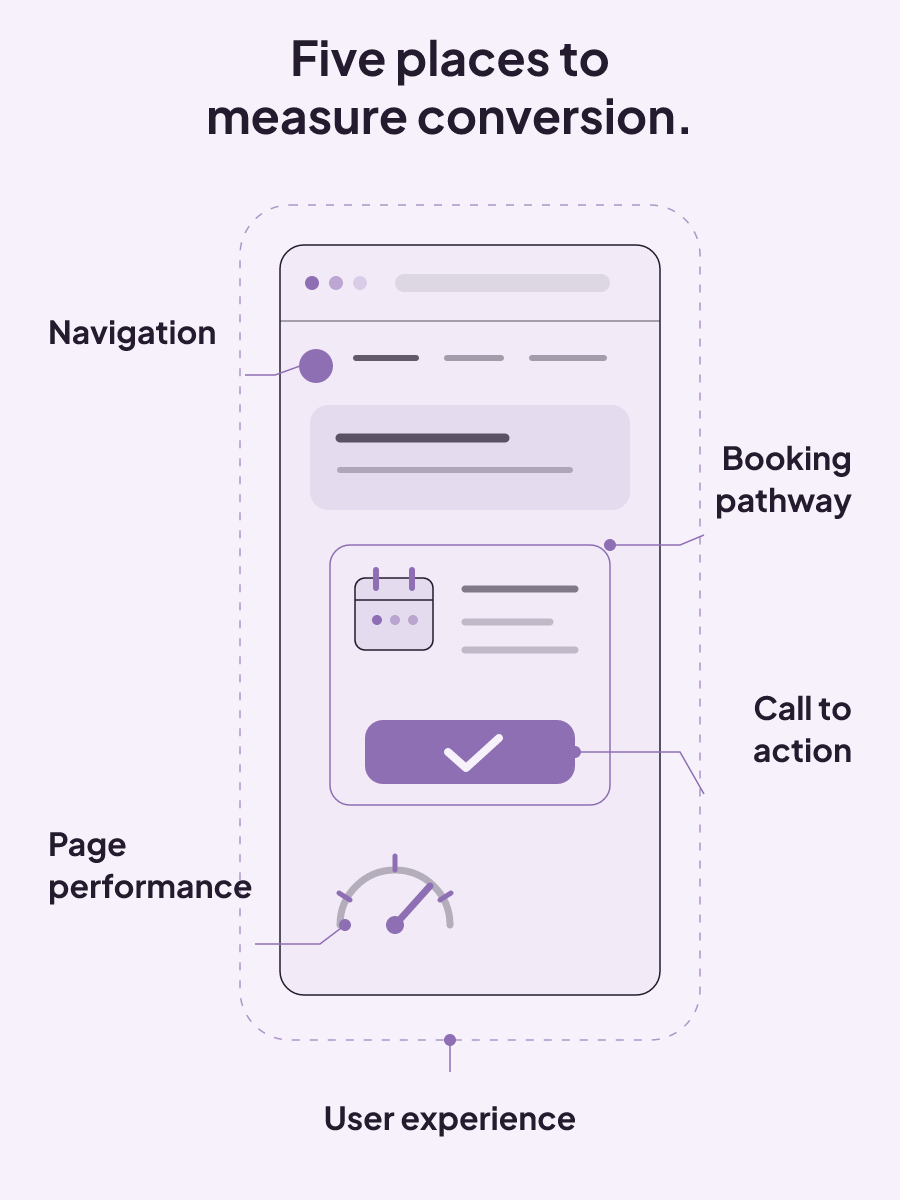
Dental conversion work can focus on five concrete areas:
- website navigation;
- appointment-booking pathways;
- calls to action;
- page performance; and
- user experience.
The strategy itself can change with five practice factors:
- location;
- services;
- competition;
- growth objectives; and
- marketing budget.
These lists explain why a copied dental marketing plan can miss the practice it is meant to serve. The conversion surfaces identify where the website experience can be assessed. The practice factors define the setting in which channel results have to be understood.
For a dental operator, measurement is what separates activity from a channel that is working. For a plastic-surgery operator, the adjacent example is useful as a measurement principle, not a promised transfer of dental tactics or results. AI answer appearances still need their own monitoring, just as booking pathways and page performance need their own measures.
Is there an AI for plastic surgery?
Yes, but the phrase covers very different uses. Generative AI has potential in plastic-surgery tasks such as surgical planning and discharge summaries. Potential is not the same as a demonstrated improvement in surgical outcomes.
Administrative uses are easier to separate. AI can answer calls, respond to web inquiries, and schedule plastic-surgery consultations around the clock. It can also be used for appointment reminders. Front-office AI used for calls, scheduling, and reminders has a fundamentally different risk profile from AI that touches clinical decisions.
This distinction prevents three subjects from collapsing into one label. AI visibility concerns whether a practice appears in generated answers. Administrative AI handles tasks such as inquiries and scheduling. Clinical AI can touch surgical planning or discharge summaries. The same purchase, governance, and risk assumptions should not be applied across all three categories.
Clinical generative AI carries a broader risk test
Generative AI in surgical care raises concerns about misinformation, data breaches, bias, and misuse. Those concerns make a simple productivity argument incomplete when the technology touches clinical work.
A proposed ethical framework for generative AI in plastic surgery names five principles: data transparency, patient autonomy, safety and accountability, equity, and sustainability. These principles do not establish that a particular system is safe or effective. They provide a wider set of issues for evaluating clinical use.
The practical boundary is clear. An around-the-clock response to a web inquiry is an administrative task. Surgical planning touches clinical decisions. The risk profile changes with that role, so the review must account for the actual task. Published discussion of generative AI in plastic surgery identifies both the potential tasks and the concerns that come with surgical-care use.
The four concerns and five principles address different parts of the decision. Misinformation and misuse concern what a system may produce or how it may be used. Data breaches concern information handling, and bias concerns uneven effects. Transparency, autonomy, accountability, equity, and sustainability widen the evaluation beyond speed or convenience. They remain proposed principles, not an approval or outcome claim.
What does AI visibility for a plastic surgery practice cost?
AEO agency pricing varies with practice size, surgeon count, and the scope of work. Smaller, templated engagements can start in the low four figures per month. Dedicated full-service work and multi-location support can cost considerably more.
If you want to build the measurement approach before comparing providers, read our answer engine optimization guide for clinics. You can also use AI share of voice to frame the competitive visibility question without treating it as a guarantee.

AEO vs GEO: the practical difference and where SEO fits
AEO targets direct answers, GEO targets generative citations, and SEO supplies their shared foundation; a task matrix clarifies where each fits.
Read insight
ROI tracking: calculate the return and label what the number proves
ROI tracking is credible when every cost is counted and each result is labeled as observed, attributed, or experimentally incremental.
Read insight
Med spa profit margins: how to calculate what your clinic actually keeps
Med spa profit margins depend on treatment contribution, provider capacity, fixed costs, acquisition, no-shows, and repeat booking.
Read insight