

Key takeaways
AEO vs GEO is a comparison of emphasis, not a choice between two sealed channels. AEO focuses on immediate answers. GEO focuses on citations and representation in broader generated explanations. SEO provides foundations both can use. AI SEO is a flexible umbrella label, and industry usage remains inconsistent.
AEO vs GEO at a glance
Use these labels to identify the job and the signal attached to it. That is more useful than treating any acronym as a fixed service category. The working scopes overlap, so a proposal for AEO and GEO in digital marketing should name the actual work behind each label.
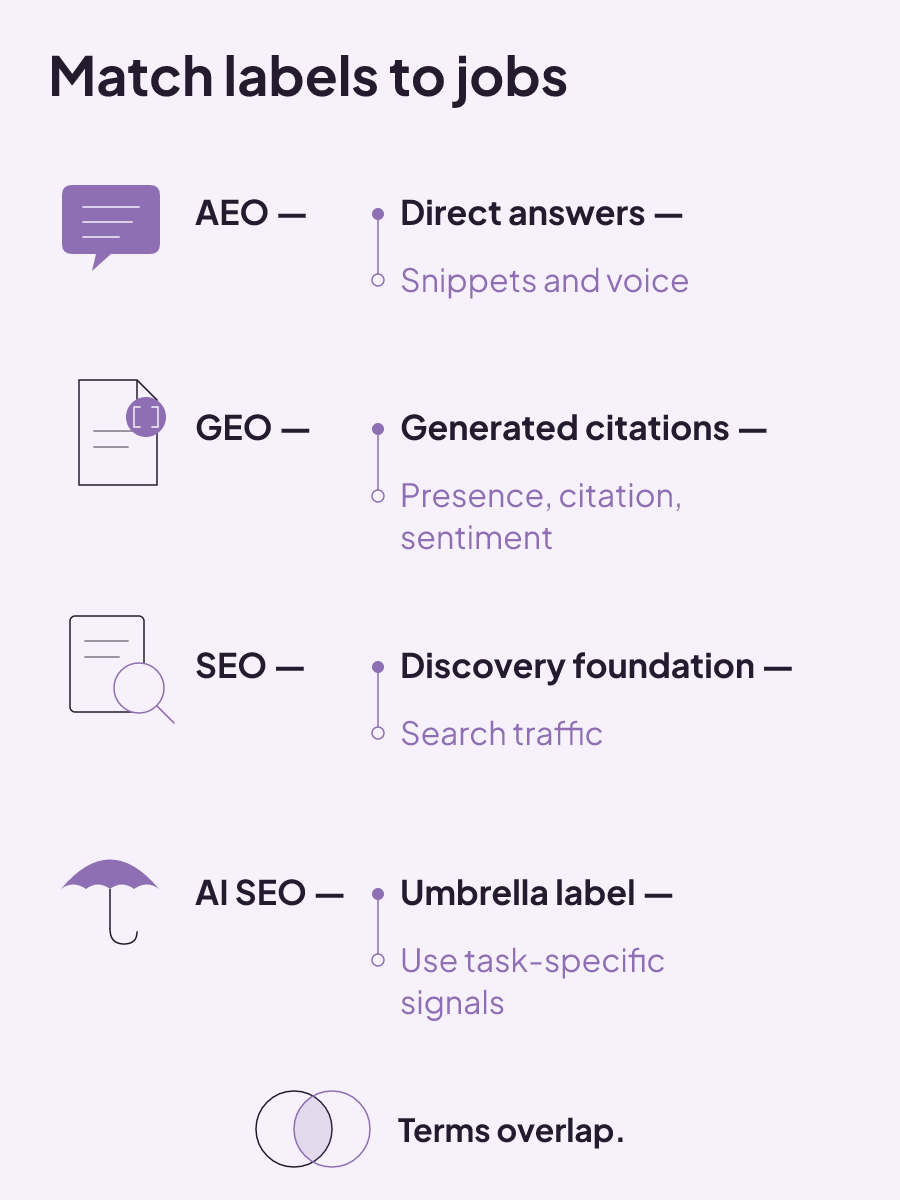
| Working label | Primary task | Practical signal | Limitation |
|---|---|---|---|
| AEO | Shape content for immediate answers, featured snippets, and voice search | Featured-snippet or voice visibility | The label has no standardized industry boundary |
| GEO | Improve the chance of being cited or represented in broader AI-generated explanations | Brand presence, citation quality, or sentiment | A citation is one part of visibility, not a guaranteed outcome |
| SEO | Support crawling, indexing, ranking, and search discovery | Traffic trends in Search Console | Website sessions do not capture all exposure inside AI interfaces |
| AI SEO | Group AI-enhanced search strategies under one umbrella | Measures tied to the actual AEO, GEO, or SEO task | The umbrella can hide which task was completed |
The clearest AEO vs GEO difference is the target. AEO aims at a direct answer. GEO aims at generative citations and broader explanations. AI SEO can include either scope, but it is not automatically the same as AEO or GEO.
Is GEO replacing SEO?
No. AI search extends traditional SEO; it does not make the foundation obsolete. Technical SEO helps search engines crawl, index, and rank content. Those same fundamentals can improve the chance that content appears in AI-generated answers. If a GEO plan ignores crawl access or basic discoverability, the new label has not removed the old dependency.
That relationship also answers a common SEO vs AEO vs GEO question. SEO handles the discoverability base. AEO applies that base to immediate-answer visibility, including featured snippets and voice search. GEO applies it to the chance of being used as a source in a generated explanation. These scopes can sit inside one plan because they describe different jobs performed on connected content.
Structured data is one concrete part of that foundation. It can be used to understand page content, and the content may then appear as a rich result. For rich-result eligibility, the markup must accurately represent the page. It must also be complete, current, in a supported format, and accessible to the relevant crawler. Correct markup still does not guarantee a rich result.
That last boundary matters when you review an AEO, GEO, or SEO proposal. "Add structured data" describes a task. It does not describe a guaranteed placement, citation, or result. Ask the proposal to name the page being marked up, the business facts represented, and the visibility signal that will be watched. This keeps the work concrete without turning one technical change into a promise it cannot support.
A direct answer and a broader generated explanation are different outputs. AEO focuses on the first. GEO focuses on citations and representation in the second. SEO supports the crawling, indexing, ranking, and traffic visibility behind discoverable pages. AI search builds on that foundation.
When a report uses the phrase AI SEO, read it as a heading until the tasks are named. Is AI SEO called AEO? Sometimes the labels may be used that way because the terminology is inconsistent. That does not make them categorically identical. The work beneath the heading should tell you whether the real target is search discovery, direct answers, generative citations, or a mix.
Clinic visibility spans official facts and comparison surfaces
For a clinic, the abstract SEO, GEO, AEO discussion becomes clearer when you look at the public surfaces involved. One group establishes official business facts. Another gives patients material they can compare. Both groups are visible before a booking decision, but they serve different practical roles.
Start with the clinic website. Organization structured data on the homepage can specify the organization's name, logo, and contact information. Local-business structured data can identify the business name and address. Its required properties include @context, @type, name, and address. These details give the clinic a concrete, machine-readable identity on its own site.
The clinic can also manage how it appears across maps and search through its Business Profile. Search Console verification can establish the official website presence. Accurate knowledge-panel information and structured data add more official business detail. Each item describes a public surface or business fact that the clinic can maintain.
Now consider what a prospective patient compares. Profiles, reviews, accurate details, treatment pages, and proof can all be part of the evaluation. That is a wider set of surfaces than the homepage markup alone. A correct name and address do not replace the treatment page a patient reads. A treatment page does not replace the profile details or reviews the patient checks.
Here is a bounded AEO vs GEO example for a med spa:
- The homepage identifies the clinic's organization name, logo, and contact information.
- Local-business markup represents the clinic name and address.
- The clinic maintains its Business Profile and verifies its official website presence.
- Patients evaluate the clinic through profiles, reviews, accurate details, treatment pages, and proof.
This example does not claim that one item causes the next. It shows the distinct public inputs around a clinic. Direct-answer work may draw attention to a clear fact or answer. Generative-answer work may concern whether the clinic is cited or represented in a broader explanation. Traditional search work supports discovery of the underlying pages and business information.
The Ownerized take is simple: do not let an acronym hide the surface being changed. If a proposal says "GEO optimization," ask whether the task concerns crawler access, structured business information, public pages, or citation measurement. If it says "AEO content," identify the immediate question and the answer surface being targeted. The label is useful only after the work is visible.
For a short definition you can share with your team, our answer engine optimization glossary keeps the AEO meaning focused. Our definitions of AI visibility and an AI citation separate presence from the narrower act of being cited.
AI search reaches beyond one answer format
GEO in marketing concerns visibility inside generated responses, especially citations and broader explanations. But AI search is not one uniform answer box. The available mode and the user's request can change whether current public-internet information enters the conversation.
ChatGPT search can return timely answers with links to relevant web sources. The system may choose to search the web based on a user's request, and a user may also select web search manually. That capability creates a web-connected answer surface where a source link can appear directly beside the response.
Search and deep research are also different ways to search the public internet. Search can bring current internet information into a conversation. The distinction matters because "visibility in AI" does not identify one single mode. A useful GEO plan should name the surface being observed instead of treating every generated response as the same event.
What does technical GEO work cover?
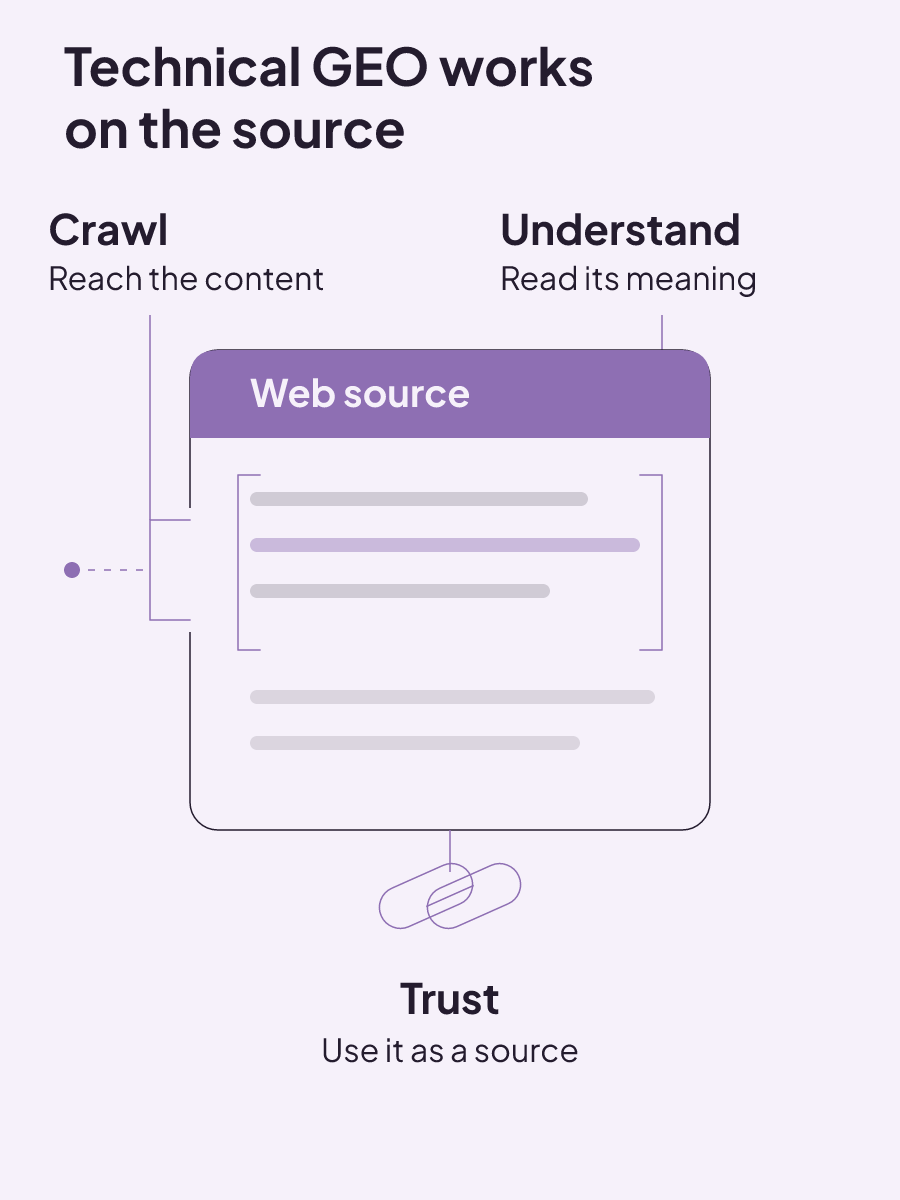
GEO can include technical work that helps AI-driven engines crawl, understand, and trust a site as a source. Those are three distinct functions within the same scope:
- Crawl: the engine needs technical access to the content.
- Understand: the content and business information need to be interpretable.
- Trust: the engine needs a basis to use the content as a source.
This is where SEO, GEO, and AEO meet without becoming synonyms. Traditional technical SEO supports crawling, indexing, and ranking. GEO can apply technical work to source inclusion in generated answers. AEO focuses the content toward an immediate answer. The overlap is real, but the desired result and the measurement still need names.
Are AEO and GEO the same?
They can overlap, and people apply both labels inconsistently. As working scopes, they point to different emphases. AEO targets the immediate answer, including featured snippets and voice search. GEO targets citations in AI chatbots and representation in broader AI-generated explanations.
The distinction is useful when it changes the assignment. A direct-answer task should state the question and the answer surface. A generative-visibility task should state where the brand's presence or citations will be observed. If both tasks are included, "AEO and GEO" can be an honest description of a combined scope. It should not be used to make the same task look like two separate channels.
Is AI SEO the same as GEO?
Not categorically. AI SEO is used as an umbrella term for AI-enhanced search strategies. GEO focuses on citations and representation in generated responses. AEO targets direct-answer visibility, including featured snippets and voice search.
In an AEO vs SEO vs GEO vs AI comparison, "AI SEO" names the broad area. The other labels can identify more specific work. Industry usage is inconsistent, so the tasks and signals in a proposal or report provide more clarity than its chosen umbrella term.
How should AI visibility be measured?
Measure AI visibility in two connected parts: exposure inside the AI interface, then performance after someone visits the website. People can compare brands, evaluate options, and form opinions within an AI interface before they ever reach a site. Website traffic cannot describe that whole pre-visit period.
The exposure view can track brand presence, citation quality, and sentiment in addition to position. Those signals answer different questions about the generated response. Did the clinic appear? Was it cited? How was it represented? This is the GEO side of the report, because it examines what happened in the AI environment.
The on-site view begins when a visit occurs. Website sessions show engagement, but sessions alone do not capture upstream AI-search exposure. A reporting framework can connect those exposure signals with on-site performance instead of asking traffic to stand in for total visibility.
That two-part view prevents a common reporting mistake. A clinic may be compared inside an AI interface before any click occurs. If the report starts and ends with sessions, that exposure is absent from the picture. If the report tracks only presence or citations, it leaves the website side disconnected. Bringing both views into one framework shows the path without claiming that exposure caused a visit or that a visit caused a booking.
This is also the practical answer to "how AEO and GEO works" as a measurement question. AEO needs a signal tied to the immediate-answer surface, such as featured-snippet or voice visibility. GEO needs signals tied to generated responses, such as presence, citation quality, or sentiment. SEO can retain traffic trends in Search Console. An AI SEO report should use the measures attached to the actual tasks included under that umbrella.
When you review a report, look for a clean match between task and signal. If the work targeted citations, a sessions-only report is incomplete. If the work targeted website discovery, an AI-presence score does not replace search traffic trends. The point is not to crown one metric. It is to keep the metric tied to the visibility job it can describe.
Learn the AEO layer in more detail
If your immediate concern is direct-answer visibility, read our answer engine optimization guide for clinics. It goes deeper on the AEO layer while keeping it connected to the public information and search foundations around a clinic.
We treat clinic visibility as a connected path across local search, AI answers, business profiles, reviews, treatment pages, social proof, and booking flow. That operating view keeps the work anchored to the surfaces patients use to find and compare clinics. It does not turn a single technical change into a promise of rankings, citations, or consultations.
Read the guide for a focused explanation of answer engine optimization for clinics, including the direct-answer layer and the search foundations around it.
AI visibility for a plastic surgery practice: what to measure and what proof matters
AI visibility for plastic surgery involves answer-engine exposure plus specialty proof on procedures, safety, credentials, and clinical photos.
Read insight
ROI tracking: calculate the return and label what the number proves
ROI tracking is credible when every cost is counted and each result is labeled as observed, attributed, or experimentally incremental.
Read insight
Med spa profit margins: how to calculate what your clinic actually keeps
Med spa profit margins depend on treatment contribution, provider capacity, fixed costs, acquisition, no-shows, and repeat booking.
Read insight