
Key takeaways
- Marketing starts with customer needs, positioning, audience, and goals.
- Advertising pays to place messages within that broader marketing system.
- Digital marketing also includes websites, search, social media, and email.
Marketing vs advertising at a glance
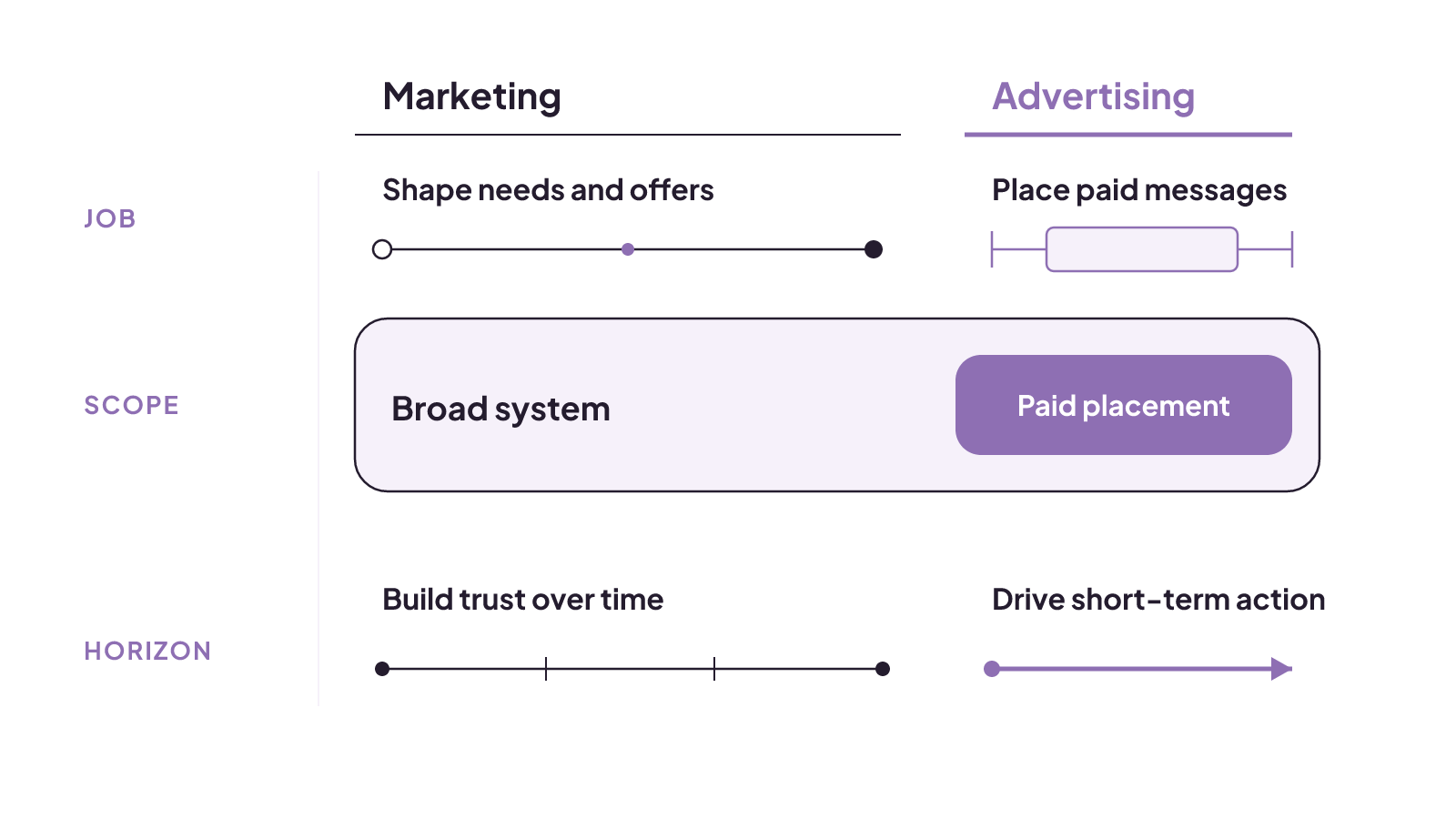
The central marketing vs advertising difference is the job each one does. Marketing identifies, predicts, and meets customer needs. Advertising pays to place a message or brand in a chosen location. For a clinic deciding where to put its next growth dollar, five practical differences make the funding choice clearer.
| Criterion | Marketing | Advertising |
|---|---|---|
| Core job | Identifies customer needs and develops offers that provide value | Creates and places paid messages to capture attention and prompt action |
| Scope | Covers needs, offers, and trust built over time | Covers paid message placement |
| Time horizon | Can include long-term trust building | Often aims for specific actions in the short term |
| Strategic role | Shapes the strategy | Puts that strategy in motion through paid messages |
| Cost pattern | Can range from practically free to very expensive | Campaign costs are typically easier to predict and control |
This is why a clinic can have a marketing problem even when its ads are reaching people. The unresolved issue may sit in the audience, offer, positioning, or plan. It is also possible to have sound marketing foundations but no paid campaign distributing a specific message. Neither fact ranks one field above the other. It defines the work in front of you.
Does advertising fall under marketing?
Yes. Advertising is part of marketing, so the words are related but not interchangeable. Advertising handles paid placement. Marketing includes that activity while also covering the decisions that give the paid message its audience, offer, and purpose.
A marketing plan can contain strategies for SEO, SEM, social media, email, content, events, public relations, and traditional media. That list shows how much broader the plan can be. Traditional media can sit beside email or events, all within one plan.
For a clinic operator, the part-to-whole relationship prevents a common budgeting error. An advertising budget answers how much to spend on paid placement. It does not, by itself, define the rest of the marketing plan. The plan still needs to identify the audience and decide what the clinic is trying to achieve.
What comes first, marketing or advertising?
Marketing strategy and activity planning come first. Planning before running advertisements reduces the risk of wasting time and money. The planning foundation helps focus the clinic's time and budget on programs intended to reach its business goals.
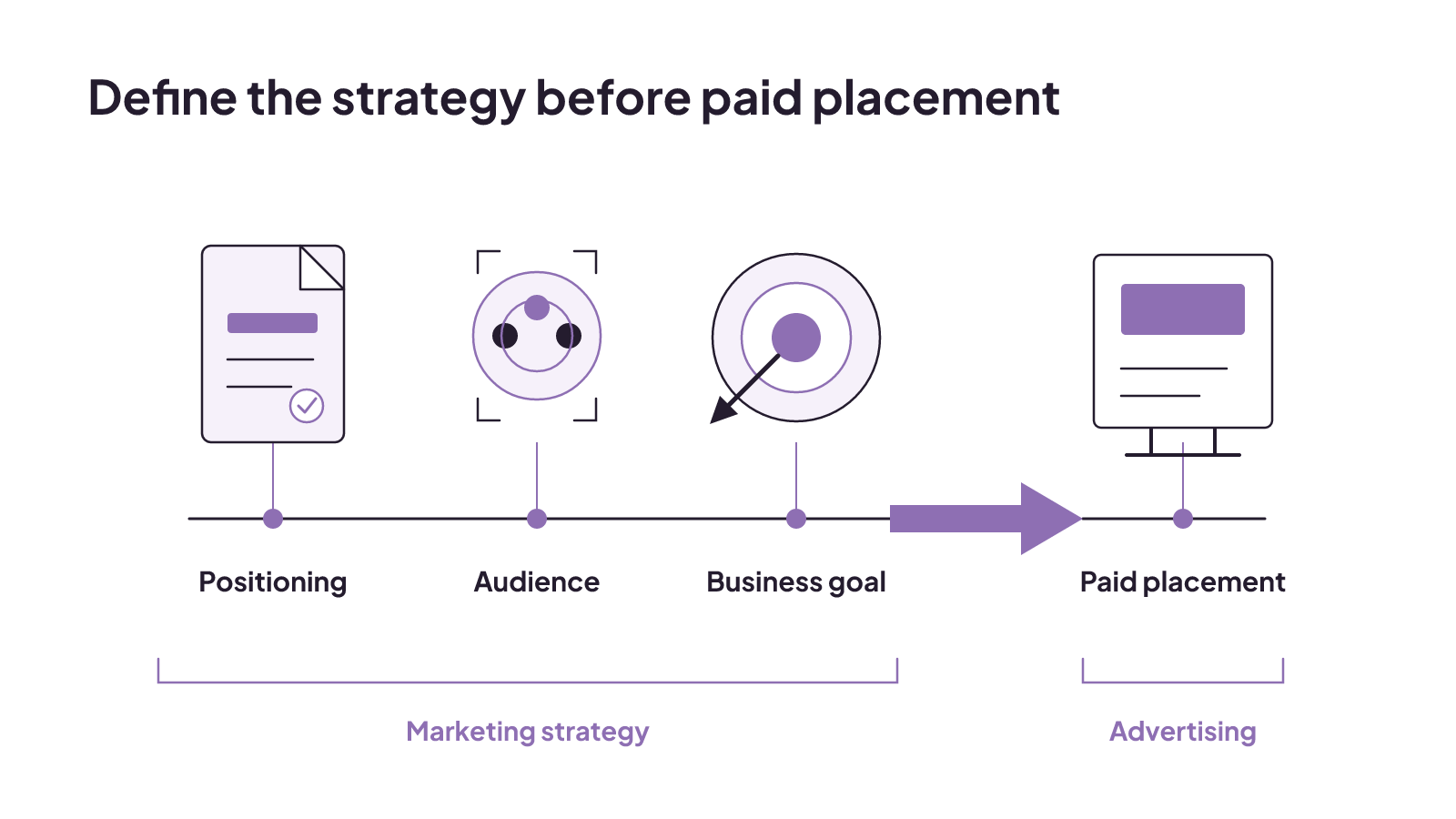
Start with positioning. Marketing planning can define a positioning statement, a primary value proposition, supporting benefits, and proof points before channel choices are made. This work determines what the message can honestly say and why the intended audience should care.
Then define that audience. A plan can distinguish end users from purchasing decision-makers and segment them by demographics, psychographics, behavior, and pain points. For an aesthetic clinic, this is the point where a broad intention to “get more attention” becomes a defined customer and business problem. The advertising channel has not been selected yet because the message and audience are still being shaped.
With positioning and audience defined, you can decide whether to pay for message placement and which result the campaign should pursue. Advertising that starts without a strategy or activity plan risks wasting time and money.
This order does not mean every marketing decision must be finished forever before an ad can run. Marketing plans can be measured and refined. It means the campaign should begin from an actual plan, not become a substitute for one.
Marketing has more levers than promotion
If the clinic's problem is bigger than message distribution, adding advertising may leave the central issue untouched. Marketing starts by uncovering customer needs and designing solutions that meet those needs. That broader job includes four connected levers: product or service, price, place, and promotion.
The product or service lever concerns what the business creates or delivers to meet customer needs. In a clinic setting, this is the offer itself. Before promoting it, the marketing work asks whether what is being delivered addresses the needs already identified.
The price lever covers pricing strategy and how customers pay for the product or service. It belongs in marketing because the terms of the offer are part of what the customer encounters. Paid placement can communicate a price, but the advertising campaign does not create the underlying pricing strategy.
The place lever covers where the product or service is made, found, distributed, sold, and supported. It includes physical and digital presence. This brings the customer's route to the offer into the marketing decision, well before a campaign chooses where to place a paid message.
The promotion lever concerns communicating products and services to a target audience to encourage purchases. Advertising fits here as a paid form of message placement. Promotion is one lever within the larger marketing job, not the full job by another name.
This distinction is useful when you are diagnosing a weak offer. If the open question concerns what you deliver, how people pay, or where they find and receive support, the work sits outside advertising placement. If those decisions are already defined and the immediate job is paid distribution, advertising may be the relevant activity.
The difference between marketing and advertising becomes concrete in the sequence. Marketing can uncover a customer need and shape the offer, price, access, and communication around it. Advertising then pays to put a chosen message in a chosen location.
Digital marketing vs advertising: paid ads are one online channel
Digital marketing is not another name for online advertising. Digital marketing uses websites, search engines, social media, email, and paid advertising to promote products and services. It can target specific audiences and measure performance in real time. Paid advertising is one part of that online scope.
Advertising methods also extend beyond digital marketing. Common methods include paid search, social media, display, native, print, and broadcast advertising. The first four can use digital placements. Print and broadcast show why advertising cannot be reduced to online channels.
Consider a geo-targeted marketing campaign. It can run across social media, online advertising, and local publications. That is one marketing campaign using several communication routes. The online advertising is paid placement within the campaign, while the social and local-publication activity describes a wider channel mix.
For a clinic budget, the practical digital marketing vs advertising question is whether you are funding the wider online system or buying paid distribution within it. A website, email activity, and search presence can all belong to digital marketing. A paid search placement belongs to both digital marketing and advertising because it is online and paid.
Channel labels alone still do not establish whether the campaign is ready. A paid campaign needs a result that the business has decided to pursue.
A paid campaign needs a defined result
Advertising creates and places paid messages to capture attention and drive specific actions in the short term. Before you fund that placement, name the business result the campaign is meant to pursue.
Different marketing types contribute to different objectives, including brand awareness and lead generation. Select the strategy that fits the goal. For a clinic operator, this keeps the budget decision tied to the desired result instead of treating paid distribution as the result itself.
Put that decision into the marketing budget plan. The plan can allocate spending by channel, estimate expected return on investment, and define key performance metrics. Paid placement then sits beside other planned activity with a channel budget, an expected return, and measures that match the business goal. Those controls give the campaign a specific role within the broader marketing plan.
A marketing plan turns strategy into controlled work
A marketing plan makes the broader strategy practical. It is a detailed document with realistic, measurable activities, and it covers the execution of tactics, actions, and controls. That gives each activity a place in the plan instead of leaving channels to compete for budget without a shared structure.
Budget planning can allocate spending by channel, estimate expected return on investment, and define key performance metrics. This is where an operator can put advertising beside other marketing activity without treating every expense as the same kind of work. The channel allocation shows where money is assigned. The expected return and performance metrics state how the plan intends to evaluate it.
Controls matter because a plan is meant to guide work after approval. Tactics identify what will be done, actions make that work concrete, and controls keep execution tied to the plan. Measurable activities let the clinic monitor whether the work is moving toward its stated goals.
If patient growth is the goal, our guide to healthcare marketing and patient acquisition can help you frame that broader business question before treating a channel as the answer.
Marketing continues after a campaign launches
Launch is not the end of the marketing job. A structured marketing plan keeps activities targeted and makes success monitorable. The plan can follow a repeating cycle: write the plan, implement the tactics, measure results against key performance indicators, and refine the plan.
That cycle creates a clear place for what the campaign teaches. Implementation produces activity. Measurement compares it with the selected indicators. Refinement updates the plan. Advertising results can inform this work, but the ongoing process belongs to marketing because it can change the broader mix of tactics, budgets, and controls.
Marketing also continues beyond short-term acquisition. Relationship marketing focuses on loyalty and long-term engagement instead of concentrating only on shorter-term acquisition and individual sales. It uses customer loyalty to encourage repeat purchasing.
For an aesthetic clinic, this widens the budget question. A paid message may be intended to capture attention and drive a specific action in the short term. Relationship marketing addresses loyalty, repeat purchasing, and longer-term engagement. Both can belong to the marketing plan, but they do different work and should not be judged as if they shared one immediate purpose.
The plan's cycle also prevents a single campaign from becoming the whole strategy. You can measure campaign activity, refine the plan, and continue work aimed at customer relationships. That is a longer operating rhythm than buying a placement and waiting for one reporting period to settle every marketing question.
Should you study marketing or advertising?
Choose the field by the work you want to learn. Marketing study focuses on research, product and service development, and brand alignment. Advertising study focuses on promoting a product, service, or brand.
The day-to-day orientation can help clarify the choice. Some people gravitate toward long-term planning, analytics, and market research. Others are drawn to campaign execution, design, and digital media.
A marketing vs advertising major decision therefore comes back to scope. Marketing gives more attention to researching needs and aligning the offer and brand. Advertising gives more attention to how promotion is created and executed. If you want to work across planning, analysis, and development, marketing may match that interest. If you want to concentrate on campaigns, design, and media, advertising may be the closer fit.
Advertising is part of marketing, while each course of study places its main emphasis on different work.
Choose by goal and business context
Fund the work that fits the goal your clinic has defined. Different marketing types contribute to different objectives, including brand awareness and lead generation. A strategy selected for one objective should not be assumed to fit the other automatically.
Business and industry context also affect which campaign type is appropriate. That rules out a universal answer such as “advertising first” or “marketing only.” If the clinic has not defined customer needs, positioning, audience, and goals, fund that marketing foundation.
Compare the next clinic-growth investment by expected payback, then use marketing attribution to connect spend with results. If the broader goal is bringing more patients into the growth system, start with the practical distinction between marketing activity and patient acquisition.

Med spa profit margins: how to calculate what your clinic actually keeps
Med spa profit margins depend on treatment contribution, provider capacity, fixed costs, acquisition, no-shows, and repeat booking.
Read insight
How to start a med spa: a three-checkpoint launch guide
Starting a med spa begins with three checks: ownership structure, startup cash, and a patient journey tested before you commit to software.
Read insight
Marketing strategy vs marketing plan: the difference and how they connect
A marketing strategy sets direction and positioning; a marketing plan assigns the actions, owners, budgets, deadlines, and measures that execute it.
Read insight