
Key takeaways
- Ownership and financial-interest rules vary by state.
- Your budget is too tight if it needs busy treatment rooms right away.
- Test the connected patient journey before choosing software.
Three checkpoints before you commit
If you're working out how to start a med spa business, begin with the decisions that can reshape the launch. Your legal structure, launch scale, and booking workflow affect what you can sensibly commit to. Resolve them before treating a location, device, or software contract as settled.
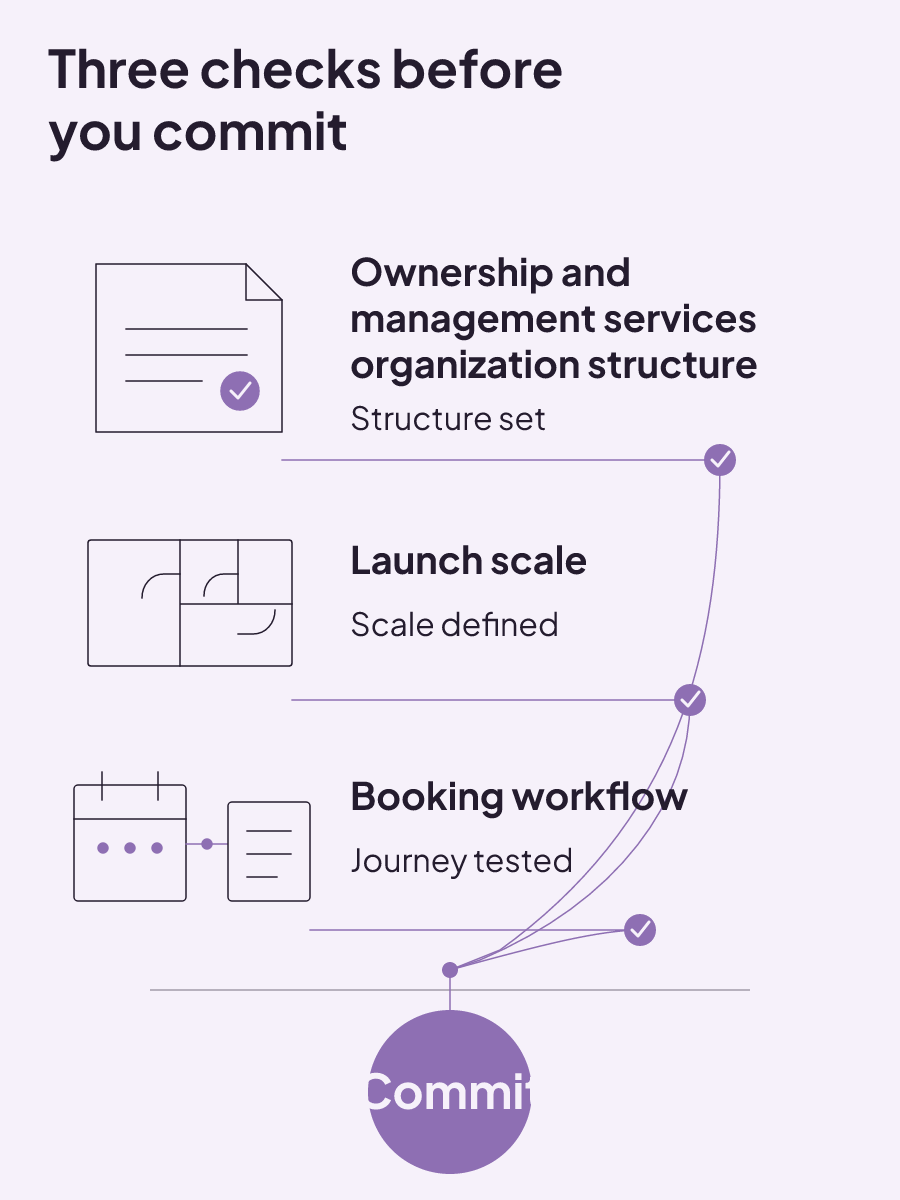
Use this worksheet to turn each checkpoint into a working answer:
| Checkpoint | Question to resolve | Working output | Commitment affected |
|---|---|---|---|
| Ownership structure | Who may own or hold a financial interest, and is a management services organization needed? If so, how will its management fee be structured? | A jurisdiction-specific ownership and management structure | Ownership, management, and financial plan |
| Launch scale | Will you open lean with fewer rooms, a narrower service mix, lower payroll, and less equipment risk, or open larger with a broader menu? | A defined room count, service mix, staffing level, and equipment exposure | Space, payroll, equipment, and required cash |
| Patient journey | Can a prospective patient see accurate availability, provide useful context, receive reliable follow-up, and move through a measurable booking path? | A tested workflow from inquiry through completed visit | Forms, calendars, follow-up, measurement, and software choice |
A lean launch leaves more room to adjust if demand is slow. A larger launch offers more revenue potential, but its fixed costs are higher and it leaves less room for mistakes. That tradeoff belongs in the plan before you price the rest of the business.
Can anyone open a med spa?
There is no single ownership structure for every med spa in the United States. State-specific questions include who may own the medical business, who may hold a financial interest, whether nonphysicians may participate, and whether a management services organization can be used.
Nurse practitioners may own a medical spa in many states when the right structure is in place. The legal and operating framework still needs to match the state. Opening also involves conventional business requirements plus licensing, certifications, protocols, and safety and health plans.
Florida shows how much can sit inside one state-level review. Planning there involves professional licensing, supervision rules, healthcare-clinic laws, HIPAA compliance, healthcare advertising regulations, and patient-safety obligations. Those are Florida planning requirements, not a template for every jurisdiction.
Your planned services also need to fit the applicable scope of practice, staffing, and delegation boundaries. Settle that operating structure before building a service menu around assumptions that may not hold.
Before choosing an entity, write down the jurisdiction, the proposed owners, each planned financial interest, and whether nonphysicians will participate. Add whether the plan may need a management services organization. Those are the ownership inputs the state-specific structure must answer. A person's professional title alone does not resolve all of them.
How to start a med spa with a defined clinic plan
A useful business plan explains what you are opening, how it will operate, and how the numbers support it. Start with the clinic's mission, goals, services, leadership, employees, and location. Add the financial plan and high-level growth plans. If the plan will support financing, these are core inputs rather than later details.
The plan should also explain how the clinic will achieve its goals. Define the operating model, the local competitive environment, what will make the clinic different, and the marketing approach. This turns a broad idea into a business that can be costed.
Be clear about whether your strategy emphasizes reducing cost or maximizing value. Then identify the largest costs tied to that choice. A lower-cost strategy and a higher-value strategy ask for different operating decisions, so vague positioning makes the financial model less useful.
The U.S. Small Business Administration's business-planning guidance calls for financial information alongside the mission, offer, leadership, employees, location, and growth plans. For a medical spa, the plan also needs the service proposition and the underlying financial path. Put those inputs on paper before using a startup estimate as your budget.
Give every goal two companions: how you plan to achieve it and the financial plan beneath it. Then describe how the business will operate, the market it will enter, and the way it will differentiate itself. This keeps growth plans, marketing, and financial information inside one operating model. It also makes the cost strategy explicit before larger commitments enter the budget.
Match services to staff, space, and equipment
The service menu determines what the clinic must be able to deliver. For each planned service, identify the partners, providers, and staff required. Then identify the technology, equipment, and inventory needed to support that delivery.
Space is part of the same calculation. Account for the cost of leasing or buying the location and for any necessary buildout. A service plan that needs more providers, equipment, inventory, or rooms changes the launch cost before the first appointment is booked.
Staffing needs more precision than a headcount. Worker misclassification can create tax liability, wage disputes, licensing issues, and liability exposure. The roles in the plan should therefore match the structure used to engage the people doing the work.
Run this planning pass service by service. Name the people required to deliver the service, then the technology, equipment, and inventory it needs. Finish with the room and buildout required to house it. The result is a set of delivery requirements that can be priced, staffed, and fitted into the planned location.
This is where an opening a medical spa checklist becomes specific enough to help. It should connect the service menu to named delivery inputs: providers and staff, technology and equipment, inventory, and the space plus buildout. A list that separates these choices can hide how one service decision changes several cost categories.
Once the service plan and delivery model are defined, the startup estimate has something real to measure.
How much does it cost to start a medical spa?
For a small medical-spa facility, estimated one-time startup costs range from $190,000 to $325,000 in California and $96,000 to $200,000 in Florida. Estimated monthly operating costs range from $40,800 to $71,000 in California and $22,500 to $43,000 in Florida.
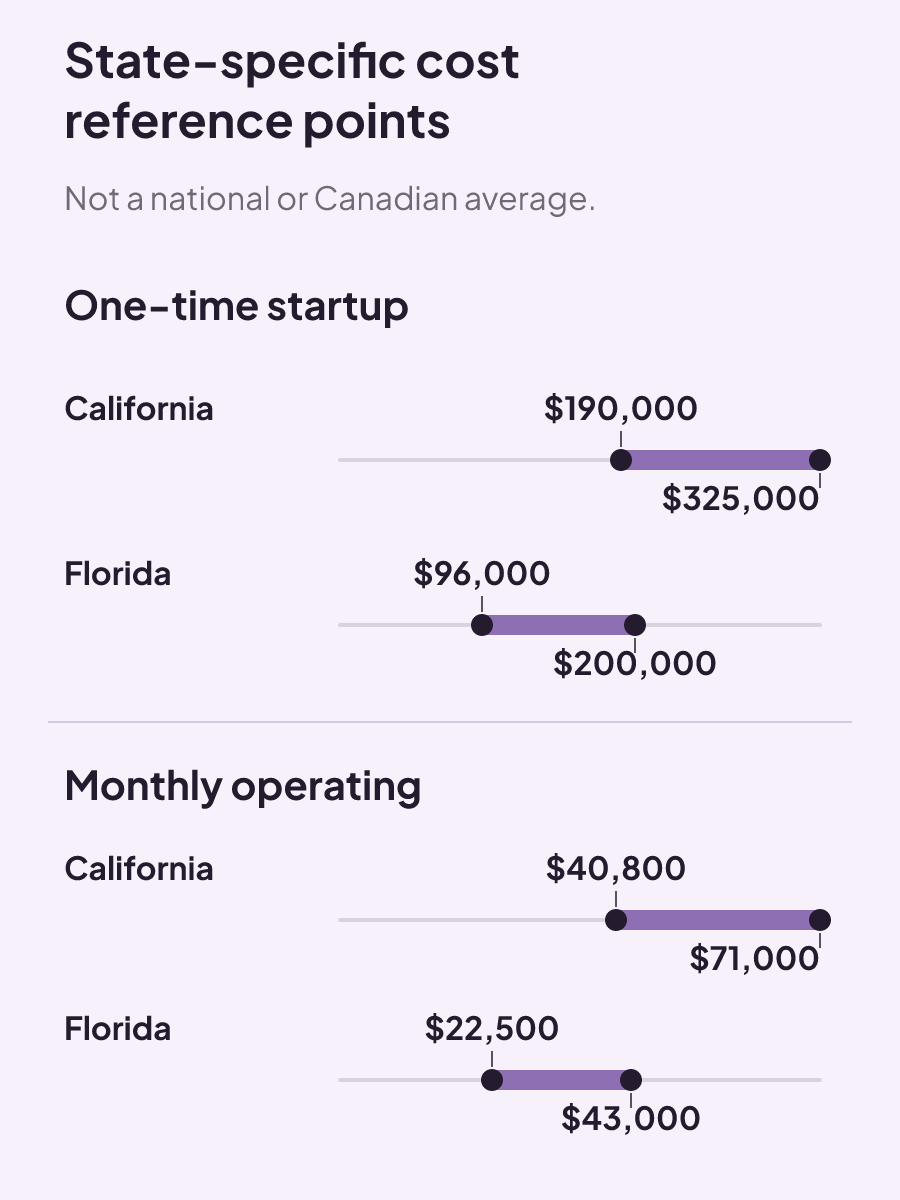
These state estimates are not a national or Canadian average. Medical-spa costs change with location, services, staffing, and other operating choices. Complete the financial projections for the clinic you have actually defined.
Use the figures as location-specific reference points, not as a shortcut to one startup number. Put location, service mix, staffing, and operating choices directly into the projection. When one of those inputs changes, update the affected startup and monthly cost lines before relying on the total.
Keep startup and ongoing costs separate. Startup costs include space, renovation, equipment, hiring, marketing, licenses, and permits. Ongoing costs include occupancy, utilities, payroll, supplies, insurance, marketing, and equipment maintenance.
That split keeps two different questions visible. The first is how much it takes to reach opening day. The second is how much cash the clinic will consume while it operates. A launch can cover the buildout and still lack enough money for the early operating period. The cash plan therefore needs both groups, not just an opening total.
How much cash do you need before opening?
The cash requirement is broader than the price of the lease, buildout, and equipment. Model it once with this formula:
Startup cash required = one-time costs + pre-opening costs + operating reserve + contingency - committed financing
Committed financing means cash, credit, or equipment financing that is already approved and available. Expected financing does not reduce the amount the launch still needs.
Keep the financing subtraction concrete. Record the approved amount that is available from each committed source. Leave a pending application or an unapproved credit request out of that line, then model the launch with the remaining cash requirement visible.
The operating reserve should cover several months of fixed costs while bookings ramp. Include rent and utilities, payroll, software, inventory reorders, advertising, and debt payments. A budget that works only when treatment rooms become busy immediately is probably too tight.
This calculation gives a direct answer to “How much money do you need to start a med spa?” It is the amount produced by your clinic's one-time and pre-opening costs, reserve, and contingency after subtracting financing you can actually use. A state estimate can orient you, but it cannot replace that model.
Financing must work when expected money falls through
Equipment financing can fund a large device, but it does not solve the rest of the launch by itself. Payroll, rent, marketing, buildout, software, and slow early cash flow still need another funding source.
Model monthly cash flow with the full financing terms included. That review should account for loan fees, interest, lease payments, and personal guarantees. Test the budget again without financing that has not been approved.
That second version is the useful pressure test. It shows whether the clinic can still reach opening with the money that is available, while the first version shows the effect of approved financing. Neither should assume that an application, conversation, or hoped-for credit line is cash in hand.
Service mix changes the economics
Price each service with local market research and the value you plan to offer. Pricing should remain competitive, and promotions and packages should be transparent. The aim is not to copy a nearby menu. It is to connect local pricing with the clinic's own costs and value.
Professional-product cost is one useful check. Compare the product used for a service with the service price, using an average product-cost target no higher than 18% of that price. A service mix concentrated on injectables or fillers can create cost-of-goods pressure. Machine-based service revenue can provide balance, but it still belongs in the equipment and financing plan.
Marketing needs its own assumption. The 2024 Medical Spa State of the Industry Report placed average medical-spa marketing investment at about 7% of revenue. It put the broader aesthetic-industry range at 2% to 15%, depending on business size, competition, and growth goals. This is a dated industry benchmark, not a required budget for every new clinic.
Put these checks beside the planned service mix: local price, product cost as a share of service price, concentration in product-heavy services, and the marketing assumption. Together they expose whether the menu and budget describe the same business.
Make the comparison at service level before judging the mix as a whole. Local market research informs the price, while professional-product cost tests that price against the 18% average target. The concentration check then shows how much of the menu depends on injectables or fillers, while the marketing assumption reflects business size, competition, and growth goals.
Test the patient journey before choosing software
Our patient-path model begins when someone asks a question, compares clinics, and messages the clinic that feels right. Before choosing software, follow that path through the clinic's operating workflow.
Test how calendars, forms, payments, records, patient qualification, and follow-up connect. The booking workflow needs accurate availability, useful patient context, reliable follow-up, and measurement from the first inquiry through the completed visit.
Trace one test inquiry through the whole workflow. Check whether the calendar presents accurate availability and whether the forms collect useful patient context. Follow the handoffs through payments, records, qualification, and follow-up. The test should continue until the completed visit can be connected to the original inquiry.
Track six operating measures: inquiry volume, response speed, appointment conversion, channel performance, no-shows, and reschedules. Those measures reveal what the workflow can observe before software becomes a fixed part of the stack.
This connected pre-booking path is also the operating layer behind our patient booking systems for med spas. The practical test comes first: map the patient path, identify the information and handoffs it needs, and then assess software against that workflow.
Intake and follow-up belong in the launch plan
The patient journey does not stop when an appointment appears on the calendar. Because a med spa is a medical facility, its launch workflow should include properly drafted intake forms. Those forms establish the provider-patient relationship, set expectations, and create protective documentation.
The post-procedure workflow also needs four defined parts: aftercare guidance, realistic result timelines, clear contact points for issues, and a feedback loop for improving the patient experience. These are operating requirements that belong in the workflow before software selection.
Work through the three-checkpoint worksheet before you commit to a location, major equipment, or software. Resolve the ownership structure, model the cash requirement with only approved financing, and test the patient journey from inquiry through follow-up. Then use the applicable scope-of-practice requirements to shape the staffing, delegation, and service-menu decisions that remain.

Med spa profit margins: how to calculate what your clinic actually keeps
Med spa profit margins depend on treatment contribution, provider capacity, fixed costs, acquisition, no-shows, and repeat booking.
Read insight
Marketing strategy vs marketing plan: the difference and how they connect
A marketing strategy sets direction and positioning; a marketing plan assigns the actions, owners, budgets, deadlines, and measures that execute it.
Read insight
ROI tracking: calculate the return and label what the number proves
ROI tracking is credible when every cost is counted and each result is labeled as observed, attributed, or experimentally incremental.
Read insight