

Key takeaways
Your marketing strategy sets long-term direction through vision, goals, value proposition, and market position. Your marketing plan follows that strategy and assigns the actions, tactics, timelines, responsibilities, and budgets that carry it out. Strategy makes the choices. The plan organizes the work.
Marketing strategy vs marketing plan at a glance
| Decision point | Marketing strategy | Marketing plan | How they connect |
|---|---|---|---|
| Purpose | Set the long-term vision, goals, value proposition, and position | Turn that direction into practical, measurable work | The plan extends and builds on the strategy |
| Core contents | Target market, value proposition, positioning, and desired outcomes | Actions, tactics, timelines, responsibilities, budgets, and measures | Each planned action carries out a strategic choice |
| Level of detail | Direction and major choices | What happens, when, how, where, and how results are measured | Detail increases when the strategy becomes assigned work |
| Relationship | Comes first and guides execution | Follows the strategy | The marketing strategy and marketing plan form one connected system |
| Weakness when used alone | Direction remains unassigned, with no actions, timelines, responsibilities, or budgets | Organized activity cannot supply long-term vision, value proposition, goals, or positioning | Starting advertising before both are developed risks wasting time and money without achieving the intended result |
What belongs in a marketing strategy?
A marketing strategy starts with the customer. Marketing begins by uncovering customer needs and designing solutions that meet them. That work gives the rest of the strategy a real subject. Without it, a value proposition or market position has no defined customer to address.
The target market may still be too broad to guide useful choices. Market segmentation divides that broad market into smaller groups whose members share characteristics, including demographics or behaviours. For a clinic operator, the strategic task is to define the group clearly enough that the value proposition and position can speak to it.
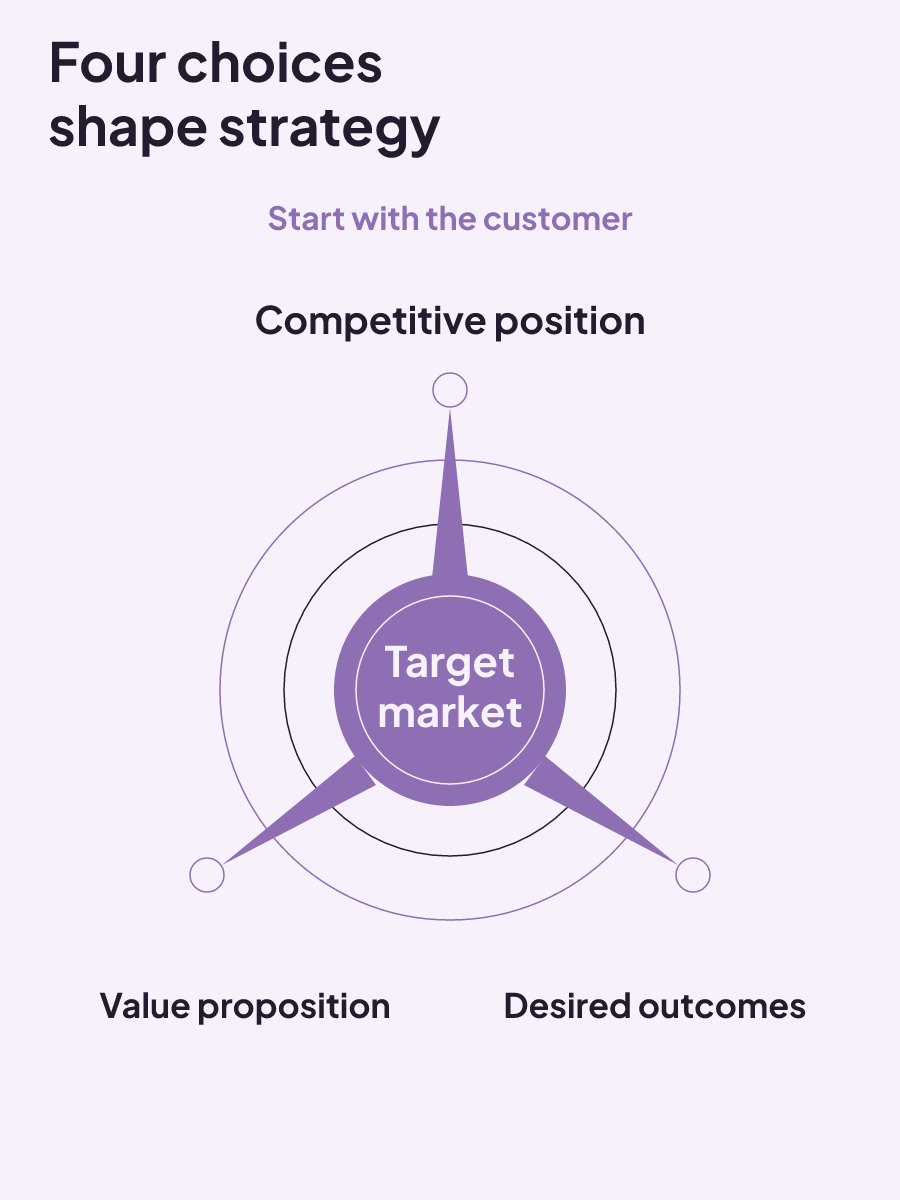
Four fields turn that thinking into a usable strategy bundle:
- Target market: the group the business intends to serve.
- Value proposition: the value offered to that target market.
- Competitive positioning: the place the business intends to hold in the market.
- Desired outcomes: the outcomes the strategy is meant to pursue.
These fields resolve different questions, but they work together. The target market identifies the customer. The value proposition defines the value for that customer. Competitive positioning distinguishes the business in the market. Desired outcomes give the strategy a business direction.
Write the four choices in plain language
You can test the strategy bundle with four direct prompts:
- Which target market are we choosing?
- What value are we offering that market?
- How will the business be positioned against other choices?
- Which outcomes does the strategy seek?
The answers can be short. They still need to name the market, value, position, and outcomes. A broad market can be divided into smaller groups that share traits such as demographics or behaviours. That split makes the target market more precise. The value proposition and position can then address the group named in the strategy.
If a clinic has several possible audiences or objectives, this is where prioritization belongs. The strategy should settle which audience, value, position, and outcome will guide the work before the calendar fills with campaigns. For patient-acquisition planning, our guide to patient acquisition strategies offers a useful place to examine that priority in more detail.
Competitive advantage gives strategy its edge
Competitive positioning needs a customer benefit that makes the business distinct. A competitive advantage combines marketing elements to set a business apart through a unique benefit for the customer. It is more specific than a broad wish to be preferred.
A strong competitive advantage has four practical qualities:
- It highlights a customer benefit.
- It reflects a strength the business possesses.
- It is clear, simple, and unique.
- It can adapt when conditions change.
That last quality matters during strategy work. A distinct position is not a sentence to preserve unchanged regardless of the market. It has to remain grounded in a customer benefit and business strength while adapting to new conditions.
This also sharpens the value proposition. Instead of listing every feature or activity, the strategy identifies the benefit that should stay clear across marketing work. The plan can then carry that position into channels and campaigns without turning each channel into a separate message.
Write the competitive advantage as a clear statement of customer benefit, business strength, and unique difference. Then revisit it as conditions change. This keeps the market position tied to the benefit customers receive and the strength the business can bring to it.
The marketing plan assigns the work
A marketing plan turns direction into a detailed set of realistic, measurable activities. Its job is operational. The plan covers tactics, actions, and controls, then assigns enough detail for people to carry the work forward.
The operating chain looks like this:
- Tactic: name the method used to pursue the strategic goal.
- Action: define the activity or task that must be completed.
- Control: identify how execution and performance will be managed.
- Milestone or launch date: mark when a meaningful stage or release is due.
- Deadline: set the date for the assigned work.
- Owner: assign responsibility for completing it.
- Budget: allocate the resources attached to the work.
A marketing action plan translates strategy into activities and tasks with milestones, deadlines, launch dates, responsibilities, and budgets. The result is not merely a longer strategy document. It is a working account of who owns each activity, when it should happen, and what resources support it.
Make the activity realistic and measurable
The plan should contain realistic, measurable activities. Give each activity a tactic, action, and control. Then add the milestone, deadline, launch date, owner, and budget that apply to the work.
Those details let the team see the full assignment. The action states the work. The milestone and deadline place it on the schedule. The owner carries responsibility. The budget records the resources assigned to it. The control provides a way to manage execution and performance.
A focused plan can also show which tasks make up a larger activity. That matters when one launch includes work from several people. Each task can receive its own responsibility and date while remaining part of the same marketing action plan.
This is the useful distinction in the marketing plan vs strategy question. Strategy establishes the choices that guide marketing. The plan makes those choices executable through specific work and controls.
How do you turn strategy into a working plan?
A marketing plan and marketing strategy template can record positioning, value proposition, supporting benefits, proof points, target audiences, and buyer personas before channel work begins.
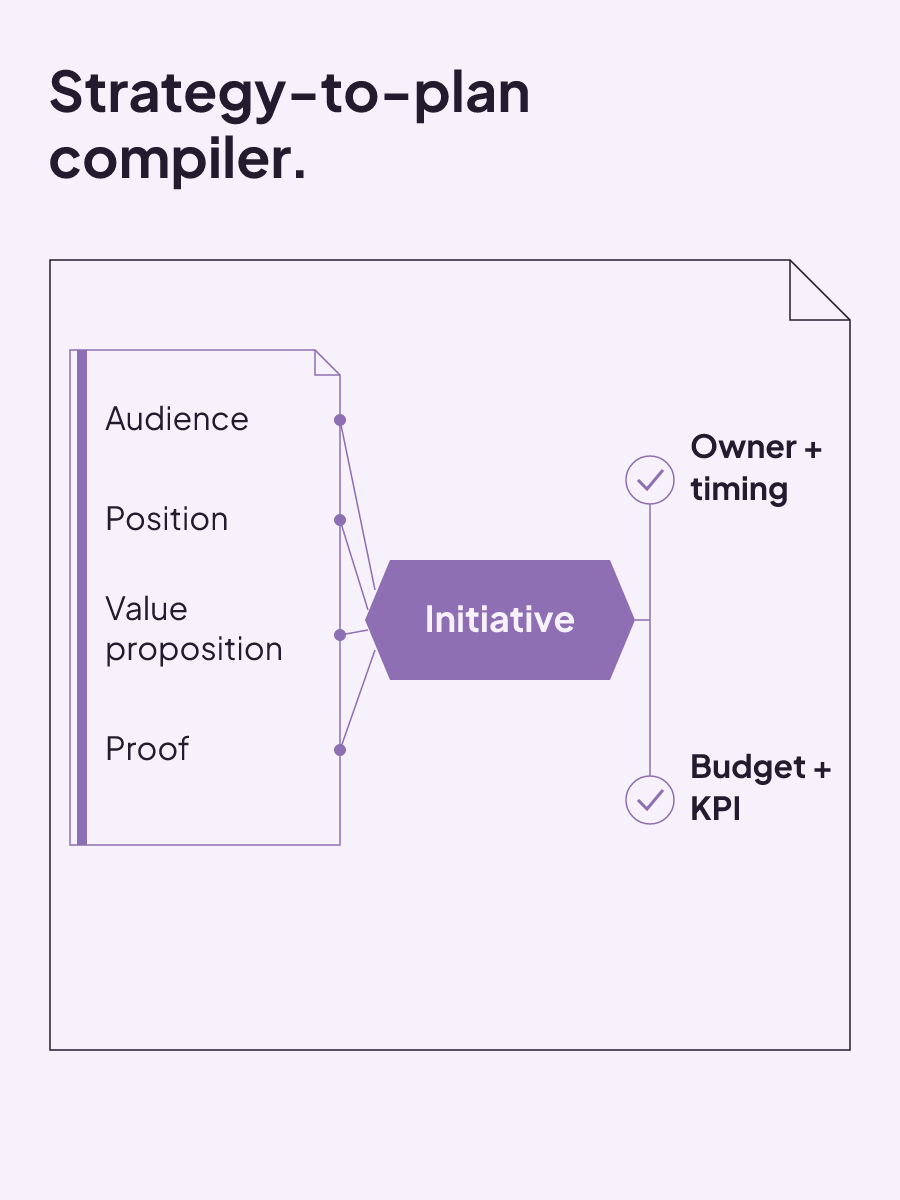
Strategy-to-Plan Compiler
| Strategic decision | Initiative or activity | Owner or timing | Budget or KPI |
|---|---|---|---|
| Target audience or buyer persona | Assign the initiative, campaign, channel, and activity for that audience | Name the action owner, deadline, and dependencies | Set the channel budget and performance metric |
| Brand positioning | Carry the position into the selected channel tactic | Assign responsibility and a phased implementation date | Set the channel budget and expected return on investment |
| Primary value proposition | Connect each channel tactic to the primary value proposition | Assign the activity owner and launch date | Select the performance metric for that tactic |
| Supporting benefit or proof point | Place the supporting benefit or proof point in the relevant campaign activity | Assign content responsibility, dependencies, and deadline | Allocate budget and define the key performance indicator |
Choose the right amount of detail
The template can be concise or detailed. A strategy may fit on one page. A strategy-and-plan section inside a business plan can be more comprehensive. In either form, structured planning breaks initiatives into assignable activities with owners, deadlines, and dependencies. Daily work can then connect to larger goals.
The plan can name the steps, initiatives, campaigns, timelines, budgets, and key performance indicators used to pursue the objectives set by the strategy. It can also include channel budgets, expected return on investment, performance metrics, a phased rollout, action owners, and deadlines. These are the fields that turn a chosen direction into scheduled and funded work.
The shorter format suits a concise statement of strategic direction. The fuller format has room for the campaigns, tasks, resources, dates, and measures needed for execution. Both begin with the same core choices about audience, position, value, benefits, and proof.
Measurement needs shared language as well as a field in the plan. Our marketing attribution glossary can help you keep that term clear while defining how work will be measured.
What does the difference look like in practice?
A product launch provides a practical marketing strategy vs marketing plan example. The strategy records the target audience, positioning, value proposition, supporting benefits, and proof points. The plan then specifies the steps, campaigns, timeline, budget, and measures used to pursue the objectives set by that strategy.
At the execution level, the launch plan can schedule social-media teasers, influencer partnerships, and an event. It can also assign content creation, ad placement, and event coordination. The schedule states when each activity happens. The assignments state who handles the work.
This marketing plan and marketing strategy example becomes useful when the fields sit beside each other. A target audience connects to the campaign intended for that audience. Positioning and the value proposition connect to the message carried through each channel tactic. Activities receive owners and dates, while the plan records the budget and measure attached to the work.
The marketing plan vs marketing strategy decision turns on what is unresolved. If the audience, position, value proposition, or desired outcome is still undecided, the strategy needs attention. If those choices are set but the launch lacks scheduled activities, owners, deadlines, and budgets, the plan needs attention. The example is concrete because each strategic choice has an execution counterpart, not because the document contains a long list of channels.
Plans change with resources and conditions
A working plan has to fit the resources available. A phased marketing plan should reflect the skills, time, and staff the business can use. It also changes through repeated implementation. That makes planning an operating process, not a one-time exercise in filling fields.
Budget, projected return on investment, and goals shape the duration of an implementation plan. Each campaign also needs a realistic start and end date. These constraints affect what can be assigned now, what needs a later phase, and how long the work can reasonably run.
Resource planning becomes more useful when it is concrete:
- Match each planned activity to the skills required to complete it.
- Assign staff and time to the activities in the active phase.
- Attach a budget and projected return on investment to the implementation decision.
- Give each campaign a realistic start and end date.
- Update the phased plan through repeated implementation.
Phase the work against real capacity
A phase should match the staff, time, and skills available for it. This allows the plan to place some activities in the active phase and hold others for a later phase. The plan can change as the team implements the work again.
Campaign dates also need to fit the implementation plan. Its duration depends on budget, projected return on investment, and goals. Giving each campaign a realistic start and end date makes that time frame visible beside the resources and goals that shape it.
A marketing planning process can support accountability and collaboration, as well as resource allocation and performance management. Owners make responsibility visible. Dates allow teams to coordinate. Budgets allocate resources. Performance measures give the work a defined management field.
The tradeoff is capacity. A plan may contain several worthwhile activities, but the active phase still needs to reflect available skills, staff, time, and budget. A realistic phase is more useful than a crowded calendar that assigns work beyond the resources recorded in the plan.
Conditions can change too. The strategy's competitive advantage may adapt to new conditions, while the plan changes through implementation. The first change concerns customer benefit and market distinction. The second concerns the activities, resources, timing, and controls used to carry the strategy out.
Which one do you need right now?
You need strategy work when the direction is unresolved. If the target market, value proposition, competitive position, desired outcomes, or priorities are still competing, settle those choices before assigning more marketing activity. Companies may need to prioritize and balance several objectives, and those objectives are often tied to the overall company strategy.
You need plan work when the high-level goals are defined but the activities are not. The purpose of a marketing plan is to translate those goals into clear, focused marketing activities. At that point, the questions move to initiatives, channels, owners, dependencies, deadlines, budgets, and measures.
Use this two-condition test on your current work:
- Direction is not settled: return to the strategy. Define the customer, value proposition, position, outcomes, and priorities.
- Direction is settled, but execution is vague: build the plan. Assign activities, responsibilities, dates, resources, controls, and measures.
Starting advertising before developing a strategy and plan creates a risk of spending time and money without achieving the intended result. That does not mean a strategy should become a long theoretical document. It means advertising activity should have a defined strategic reason and a practical plan.
Use the Strategy-to-Plan Compiler on the marketing work already under consideration. Put the target audience, position, value proposition, benefit, and proof beside the related initiatives. Then assign owners, timing, dependencies, budgets, and measures. To develop the patient-acquisition side of the strategy, explore our patient acquisition strategies for clinics.

Med spa profit margins: how to calculate what your clinic actually keeps
Med spa profit margins depend on treatment contribution, provider capacity, fixed costs, acquisition, no-shows, and repeat booking.
Read insight
How to start a med spa: a three-checkpoint launch guide
Starting a med spa begins with three checks: ownership structure, startup cash, and a patient journey tested before you commit to software.
Read insight
ROI tracking: calculate the return and label what the number proves
ROI tracking is credible when every cost is counted and each result is labeled as observed, attributed, or experimentally incremental.
Read insight