
Key takeaways
- Digital lead generation attracts the right audience and turns that audience into qualified leads, not merely more traffic.
- A sign-up page gathers contact details, which marks capture rather than qualification.
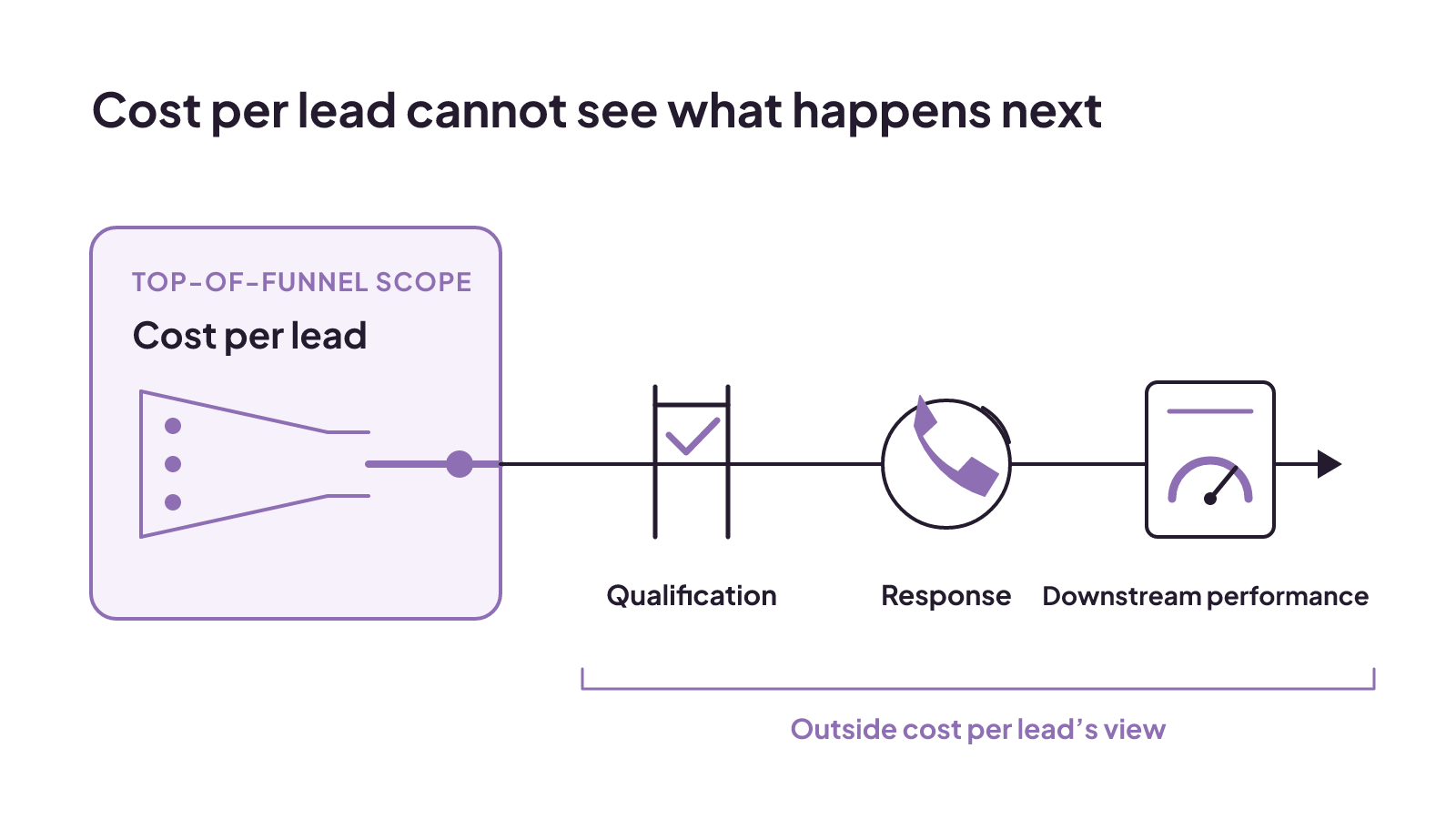
- Cost per lead covers the top of the funnel but ignores downstream performance.
Digital marketing for lead generation connects those parts of the patient journey. If reports show clicks, calls, and forms in isolation, the five checkpoints below help you find where useful demand is being lost.
How does digital marketing for lead generation work?
Digital lead generation attracts the right audience and converts that audience into qualified leads. More traffic alone does not meet that goal. A direct-response campaign asks for a defined action, while a sign-up page gathers contact details.
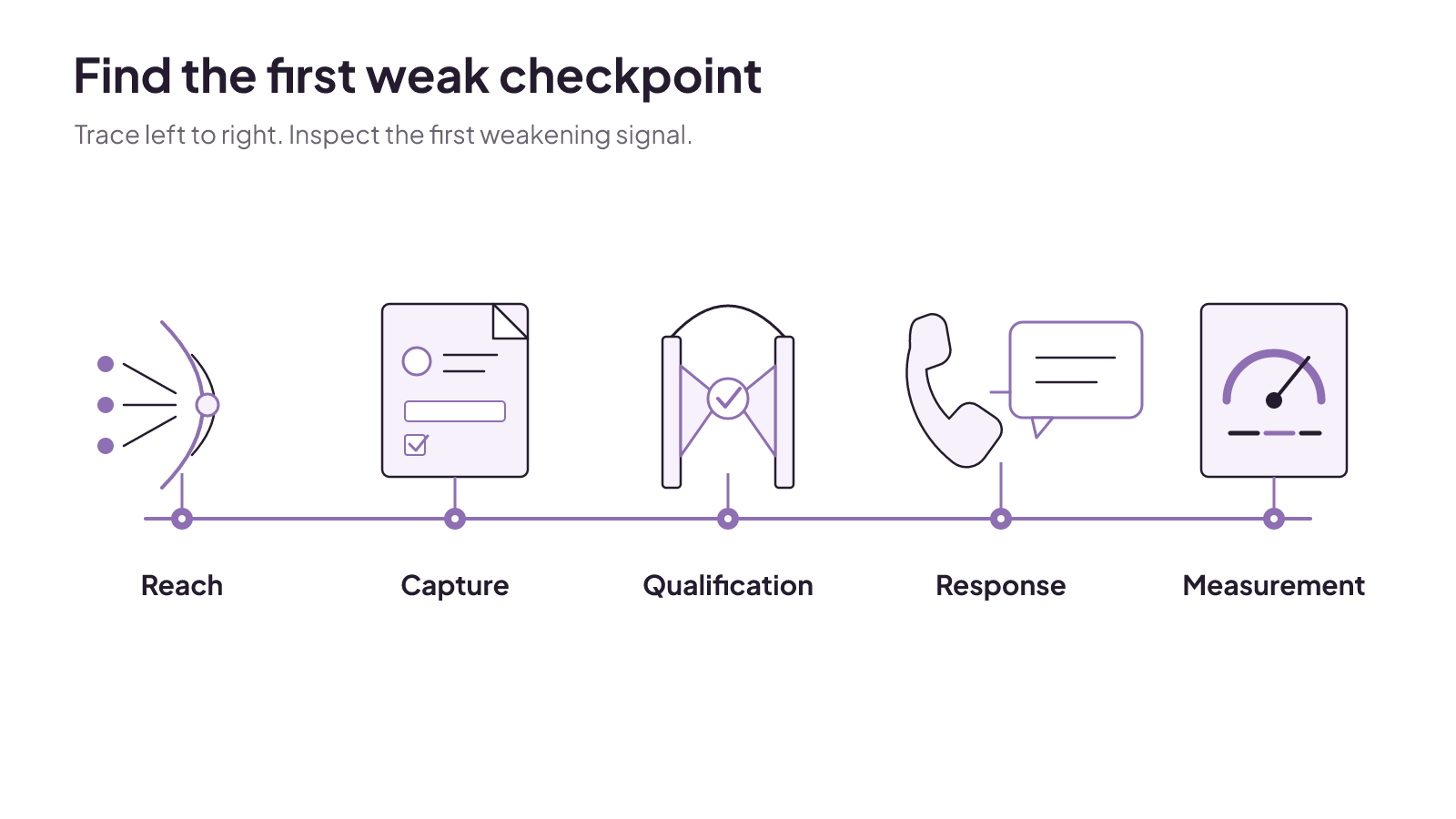
Use this Lead-Path Diagnostic to identify the first weak point:
| Checkpoint | Observable signal | Question or metric | What it reveals |
|---|---|---|---|
| Reach | The intended audience responds | Is the activity coming from people who fit the lead-generation goal? | Whether the campaign is attracting the right audience, not simply more traffic |
| Capture | A specific action produces contact details | Calls or completed sign-up forms | Whether interested people become identifiable contacts |
| Qualification | Fit, intent, authority, timing, pain, budget, and buying signals | How many contacts meet the qualification criteria? | Whether captured contacts show readiness, value, and need |
| Response and follow-up | The experience across calls, forms, email, and scheduling answers | Missed calls, delayed answers, and follow-up activity | Where the administrative experience may weaken patient trust |
| Measurement | Calls are connected with their source and assessed after capture | Call volume, response time, quality, and downstream performance | Whether channel activity creates value beyond a low cost per lead |
Start with the first checkpoint whose signal does not match the desired result. Qualification criteria separate serious prospects from weak leads, while cost per lead only describes the top of the funnel. The diagnostic keeps a cheap captured contact from being mistaken for a commercially valuable patient.
What is an example of lead generation?
Consider a clinic using social media to reach prospective patients. Social media is the channel. A direct-response message asks for a specific action, and a sign-up page gathers contact details. The resulting name and contact information show that capture happened. They do not show that the person has been qualified or that follow-up worked.
Email can play a similar channel role. Medical-practice marketing can also use search engine optimization, physician referrals, and community events. The right mix depends on the patient demographics the practice wants to reach, and medical practices need compliant tracking for the channels they select.
Content has a different job within that mix. Content marketing creates and distributes useful, relevant, and consistent material for a clearly defined audience. Content consumption is not the same event as a captured contact.
This distinction makes budgeting more useful. Start with the role a channel needs to play: audience reach, direct response, or contact capture. Then keep qualification and follow-up visible as separate operating jobs. A clinic can have active social, email, search, referral, community, and content programs while still losing prospective patients after they respond.
For a clinic-specific view of channel priorities, see what Canadian med spas should fund first for lead generation. The useful question is not how many channels are active. It is whether each chosen channel reaches the intended patient population and creates a trackable route to a specific action.
How to do lead generation in digital marketing
Begin with the audience you need to attract and choose channels that match its demographics. Email and social media can both generate digital leads. Medical practices can also use search engine optimization, physician referrals, and community events. Content can attract and retain a clearly defined audience through useful, relevant, and consistent material.
Give the campaign a specific action. Direct-response campaigns can ask someone to purchase a product or sign up for a newsletter. A sign-up page performs the capture role by gathering contact details. The resulting contact then enters qualification, where fit, intent, authority, timing, pain, budget, and buying signals can be assessed before sales outreach deepens.
Keep the tracking suitable for the medical-practice setting. Channel activity shows where attention came from, while qualification indicates whether the contacts are serious prospects. Response, follow-up, and downstream measurement remain visible after capture because a contact total does not show how the later stages performed.
What does lead generation mean in sales?
In sales, a captured contact becomes more useful after qualification. The contact record tells you that someone responded. Qualification assesses whether that prospect is serious and helps match follow-up to readiness, account value, and need.
Sales organizations use qualification criteria to separate stronger prospects from weaker leads. The assessment can shape how follow-up reflects the person's readiness and likely value. This is the practical line between lead capture and sales qualification: one records interest, while the other evaluates what that interest may mean for the organization.
A defined Marketing Qualified Lead process moves attention from the volume of names collected to the quality of those names. For a clinic operator, that changes the internal conversation. Form totals and call counts remain useful activity measures, but they do not answer whether the inquiries met the qualification standard.
The standard must be embedded in the process to support consistent decisions. Without that shared qualification step, a marketing report can celebrate volume while the people handling inquiries see weak fit or low readiness. With a defined process, marketing lead generation and sales follow-up can use the same distinction between a captured contact and a qualified lead.
Qualification also guides the follow-up response. Sales organizations can match follow-up with readiness, account value, and need. A stronger lead may show meaningful need and buying signals, while a weak lead may not meet the same criteria. The point is not to assign every captured name equal commercial weight. It is to apply a defined quality process before deeper outreach.
This shared definition helps marketing and sales discuss the same result. Marketing can report captured contacts without presenting every contact as qualified. Sales can assess seriousness through the agreed criteria. The Marketing Qualified Lead process provides the bridge by shifting the focus from how many contacts arrived to the quality of those contacts.
Why is lead generation so hard?
Lead generation is hard because the patient keeps judging the practice after the campaign has done its job. A missed call can feel like indifference. A confusing message can feel risky. A delayed answer can make someone wonder whether the practice will remain hard to reach after a visit.
Those moments are not just service details. They sit inside the path from initial interest to a scheduled appointment. Clear steps, consistent timing, and calm administrative support can earn trust before an appointment begins. A campaign can therefore reach the intended audience and capture contact information while the administrative experience still weakens the opportunity.
Medical-practice marketing also has a wider job than acquiring new patients. It can support patient retention and reputation, and it operates under privacy and state advertising constraints. Those boundaries make channel selection and tracking operational choices, not just media choices. The clinic needs a suitable audience and a way to understand performance without treating raw activity as the result.
The scope of medical-practice marketing adds to the difficulty. Strategies may serve three goals: attracting new patients, retaining existing patients, and building reputation. Search engine optimization, social media, physician referrals, and community events give practices several possible routes to those goals. Each selected channel still needs to fit the intended patient demographics and use compliant tracking.
Price signals can mislead here. Broader targeting can produce cheaper leads by reducing lead quality. So can weaker gated content and lower information requirements. Each approach makes it easier for more people to enter the funnel, but the lower cost does not establish that those contacts are stronger prospects.
This is why cost per lead cannot diagnose the whole problem. A lower figure can sit beside poor fit, low readiness, a missed call, an unclear message, or delayed follow-up. The useful diagnosis finds the first checkpoint where performance weakens. If reach and capture look active but qualified inquiries remain weak, audience fit or qualification deserves attention. If qualified inquiries arrive but the patient experience breaks down, the operating issue sits in response and follow-up.
That administrative checkpoint is easy to overlook because campaign dashboards often stop at the conversion event. Patients do not. They continue through calls, messages, forms, email, and scheduling responses, forming judgments throughout that experience.
Clear administrative support does more than move a record through a queue. Clear steps, consistent timing, and a calm response can build trust before the appointment starts. A missed call, confusing message, or delayed answer can have the opposite effect on the patient's judgment. That makes service friction a genuine lead-path problem even when reach and capture appear active.
Lead-generation tools should expose the weak checkpoint
Choose a tool for the checkpoint that needs visibility or less administrative work. A tool can capture useful signals or streamline a workflow, but diagnosis and repair are still different jobs.
- Follow-up automation: When staff time limits patient follow-up, automated technology and clear delegation can streamline follow-up protocols. The value here is operational: the workflow makes responsibilities clearer and reduces the amount of manual coordination.
- Integrated health-record workflows: Workflows connected with clinic health records can reduce the administrative burden involved in patient follow-up. This role belongs to follow-up operations, not audience reach or lead capture.
- Telehealth platforms: Telehealth platforms can reduce administrative burden in patient follow-up. They are another workflow option, not a measure of lead quality on their own.
- Call tracking: Trackable phone numbers can capture calls. Call-tracking tools can record and transcribe conversations, log who called and why, and associate the call with a source, customer, or agent. That creates a clearer record of what happened after a campaign generated a phone response.
The diagnostic value of call tracking comes from the service details it can expose. Recording and scoring calls can reveal long hold times, missed calls, and inconsistent answers. Reports can then show call volume, response times, and quality. Those measures help separate a reach problem from a response problem. If calls are arriving but going unanswered, buying more traffic does not address the breakdown visible in the call data.
A trackable phone number can connect a call with its source. The call record can also identify who called, why they called, and which customer or agent was involved. Recording and transcription add detail to that record. Together, those functions make phone inquiries easier to examine than a total call count alone.
The service review has a narrower purpose. Long holds, missed calls, and inconsistent answers are signs of a response breakdown. Call volume measures activity, while response time and quality describe what happened when the clinic received that activity. The tool can expose both kinds of signal without treating them as the same result.
There is an important limit: call tracking supplies diagnostic data, but tracking itself does not fix service. A transcript can show an inconsistent answer without making the answer consistent. A dashboard can display missed calls without returning them. The tool exposes the weak checkpoint; the clinic still has to repair the process that produced the signal.
That same boundary applies to workflow tools. Automation and clear delegation can streamline follow-up when time is tight. Integrated record workflows and telehealth platforms can reduce administrative burden. None of those roles turns the tool into proof of lead quality. Lead quality still comes from qualification, and commercial value still needs downstream measurement.
Measure value after the lead arrives
Once inquiries arrive, measure acquisition cost by channel and patient lifetime value. Medical-practice marketing should calculate what acquisition costs for each channel, then direct spending toward patients with higher lifetime value. That view is more commercially useful than treating the cheapest captured name as the best result.
Channel-level acquisition cost tells you where spending produced patients. Patient lifetime value changes the spending decision by adding the value of those patients over time. These measures move the analysis beyond traffic, forms, calls, and top-of-funnel cost per lead.
A channel with a low cost per captured lead may still look different after qualification and patient value are considered. Cost per lead stops at the top of the funnel. Acquisition cost by channel and patient lifetime value extend the view to commercially useful outcomes. Medical-practice marketing should use those downstream measures when shifting spending.
This is where marketing attribution becomes an operating question. The clinic needs to connect the channel with what happened after the lead arrived. Call-source data can support that connection for phone inquiries, while qualification and downstream patient value supply different parts of the commercial picture.
Reporting work can become a bottleneck of its own. Automating medical-practice marketing reports can leave the team more time for analysis instead of data wrangling. The purpose is not to produce more dashboards. It is to preserve time for decisions about channel acquisition cost and the patients whose lifetime value supports continued spending.
Automated reporting does not replace the decision. It reduces the time spent wrangling data so the team can analyze it. That analysis can compare acquisition cost by channel and direct spending toward patients with higher lifetime value. The report supports the work; the value comes from how the clinic uses those measures.
If your reports currently end at traffic, calls, or forms, trace the full patient-acquisition path from discovery and evaluation through inquiries, conversion, and onboarding. Use the first weak checkpoint to decide what deserves attention before you add more activity.
Dental local SEO: how to judge scope, cost, and value
Local SEO commonly costs $500 to $5,000+ monthly in 2026; dental practices should compare scope, ownership, and measurement before price.
Read insight
Conversion rate optimization tools: choose by the leak, not the list
The right CRO stack starts with the unanswered funnel question, then adds measurement, behavior research, testing, or appointment tracking as needed.
Read insight
How to choose a local SEO company that can show its work
A local SEO company is worth hiring when it names the work, measures business actions, prices the scope clearly, and avoids ranking guarantees.
Read insight