

Key takeaways
- Hire for named work and outputs you can inspect, not ranking promises.
- Track calls, forms, booking clicks, chats, quote requests, and direction requests.
- Compare prices against scope. SEO still gives AI tools searchable, structured, credible information.
Choosing a local SEO company gets easier once you stop comparing long service lists and start comparing commitments. You need to know what the provider will change, what it will deliver, how it will measure business activity, what the price includes, and where its promises end.
For a med spa or aesthetic clinic, that standard matters because local visibility is tied to real operating surfaces. Your website, business profile, reviews, treatment pages, forms, and booking links are not vague marketing concepts. They are things a provider can inspect, update, and report on.
Treat the proposal as a work order. The useful detail is in its actions, outputs, milestones, measures, fees, and limits. With those items visible, you can compare providers on the same terms.
What does a local SEO company do?
A local SEO company works to establish a business's relevance and authority within a defined geographic area. The work can include reviewing site content and structure, giving technical advice, researching keywords, and contributing market expertise. Google's own guidance describes these as common ways an SEO can help a business.
That scope is broader than adding a city name to a page. A provider may assess whether the site's content matches the services and locations the business wants to represent. It may review how the site is organized, identify technical changes, research the language customers use, and apply knowledge of the local market.
Local SEO services for small business can cover several of those activities, but the label alone does not tell you which ones are included. A local SEO agency, consultant, and in-house SEO expert may offer different combinations. The proposal has to name the actual work. If it only says "local SEO optimization services," you still do not know whether you are buying an audit, implementation, ongoing management, or advice.
That distinction helps when two providers use different language. Put the labels aside and map each proposal back to the same set of possible activities: content review, structure review, technical advice, keyword research, and local market expertise. A proposal does not need to include every activity. It does need to make the included work clear enough for you to recognize the deliverable later.
Profiles and reviews are operational work
Consider a clinic's Google Business Profile. Google provides tools to manage business information and profile attributes, along with the profile lifecycle itself. Those are concrete operations, not a general promise to "improve your presence." The Business Information API supports profile creation and deletion, business-information management, and attribute updates.
A Google Business Profile can help a business appear on Google Search and Maps and stay connected with customers. A proposal that includes profile management should therefore say what information or attributes the provider will manage. It should not leave the whole commitment inside a broad phrase such as "profile optimization."
Reviews also create ongoing work. Google's review tools can list reviews across locations, retrieve an individual review, post a reply, and delete a review reply. That makes review retrieval and response management inspectable parts of a service.
If you operate more than one location, the provider can describe how review activity will be handled across those locations. That is much clearer than a line item called reputation support. You can compare the named operation with the work that was actually completed.
The same test works for ongoing management. Profile creation or deletion is different from updating business information or attributes. Retrieving reviews is different from replying to them. When those operations appear as named commitments, you can tell what was assigned for each location and what should be visible in the provider's work record.
Score the proposal before you score the agency
The best comparison starts with the proposal. A confident sales call cannot replace a clear account of services, methods, milestones, fees, benchmarks, and reporting. Use the scorecard below to compare local SEO companies on the commitments they are willing to put in writing.
| Buyer question | Provider commitment | Output to inspect | Boundary or warning sign |
|---|---|---|---|
| Will you support your claims? | Complete an interview, provide references, and supply a site audit. | Reference details and the audit. | No references or audit before a major commitment. |
| What should be fixed first? | Prioritize the audit findings and explain why each fix matters. | A ranked list tied to local visibility or conversions. | An unranked issue dump with no reason for the order. |
| What services are included? | Name the included audits, keyword research, content creation, citation building, and profile management. | A defined list of deliverables. | A broad local SEO service label with no included work. |
| How will the work be done? | Name the methods and tools, then explain why they are effective. | A documented method and tool set. | Tactics that remain hidden from the buyer. |
| When will work ship? | State realistic timelines and deliverable milestones. | Dated milestones for the promised work. | A ranking date in place of delivery milestones. |
| What am I paying for? | Separate one-time fees from monthly costs and state contract terms. | Fee schedule, rights, payment, termination, governing-law, and non-disclosure terms. | Blended fees or missing commercial terms. |
| How will progress be measured? | Define performance benchmarks and the measurement plan. | Reports tied to the agreed benchmarks. | Rankings presented without the agreed measures. |
| Can I inspect proposed changes? | Let the buyer verify changes and avoid number-one guarantees, shadow domains, and link schemes. | A change record and work the buyer can review. | Top-ranking promises or undisclosed changes. |
Read the agreement with the same care. An SEO agreement should cover reporting, rights, terms and conditions, payment structure, deliverables, termination, governing law, and non-disclosure terms. A structured SEO agreement can help you see whether those areas have been addressed. The specific terms remain part of the agreement you are considering.
The commercial details also affect accountability. If the provider owns or controls something involved in the work, the agreement's rights terms should make that clear. If the relationship ends, the termination terms should already exist. You do not need to assume that every provider uses the same terms. You need the terms of the proposal in front of you.
How much do local SEO services cost?
Local SEO pricing varies by provider type and scope. These category figures give you a practical starting point for comparing a package, consultant, project, or retainer:
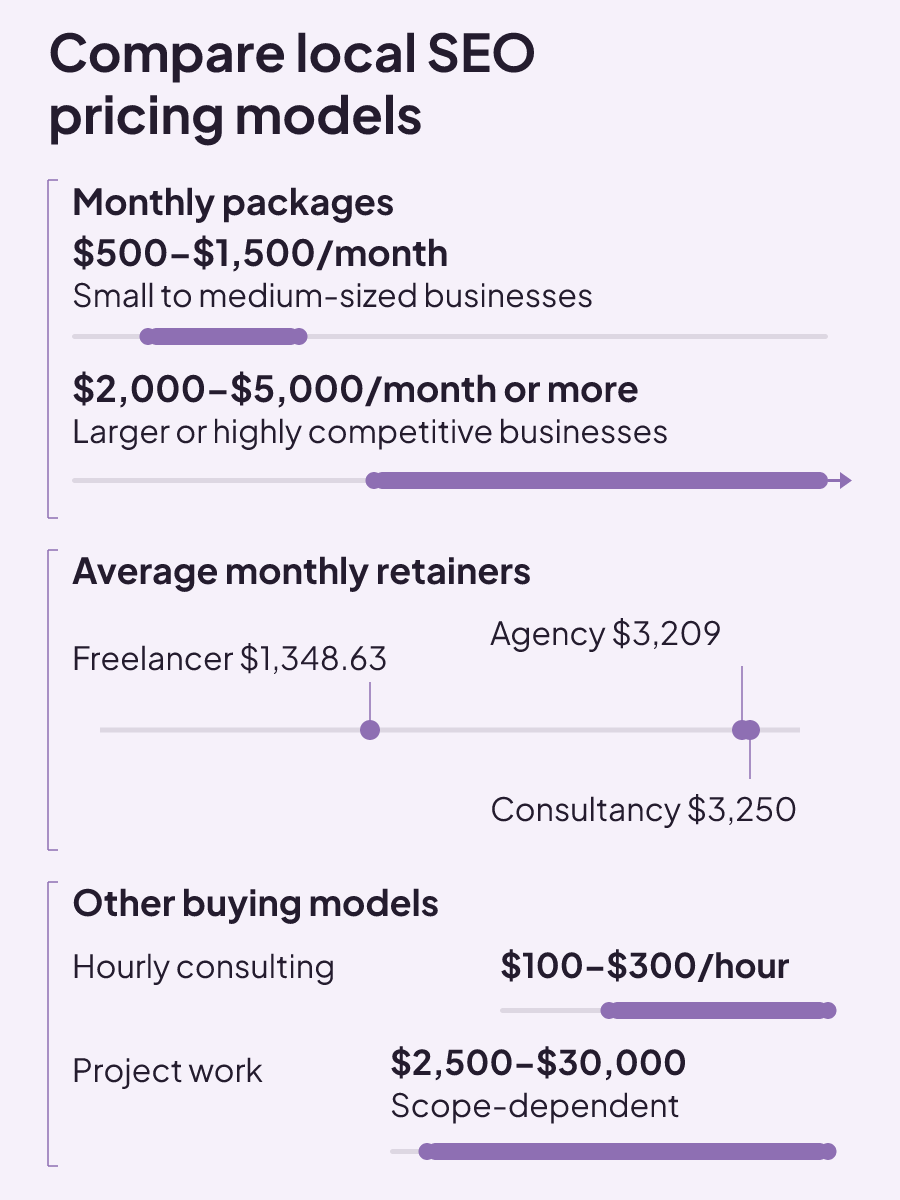
- Local SEO packages for small to medium-sized businesses typically cost $500 to $1,500 per month.
- Larger businesses or those in highly competitive markets may spend $2,000 to $5,000 per month or more.
- Average monthly retainers are $3,209 for agencies, $1,348.63 for freelancers, and $3,250 for consultancies.
- Hourly SEO consulting typically ranges from $100 to $300 per hour.
- Project-based SEO work typically ranges from $2,500 to $30,000, depending on scope.
Those figures describe provider categories, not a universal rate card. The useful comparison is between a quoted fee and the work attached to it.
Price can change with the number of locations, competitiveness of the market, condition of the site, citation cleanup, content scope, technical work, review support, and reporting requirements. Some providers also charge a setup fee for the initial audit and profile optimization before moving to a monthly retainer.
That means two proposals at different prices may also contain different work. One may cover a single location and a limited set of profile updates. Another may include broader content, technical, review, and reporting requirements. Compare the named scope and expected deliverables before comparing the total.
If you are asking, "How much is an SEO consultant?" the supported hourly range is $100 to $300. But an hourly rate still needs a defined assignment. Ask what work will be completed, which output you will receive, and whether any separate project or ongoing monthly cost applies. The same principle holds for a local SEO marketing service sold as a package: the fee becomes meaningful only when the proposal separates setup, ongoing cost, and deliverables.
Compare quotes on the same scope
Keep one-time and monthly costs in separate lines. If a setup fee covers an initial audit and profile optimization, the proposal can name those outputs. The monthly line can then stand on its own. This makes it easier to see whether an ongoing fee pays for defined work or merely continues an account.
Project pricing needs the same treatment. The $2,500 to $30,000 range is wide because scope varies. A project quote becomes easier to judge when its services, methods, timeline, milestones, and final outputs are written down. For hourly consulting, pair the $100 to $300 rate with the assignment and the expected output. You can then compare cost without pretending every provider model buys the same thing.
Is local SEO worth paying for?
Local SEO can be worth paying for when the work produces greater local visibility, qualified leads, and sales conversions. The way to judge that value is to measure whether visibility is creating business opportunities, not just whether a ranking chart moved.
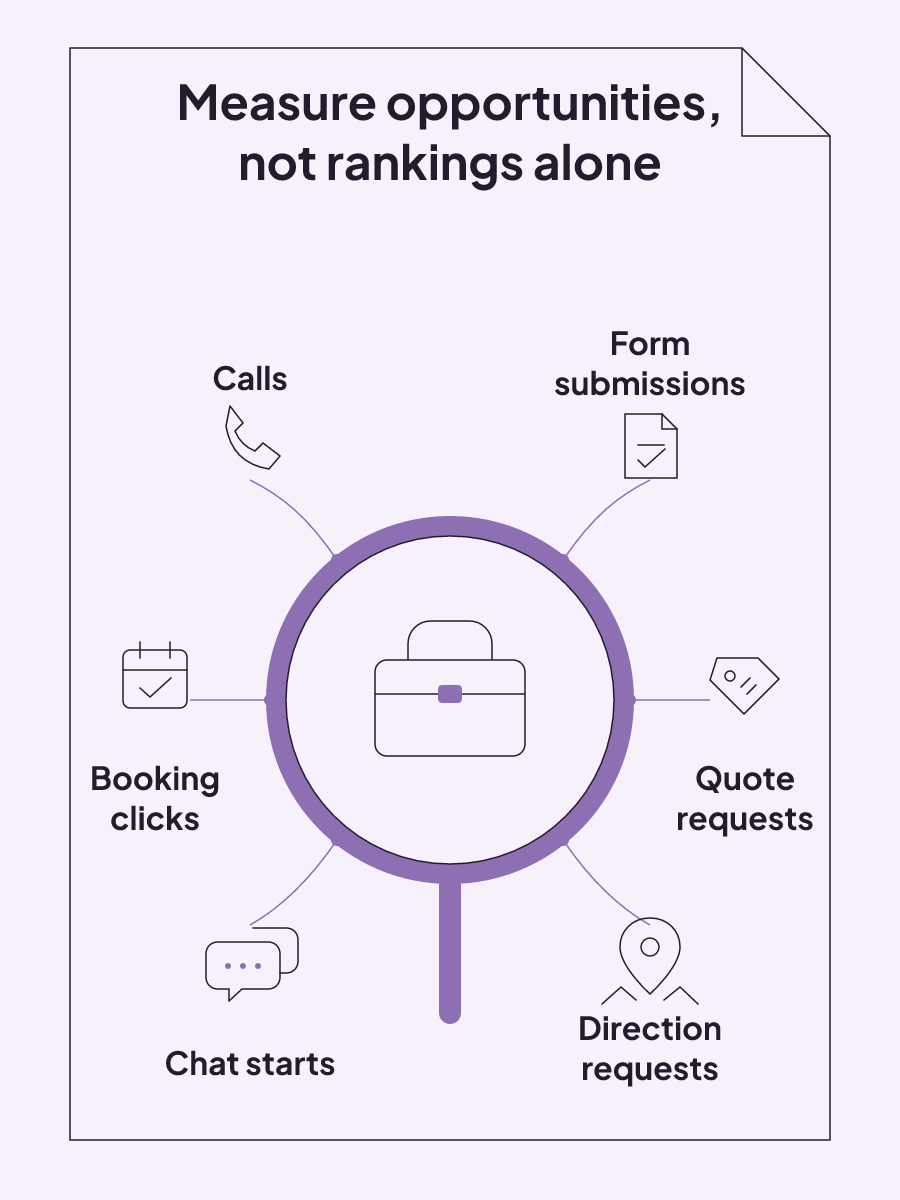
Useful local SEO reporting can track:
- calls;
- form submissions;
- booking clicks;
- quote requests;
- chat starts; and
- direction requests.
These actions give you a business-level view of the local SEO service. A visibility gain and a booking click are different measures, so the report should show the actions it has agreed to track. You can then compare those measures with the benchmarks in the proposal and the work delivered during the same reporting process.
A good measurement plan also keeps the provider's work visible. The report can show business actions, while the delivery record shows what was completed. Together, those records let you evaluate the work against the benchmarks that were agreed before the engagement began.
This is especially useful when a local SEO marketing service includes several activities. Calls or booking clicks do not tell you which individual task created them. They do show whether local visibility is generating business opportunities. That is the decision the measurement bundle is built to support.
The Ownerized take is simple: do not let a dashboard turn activity into fog. A report should help you see whether local search is creating opportunities and what the provider shipped. If the report only contains rankings, it leaves out the calls, forms, booking clicks, quote requests, chat starts, and direction requests that connect visibility to business activity.
Is SEO dead now that AI answers questions?
No. SEO remains a foundation for AI visibility because AI tools rely on searchable, structured, credible information. That does not make SEO and AI visibility identical, but it does mean the website and local-search work still matter.
For clinics, we work on websites, profiles, reviews, content, and local signals to help AI tools understand and evaluate the business. You can explore how that approach extends into AI visibility services and our explanation of answer engine optimization.
This changes a useful buying question. Instead of asking whether a local SEO agency has replaced SEO with an AI-branded service, ask what searchable, structured, credible information it will improve. Then look for named work across the site, profiles, reviews, content, and local signals.
The answer should remain concrete. Website work, profile work, review work, content work, and local-signal work are areas a provider can name. An AI label without those commitments leaves you with the same problem as a vague SEO label: you cannot tell what will change or what output you will inspect.
Our scope connects discovery to the booking path
For med spas and aesthetic clinics, we treat local and AI visibility as connected parts of the path to an inquiry. We track where a clinic is named, missed, or surpassed across AI assistants, Google, and local maps. Then we work on the pages, structure, and signals associated with those mentions.
Our med spa marketing service includes work to make clinic profiles, reviews, photos, prices, and treatment pages accurate and consistent. That creates a defined set of surfaces you can inspect. It also makes the scope more specific than a promise to improve local visibility.
Discovery is only one part of the path we manage. Our scope connects direct messages, forms, booking links, and follow-up workflows into a booking path. We provide a monthly report in plain numbers alongside the work shipped. The point is not to bury you in marketing language. It is to show the numbers and the work together.
You can also review our approach to med spa SEO. The practical distinction is that our med spa marketing scope reaches across the surfaces patients use to discover, compare, contact, and book a clinic. The proposal checks from this article still apply to us: named work, inspectable outputs, clear reporting, and honest limits.
Start with a free med spa marketing audit
If you are comparing local SEO marketing services for a med spa or aesthetic clinic, start with our free med spa marketing audit. It is the direct way to examine the clinic surfaces and booking path covered by our service before deciding on paid work.
We will not promise a fixed number of consultations. We also warn against consultation forecasts made before a provider has reviewed the buyer's data. Those promises may sound decisive, but they are not a substitute for inspecting the clinic's current position and defining the work.
Paid-ad execution is outside our med spa marketing service. Our scope centers on local and AI visibility, accurate clinic information, reviews and treatment pages, inquiry paths, follow-up workflows, consultation tracking, and monthly reporting. That boundary gives you a clearer basis for deciding whether the service matches the work you need.
Request your free audit, and we will examine the surfaces included in our service and the path from discovery to booking.

Local SEO price guide for med spas: what should your package include?
Local SEO prices usually run $500 to $2,500+ monthly, but a fair quote depends on the work, reporting, and internal execution it requires.
Read insight
Local SEO listing guide: what to fix, maintain, and pay for
Local SEO listing management starts with accurate records, duplicate cleanup, documented corrections, quarterly audits, and full per-location costs.
Read insight
Local SEO checklist for med spas: a practical roadmap for 2026
This local SEO checklist turns profile, page, citation, review, technical, and measurement work into checkpoints with owners and pass conditions.
Read insight