

Key takeaways
- Claim and verify your primary search profile.
- Inventory every listing, correct duplicates, and document each change.
- Audit listings quarterly and when your name, address, or phone number changes.
- Compare support by scale, main problem, and full per-location cost.
What is a local SEO listing?
A local SEO listing is an online record of a business location. Its core details are often called NAP: name, address, and phone number. For a med spa or aesthetic clinic, that record gives a potential patient the basic facts they need to identify and contact the location.
The record doesn't live in only one place. Search engines compare business information across search profiles, review sites, social networks, map services, and industry directories. Customers looking for a nearby business can also find local results in maps and search. Our guide to the Local Pack explains the search feature itself.
Local listing management is the work of keeping those copies of your clinic's information accurate, consistent, and current. That means the useful question isn't how many directory profiles exist. It is whether each profile presents the right clinic, at the right location, with contact details that still work.
Think of the platforms as separate holders of the same basic record. Search profiles, review sites, social networks, map services, and industry directories can each carry business information that a search engine compares. A correction made in one place does not describe the state of the other records. Your inventory needs to show where the clinic appears before it can show whether those appearances match.
This record-based view gives you a practical boundary for the work. The listing is not finished just because somebody submitted it. It remains a public copy of your clinic's business information, so it needs an owner, a correction history, and a maintenance schedule.
Is local SEO listing work worth it?
Local SEO listing work is worth doing when it protects accurate discovery and supports local visibility. A claimed business profile can improve a business's local ranking. Matching information across listings also increases a search engine's confidence that the business is legitimate, active, and suitable for local results.
The patient-side risk is simpler. A potential customer who finds a wrong phone number, an old address, or a location that appears closed may call a competitor instead of hunting for corrected information. The listing has failed at the exact moment that person is trying to reach the clinic.
That doesn't mean every directory deserves the same effort. It means accuracy and consistency are better tests than raw directory count. Start with the records people can encounter when they look for the clinic, then judge each record by whether its core business facts are current and whether your team can keep them that way.
The answer also depends on what you're buying. Correcting records is different from paying for a broader local SEO program. A program may cover work beyond listings, while a directory profile creates an ongoing record to manage. Separate those scopes before you decide whether the cost is justified.
Start with a claimed and current search profile
Claiming and verifying your primary search profile is the first practical priority. A business must add or claim the business and verify the profile before it can appear across that provider's search, map, and other services.
Once the profile is verified, it can be edited to keep four visible areas current:
- address
- hours
- contact information
- photos
These are ordinary details, but they can become stale whenever the public record changes.
Claiming, verification, and maintenance are three concrete states to track. A business must first add or claim the profile and verify it. After that, the editable address, hours, contact information, and photos still need to reflect the current location. A profile that was verified earlier can still carry outdated details later.
Free local business directories can increase online visibility, but free submission doesn't remove the maintenance duty. Every additional profile is another copy of the clinic's information. Only add one when you can include it in your inventory and keep it current.
Use a listing-integrity and resourcing worksheet
Begin with a complete inventory by searching the company name, phone number, and address in quotation marks. Then check consistency, find duplicate profiles and closed-location records, spot-check tool results, document corrections, and set the next audit date. The worksheet pairs those six integrity checks with four resourcing questions.
Part 1: listing integrity
| Check | What to inspect | Completion standard |
|---|---|---|
| Inventory | Search the company name, phone number, and address in quotation marks | Every discovered listing is recorded |
| Consistency | Compare the business data in every directory customers use | Name, address, phone number, and other business data are accurate and consistent |
| Duplicates and closed locations | Find duplicate profiles and orphaned entries for closed locations | Incorrect extra records are identified for correction |
| Manual spot checks | Review a sample after running a listing-audit tool | Tool findings have been supplemented by manual checks |
| Correction evidence | Capture the listing before and after each planned correction | The change has a documented record |
| Audit cadence | Schedule a quarterly audit and a targeted follow-up when NAP changes | The next review has a trigger and date |
Part 2: resourcing screen
- Scale: How many business locations and listing records must stay current?
- Budget: What amount is available for ongoing listing work?
- Primary pain point: Is the main burden inventory, inconsistent data, duplicate cleanup, correction tracking, or repeated audits?
- Full per-location cost: Include required features, add-ons, implementation costs, and contract length, not only the base price.
The appropriate listing management software depends on business scale, budget, and the primary pain point. Consistent, accurate business data still has to be maintained across every directory customers use. Compare software using the complete cost of that work, including required features, add-ons, implementation costs, and contract length.
How much should you pay for local SEO?
Most local businesses in 2026 invest between $500 and $5,000 per month in local SEO. Location count, competition level, and service scope affect where a business falls inside that range.
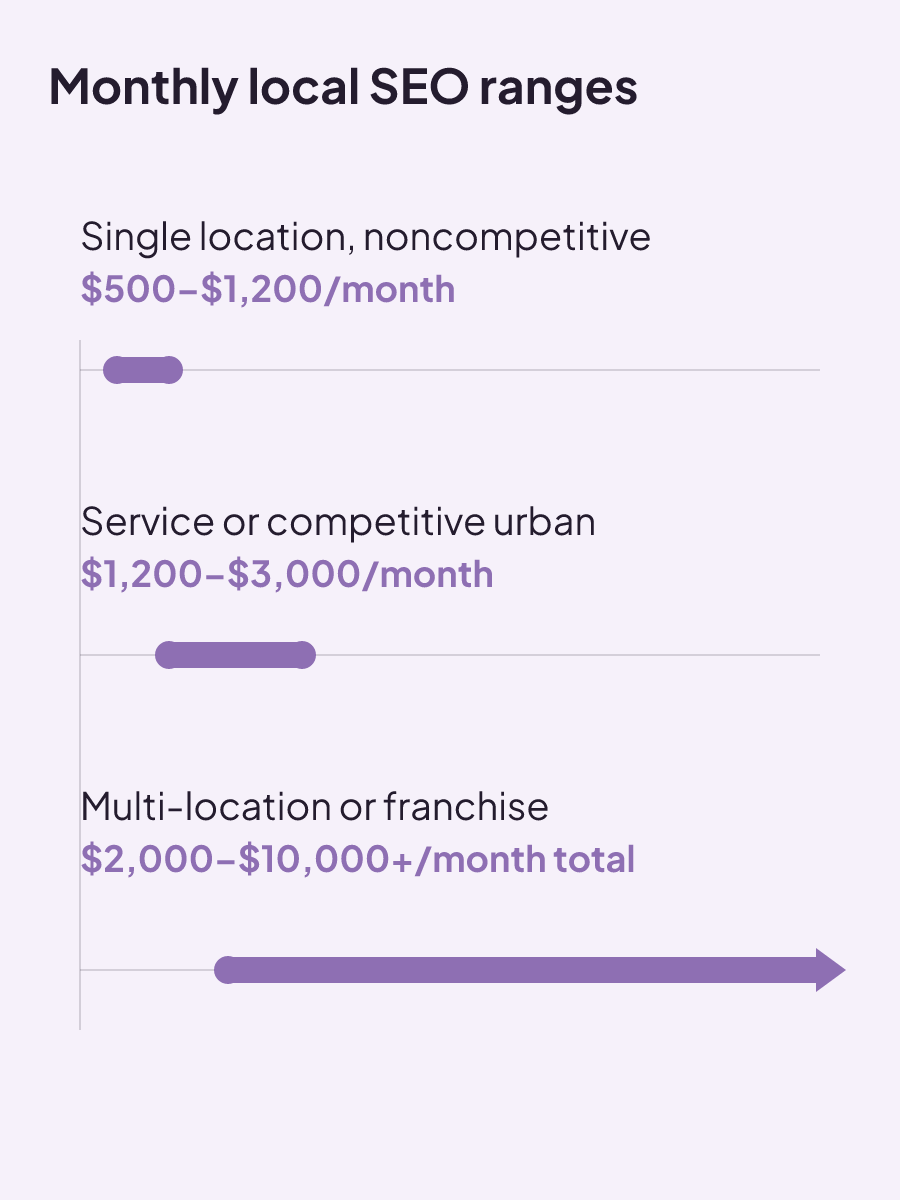
The business category makes the comparison more useful:
- A single-location small business in a noncompetitive niche: $500 to $1,200 per month.
- A service business or business in a competitive urban niche: $1,200 to $3,000 per month.
- A multi-location or franchise brand: $2,000 to $10,000 or more per month in total.
A clinic should compare its situation with the category that actually fits. The broad range becomes less useful if you ignore the number of locations or compare a competitive city market with a noncompetitive niche.
The multi-location figure is a total monthly range, while the profile-overhaul price below is a per-location project figure. Keep that distinction in the comparison. A total monthly budget and a one-time price for each location answer different cost questions.
Scope matters just as much. Local SEO can include listing work, but the price may also pay for other ongoing services. A comparable scope names the locations covered and the recurring work included. Then compare that figure with the full per-location cost from the worksheet. That avoids treating a base software fee, a listing cleanup, and an ongoing local SEO program as interchangeable offers.
Price alone cannot tell you whether local SEO is worth it. The clearest test is whether the proposed scope addresses the records and maintenance problems you can already see, at a cost your clinic can sustain.
One-time projects and retainers solve different jobs
A one-time project fits a business that needs to fix foundational issues or launch a new local presence without taking on an ongoing retainer. The stated range for one-time local SEO projects is $750 to $5,000, depending on depth. That category includes audits and business-profile overhauls.
A monthly retainer covers recurring work. In 2026, that can include:
- business-profile optimization
- content creation
- citation management
- review strategy
- reporting
Choose between them by matching the buying model to the work. A defined backlog of foundational repairs or a new local launch can fit a one-time project. A retainer fits when the scope includes ongoing profile optimization, content creation, citation management, review strategy, or reporting. Compare the quoted work with the job you need done, not with the label on the proposal.
What do common local SEO projects cost?
Common local SEO projects use different price units, so compare each quote to the matching scope:
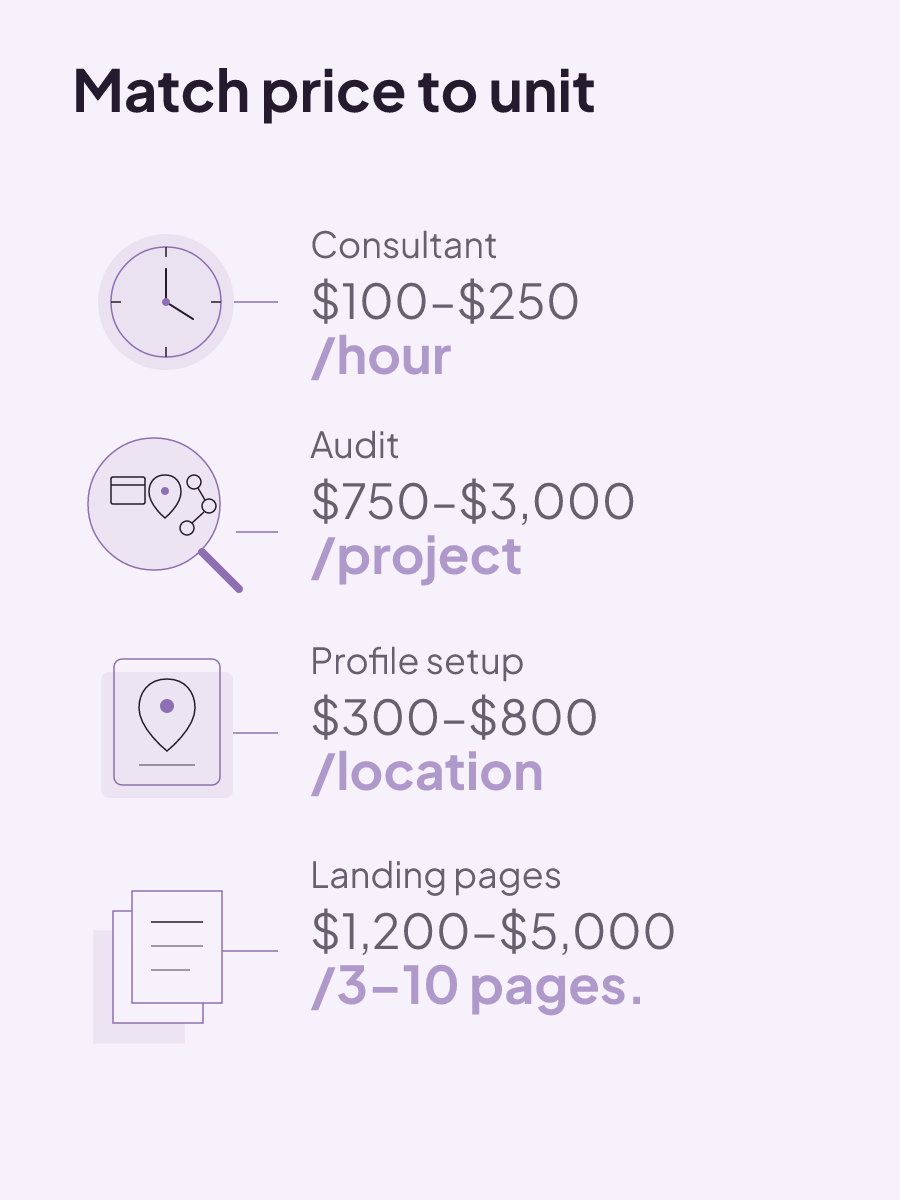
- Experienced local SEO consultants: $100 to $250 per hour.
- A local SEO audit covering the site, primary business profile, and citations: $750 to $3,000. The price varies with site size and complexity.
- A full business-profile setup or overhaul: $300 to $800 per location.
- A bundle of three to ten city or service-area landing pages: $1,200 to $5,000.
The unit changes the total. An hourly consulting rate does not define the number of hours. A per-location profile overhaul grows with the number of clinic locations. The landing-page figure covers a stated bundle of three to ten pages, while the audit figure covers the site, profile, and citations.
Site size and complexity affect the audit price within its $750 to $3,000 range. That variable belongs to the audit comparison. The $300 to $800 profile setup or overhaul remains priced per location, and the $1,200 to $5,000 landing-page amount remains attached to a bundle of three to ten pages.
Use those scopes to make quotes comparable. For an audit, confirm that the quoted work covers the site, primary business profile, and citations. For a profile overhaul, calculate the amount across every location included. For landing pages, compare the proposed number of pages with the three-to-ten-page bundle.
These project prices also shouldn't be used as a substitute for software cost. Software has required features, possible add-ons, implementation costs, and a contract term. A project has a defined piece of work. Put each number beside the job and unit it actually buys.
If your wider goal includes how clinic information appears in search, treatment pages, and other medical search surfaces, our medical SEO glossary provides that broader context.
Healthcare review replies carry a privacy boundary
For U.S. healthcare organizations, a public review response can create a privacy problem even when the clinic is trying to defend itself. Responding with specific patient details, including an accidental disclosure, can violate the Health Insurance Portability and Accountability Act Privacy Rule. Even acknowledging that the reviewer received services likely violates the rule.
This is an enforcement issue, not a theoretical edge case. The U.S. Department of Health and Human Services' Office for Civil Rights settled with a California dental practice over impermissible disclosure of protected health information in online review responses and other potential Privacy Rule violations.
The reputational boundary matters too. A public dispute with a patient may draw more attention to the negative review. Emotional or defensive responses can also harm a healthcare provider's professional reputation.
For a U.S. clinic, listing integrity includes control over review replies as well as accurate business records. Keep the response from becoming a second source of privacy or reputation harm.
We include directory listing consistency, profile optimization, and review signal optimization within our med spa SEO services. See how we handle local listings within that work, or request our free med spa SEO audit.

How to choose a local SEO company that can show its work
A local SEO company is worth hiring when it names the work, measures business actions, prices the scope clearly, and avoids ranking guarantees.
Read insight
Local SEO price guide for med spas: what should your package include?
Local SEO prices usually run $500 to $2,500+ monthly, but a fair quote depends on the work, reporting, and internal execution it requires.
Read insight
Local SEO checklist for med spas: a practical roadmap for 2026
This local SEO checklist turns profile, page, citation, review, technical, and measurement work into checkpoints with owners and pass conditions.
Read insight