

Key takeaways
- Cover profiles, location pages, technical work, citations, reviews, and measurement.
- Fix the issue most relevant to local visibility or conversion first.
- Track calls, forms, bookings, quote clicks, chats, and direction requests.
A useful local SEO checklist is an operating record, not a pile of boxes to tick. Each checkpoint needs a pass condition, a named owner, and proof that the work was completed. That structure helps you decide whether the immediate problem sits in public business facts, clinic pages, corroborating signals, or measurement.
This local SEO roadmap is designed for one clinic location at a time. Audit the four checkpoints, find the first meaningful failure, and fund work that addresses it. That keeps a long checklist tied to visible work and patient actions.
What should the local SEO checklist prioritize first?
A useful audit identifies what to fix first, why the problem matters, and how the repair could improve local visibility or conversions. Use this matrix to record the decision. The accountable owner is the person your clinic assigns, not necessarily the person who found the issue.
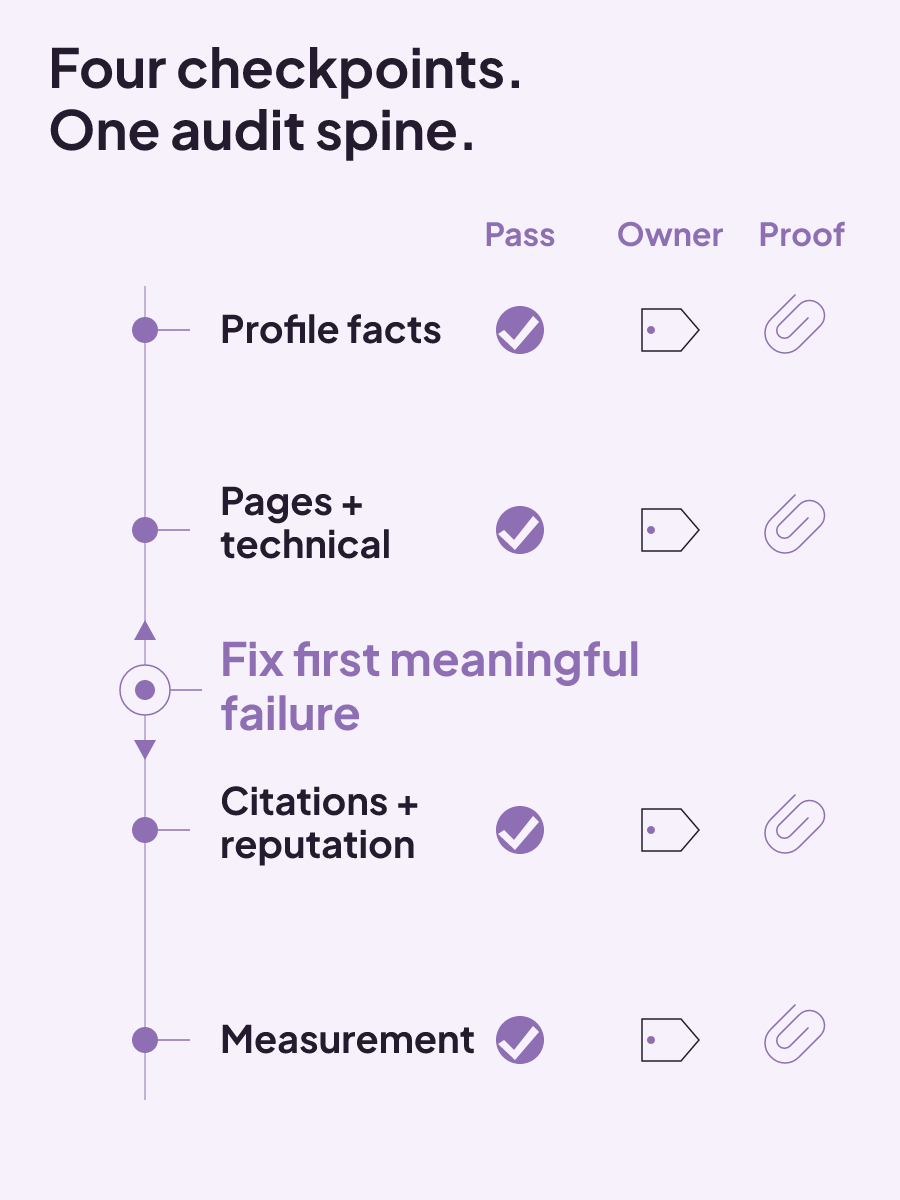
| Checkpoint | Pass condition | Accountable owner | Evidence retained |
|---|---|---|---|
| Business profile facts | Profile is claimed and verified; address, hours, contact details, photos, and location content are accurate | Assigned profile owner | Verification record and dated profile review |
| Pages and technical implementation | Location pages are discoverable, usable on mobile, reasonably fast, and connected to working booking links; structured data passes its checks | Assigned website owner | Tested URLs, crawl record, speed results, booking-link test, and validation results |
| Citations and reputation | Important listings match the master business record; review responses follow the clinic's confidentiality plan | Assigned listings and reputation owner | Listing inventory, correction log, duplicate log, and response record |
| Measurement | Calls, forms, bookings, quote requests, chat starts, and direction requests are recorded | Assigned reporting owner | Location-level report with action totals and relevant breakdowns |
Claim the profile and make every public fact accurate
For local SEO, the foundation is a claimed and verified business profile. A business must add or claim the profile and verify it before it can appear across the related search and map services. Until that condition is met, profile polishing is not the main job.
Once the profile is verified, check the address, hours, contact information, and photos against the clinic's current details. The pass condition is simple: those public facts are accurate and up to date. Keep a dated record of the review so the assigned owner can tell when it was last checked.
Accuracy also applies to what the clinic adds to the profile. Profile content must represent the location accurately and follow the platform's policies. Those rules cover reviews, photos, and videos. A profile or piece of content that does not meet the criteria may be rejected from publication.
That makes policy compliance part of completion, not a final polish. A photo upload is not complete merely because someone submitted it. The checkpoint passes when the profile is verified, its core details are current, and its published content accurately represents that location.
Make one business identity travel across the local web
The clinic's name, address, phone information, hours, and other key details should match across its website, business profile, and other online listings. Start by locking one master business record. That record gives every person handling listings the same facts to use.
Next, inventory the places where those facts appear. A citation audit should inspect major aggregators, directories, and social profiles for inconsistent information. Important listings should be claimed and verified, because an auto-generated profile can otherwise show outdated or incorrect details.
The work is more focused than collecting as many directory entries as possible. Prioritize consistent recognition of the same clinic in relevant places. Clean important listings, remove duplicates, and keep the website and business profile synchronized. When a location changes its hours or contact details, update the locked master record and the key public surfaces from that source.
This creates two different records for the owner. The master record holds the clinic facts that should appear publicly. The listing inventory shows where those facts have been checked, corrected, or left unresolved. Keeping both records makes a later citation audit a comparison against known facts instead of another search for the right address, phone information, or hours.
The checkpoint passes when the inventory is complete, priority profiles are claimed, known duplicates have been handled, and the important listings match the master record. Retain the listing inventory and correction log. They show what was reviewed, what changed, and which record still needs attention without requiring another discovery pass.
What makes each clinic location page useful?
Each location page should answer the intent behind that clinic's most important searches. That means the page needs information that is useful for the specific location, especially when nearby clinics share the same brand.
Changing a city name and rephrasing the same copy does not create unique value. In practice, the pages remain duplicated. Nearby locations under the same brand particularly need information that provides unique value on each page.
Broad geo pages deserve extra scrutiny. They are harder to rank than true location pages and can be mistaken for doorway pages. Before creating another city-targeted URL, decide whether it represents a real clinic location and whether it can offer genuinely unique information. If it cannot, more rewritten copy does not solve the underlying problem.
That gives the website owner a practical distinction. A location page represents a clinic location and answers the intent behind its important queries. A broad geo page targets an area, carries more ranking difficulty, and brings doorway-page risk. The audit record should identify which type of page is being reviewed before anyone approves another rewrite.
The pass condition is a location-specific page built around important search intent, with information that is not merely a rewrite of another clinic page. Keep the page URL and its intended search purpose in the audit record. This gives the website owner a concrete basis for comparing nearby pages and deciding whether a proposed page has a distinct job.
Technical checks connect clinic pages to search and booking
A technical SEO checklist should begin with discovery and usability. Location pages need internal links and sitemap inclusion so people and search engines can find them. On the page itself, mobile-friendliness, page speed, and functioning booking links support the user experience and conversions.
Test the whole path, not just the page's appearance. Record the location URL, the internal link that leads to it, its sitemap presence, the mobile result, the speed result, and a completed booking-link test. A visible button with a broken destination does not pass the checkpoint.
Structured data has its own pass condition. Use complete and accurate properties, check the markup with the Rich Results Test and URL Inspection Tool, and compare the performance of pages with and without structured data.
Valid markup does not guarantee a rich result. Validation proves that the markup cleared the technical check, not that a particular search appearance will follow. Retain the test result with the page record so technical completion remains separate from later performance reporting.
If this audit exposes broader clinic search issues, our med spa SEO services include technical SEO, schema implementation, profile optimization, treatment-page work, and local tracking.
Profiles and citations need a recurring maintenance owner
Profiles and listings change after the initial cleanup, so assign a recurring maintenance owner. A comprehensive business-profile audit belongs on at least a quarterly schedule. Highly competitive industries or markets may need more frequent reviews.
Use the recurring review to check profile accuracy and active content. High-quality photos, videos, and other visual content can help attract and engage potential customers. Profile posts and questions and answers can showcase services, engage customers, and support conversions. Record what was reviewed or updated and the date, so maintenance does not depend on memory.
Citations need the same rhythm. Quarterly citation audits can catch inconsistencies caused by directory updates, user edits, or aggregator refreshes. Compare the important listings with the locked master record, then add corrections and duplicates to the same log used during the initial cleanup.
The checkpoint passes when the quarterly record covers profile facts, visual content, Posts, questions and answers, and citation inconsistencies. If the clinic operates in a highly competitive market, the owner can set a shorter profile-review interval while retaining the quarterly citation check. The useful output is a dated maintenance record with a clear owner and unresolved items.
Reviews build trust, but responses must protect patient confidentiality
Reviews and reputation management help build trust and credibility with local customers. For a med spa or aesthetic clinic, responding also creates a confidentiality decision. A quick, friendly reply is not complete if it exposes information about a patient relationship.
Healthcare providers need a plan for positive and negative review responses that protects patient confidentiality. The pass condition is a repeatable response plan that covers both types of reviews and keeps confidentiality at the centre of the process.
Assign ownership for the plan and for day-to-day responses. Retain the response record as evidence that reviews were handled under that process. Obtain legal or compliance review for the clinic's patient-review confidentiality wording before the team relies on it.
Measure local visibility by the actions it creates
Local SEO reporting should show whether visibility produces calls, form submissions, booking clicks, quote requests, chat starts, and direction requests. Those six actions turn a visibility report into an operating view of what prospective patients do.
Break conversion performance down by page, device, channel, and location. Performance can vary across each dimension. A clinic with several locations should be able to separate their results instead of relying only on a combined total. The same applies to a booking click from a location page and a direction request from a profile.
The reporting system can bring those action views together with rank tracking, business-profile insights, technical audits, competitor analysis, and review management. Keep the conversion actions visible so ranking data does not become the entire report. A clinic search case study can provide context, but your own checkpoint still needs its own location-level records.
Use the breakdowns to locate variation before assigning work. Review a weak total by page, device, channel, and location, since performance can differ across all four. Keep the six patient actions in the same view as the visibility and technical information. That lets the reporting owner inspect both the search work and the actions recorded for the clinic.
Interpret movement carefully. User location and device can affect what is served, and content is not guaranteed to be crawled, indexed, or served. The pass condition is therefore a working measurement record, not a guaranteed ranking. Retain action totals and the page, device, channel, and location breakdowns used to evaluate them.
Can ChatGPT do an SEO audit?
ChatGPT can interpret real audit inputs, but dedicated tools must collect the measurements it receives.
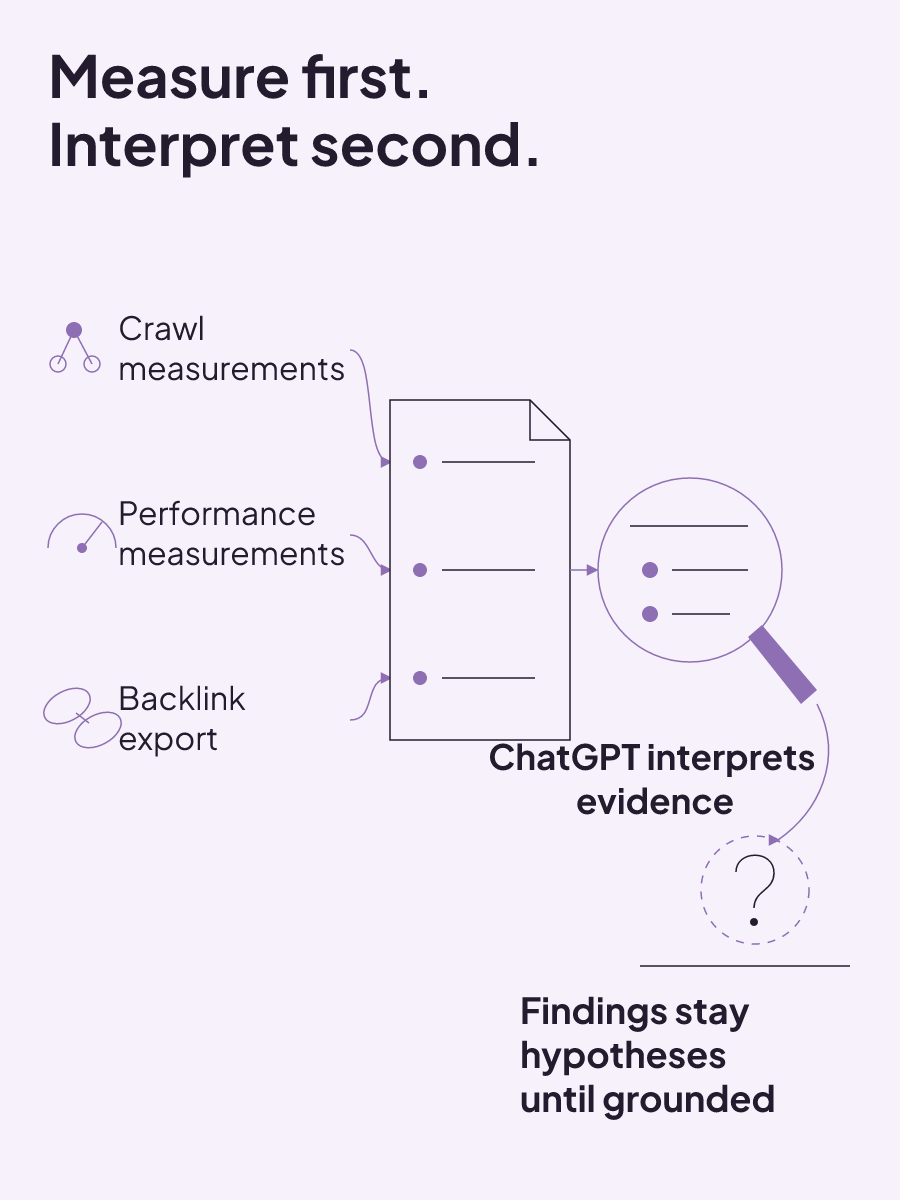
| ChatGPT can do | Dedicated tools must do |
|---|---|
| Interpret supplied crawl reports | Crawl the site and produce measurements |
| Interpret supplied performance data | Measure page and site performance |
| Analyze exported link information | Provide backlink data for export, since GPT cannot replace a backlink database |
| Organize measured findings and hypotheses | Supply the measured inputs that ground the audit |
Ungrounded GPT output can propose SEO problems that are not actually present, so opinion-based answers remain hypotheses. Using GPT on very large sites also requires batching and data engineering because of token and file limits. For one clinic location, give it the relevant crawl report, performance measurements, and any exported link information needed for the audit question.
Which local SEO tool fits the job?
There is no single best local SEO tool for every checkpoint. Select the category that matches the main job you need completed.
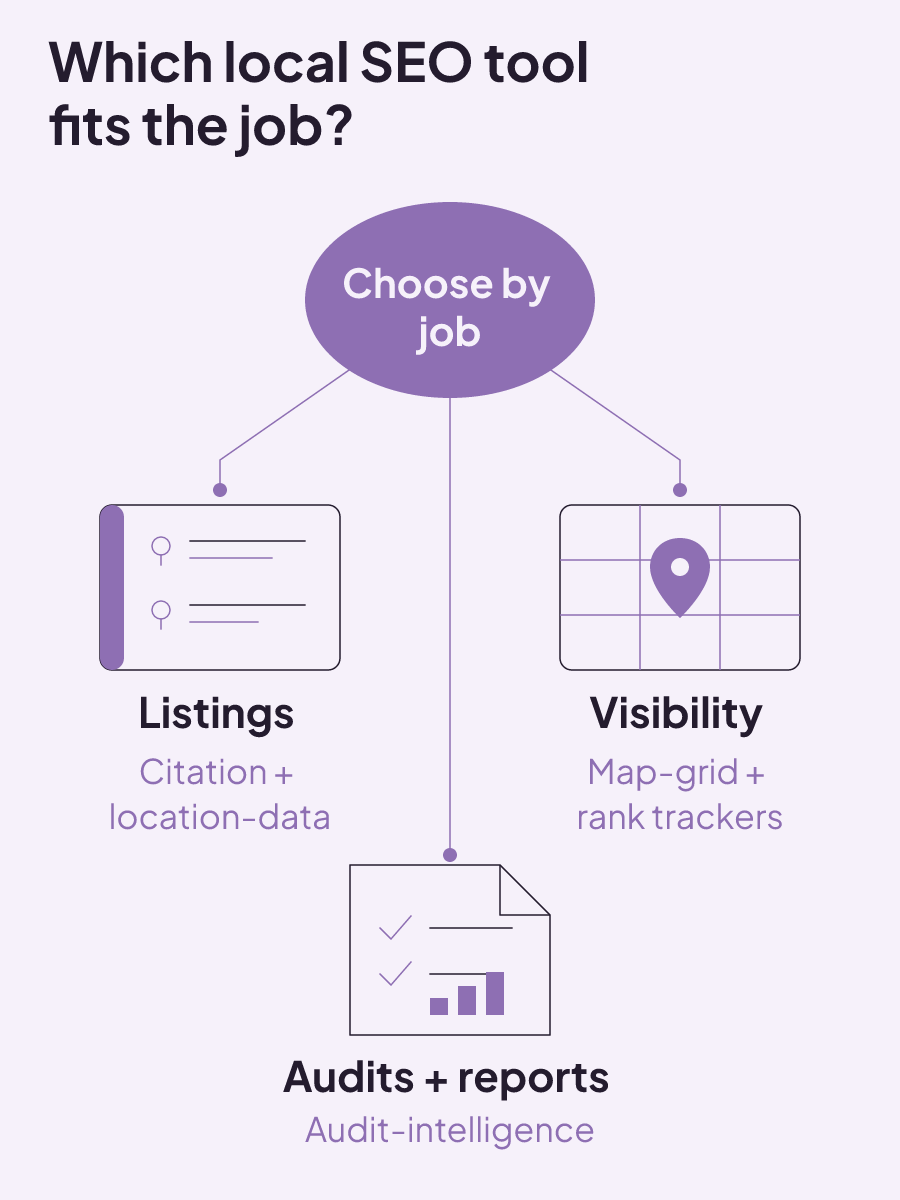
- For listings management, use citation and location-data tools.
- For local visibility, use map-grid and rank trackers.
- For audits, reports, or agency workflows, use audit-intelligence tools.
This buying split prevents a tool with one strong job from becoming the default for unrelated work. Start with the failed checkpoint in your matrix, name the output you need, and choose the tool category that produces that output. The record of completion still belongs in the clinic's audit, regardless of which tool created it.
For clinic-specific background, read our medical SEO guide. Use the four-checkpoint matrix to audit one clinic location. Assign each failed checkpoint to a named owner, and retain the record that shows when the checkpoint passes.

How to choose a local SEO company that can show its work
A local SEO company is worth hiring when it names the work, measures business actions, prices the scope clearly, and avoids ranking guarantees.
Read insight
Local SEO price guide for med spas: what should your package include?
Local SEO prices usually run $500 to $2,500+ monthly, but a fair quote depends on the work, reporting, and internal execution it requires.
Read insight
Local SEO listing guide: what to fix, maintain, and pay for
Local SEO listing management starts with accurate records, duplicate cleanup, documented corrections, quarterly audits, and full per-location costs.
Read insight