
Key takeaways
- CRO software handles measurement, behavioral research, testing, and outcome tracking as different jobs.
- An appointment funnel also includes response, qualification, routing, booking, and show-rate management.
- Start with one unanswered question, then pilot one high-impact journey before expanding your stack.
What do conversion rate optimization tools actually do?
Conversion rate optimization tools are software designed to increase the share of website visitors who complete a desired action. That action could be signing up, booking a demo, or making a purchase. For an appointment-led clinic, the wider conversion path can continue through booking and the completed consultation.
CRO platforms are not one uniform type of software. The category includes A/B testing platforms, heatmaps, session recordings, and analytics. Tools that look similar on a comparison page may answer different questions once you put them to work.
Useful CRO tool examples are easier to understand by job:
- A/B experimentation runs tests on proposed website changes.
- Landing-page building supports the page-creation part of conversion work.
- Behavioral observation examines what visitors do. Heatmaps and session recordings sit in this part of the category.
- Traffic and funnel measurement quantifies activity and movement through a journey. It gives the clinic a measurement layer.
- Revenue attribution connects revenue with its sources. This is an attribution job, not another name for session observation.
- Form or checkout analysis focuses on the flow people complete within a form or checkout.
The software is only one part of the work. CRO can draw on user research, digital analytics, psychology, experimentation, copy, design, and project management. A long feature list cannot tell you which of those jobs your clinic needs first.
That is also why a universal "best CRO tools" ranking is a weak way to buy conversion rate optimization software. We use a diagnostic comparison instead. Each category is compared by the question it answers, the evidence it captures, and the decision it supports. This is not a vendor scorecard, and it does not assume one platform should handle every part of your funnel. Named products, current prices, free tiers, feature limits, integrations, and privacy controls sit outside this category-level comparison. Those details become useful after you have defined the software job and the evidence your clinic needs.
Which conversion rate optimization tools fit each diagnostic job?
Choose the tool category from the question you cannot answer today. Finding why visitors hesitate, testing a proposed fix, and confirming whether the fix affected the business are separate jobs. They call for different software.
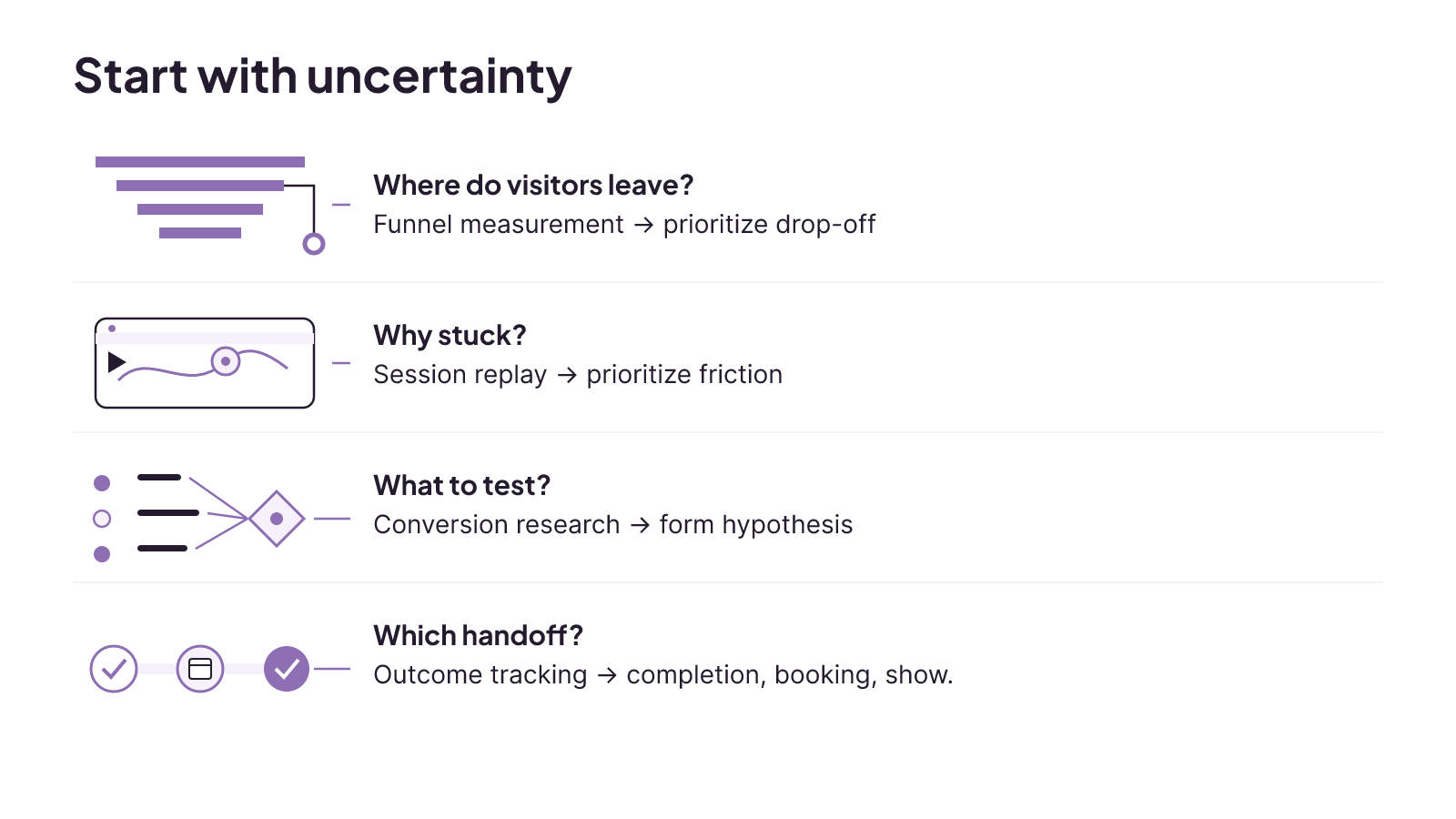
| Unanswered question | Tool job | Evidence captured | Decision enabled |
|---|---|---|---|
| Where do visitors leave the journey? | Funnel measurement | Conversion between individual steps and the point of drop-off | Which significant drop-off to prioritize |
| Why do people get stuck? | Session replay and behavioral observation | Observed sticking points and their user impact | Which friction issues deserve attention first |
| What change is worth testing? | Conversion research and experimentation | Quantitative and qualitative behavior information, insights, and a testable hypothesis | Which hypothesis to take into an A/B test |
| What happens across the appointment handoff? | Appointment outcome tracking | Completion: starters who answer every question. Booking: qualified completions that book. Show: booked consultations that occur. | Which appointment outcome needs closer review |
Funnel visualization locates step-level drop-off, while session replay can show where users get stuck. Quantitative and qualitative research can then turn useful behavior information into a test hypothesis. Collect each data point for a defined use, and prioritize must-have data over nice-to-have detail. That keeps the tool choice tied to the decision it must support.
These categories are the answer to "What are the best CRO tools?" Start with the software job that resolves your current uncertainty. Add another category only when the first answer creates a distinct decision that your existing stack cannot support.
Appointment conversion extends beyond the landing page
For a med spa or aesthetic clinic, conversion does not stop when somebody submits a form. Appointment-funnel optimization can include response time, qualification, routing, and show-rate management. Booking sits inside that path, between the website action and the consultation that actually occurs.
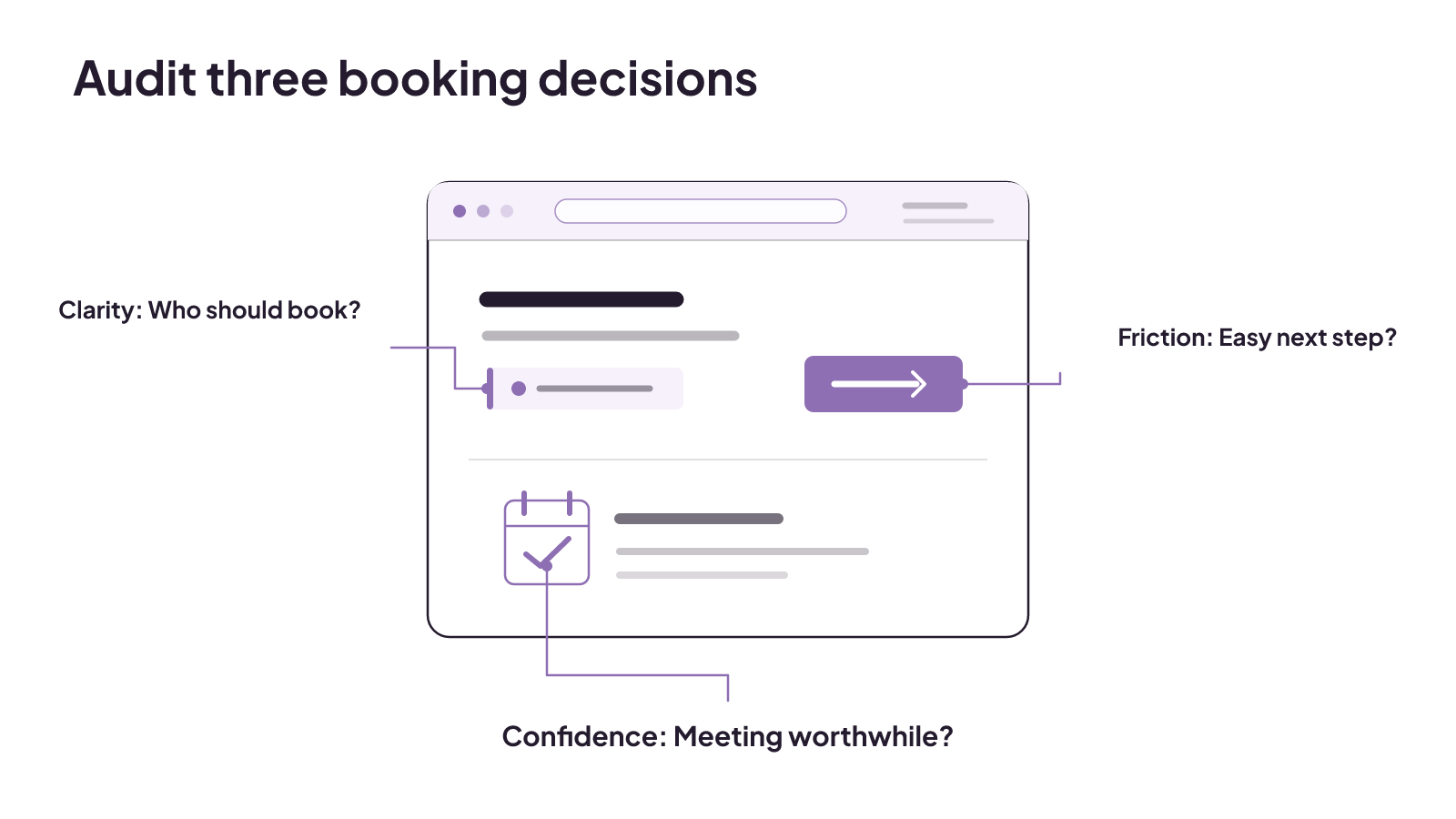
The landing page still matters. It can affect whether visitors understand who should book, whether the next step feels difficult, and whether the meeting seems worthwhile. Those are the three practical factors to review: clarity, friction, and confidence.
Put those factors into plain questions while you assess the page:
- Clarity: does the page make clear who should book?
- Friction: how easy is it to take the next step?
- Confidence: does the page support confidence that the meeting is worthwhile?
An appointment-oriented website also brings navigation, appointment-booking pathways, calls to action, page performance, and user experience into the conversion picture. Each surface can influence the path, but a clinic does not need to buy software for all of them at once. The unresolved question should set the scope.
If patients can complete a live booking or submit a request for later handling, that distinction changes what you can observe at the website handoff. Our guide to online booking helps frame that part of the path before you evaluate more software.
What does each funnel handoff tell you?
The location of abandonment narrows the operational question. If prospects repeatedly leave at a particular question or stage, that point may need to be reworded, reordered, or removed. The useful evidence is not simply that the funnel lost people. It is where the loss occurred within the questions they were asked to complete.
The booking handoff needs its own reading. A low booking rate among qualified leads can indicate friction in the booking process or insufficient follow-up between qualification and scheduling. That signal concerns people who have already completed the qualification path. It focuses the review on what happens between qualification and a booked time.
Question-level abandonment concerns the qualification step where people leave. Low booking among qualified completions concerns booking friction or follow-up before scheduling. A useful CRO platform should capture the signal required for the handoff you are investigating.
When is a free CRO tool enough for session recording?
A free CRO tool can be enough when you need an initial view of user friction. Session recordings can reveal where people get stuck, especially after funnel measurement has already identified a high-impact page. Free CRO tools become less useful when the captured view is too limited for the decision you need to make.
Review these limits before relying on a free session-recording setup:
- Data quality: confirm that the activity captured is useful for the review.
- Privacy: assess the privacy limits of the implementation.
- Scalability: consider whether the setup can support the required volume.
- Throttling and sampling: free solutions may limit or sample captured activity.
- Page load, memory use, and network requests: test the recording implementation for its effect on each one.
Sampling can support a staged approach. Start with sampled activity to see whether session recording reveals useful friction on the selected pages. Test the implementation for page load, memory use, and network requests at this stage. When the sample cannot provide the deeper insight required for the decision, a staged upgrade can expand the view. This makes "free" a starting scope, not the reason to keep or replace the software.
This is an important limit on any free-tool comparison. A free recording option can expose friction, yet data quality, privacy, scalability, throttling, and sampling can restrict the view. Test the implementation as well as the interface. Software that records useful sessions but creates an unacceptable load, memory, or network burden has introduced another issue to assess.
What can an AI CRO tool add?
An AI CRO tool can automate insights, personalize content, and streamline testing. Those are three different functions, so the presence of AI does not settle the buying decision. The useful capability depends on the job you have already identified.
Start with the priority category:
- Personalization, when that is the capability you need to assess.
- A/B testing, when the need is a more streamlined testing process.
- Heatmaps, when behavioral observation is the priority.
Selection also depends on business size, industry, budget, specific needs, and integration requirements. A trial or demo can turn those broad criteria into a focused product evaluation:
- Define whether personalization, A/B testing, or heatmaps is the priority.
- Set the context with your business size, industry, budget, and specific need.
- Include the integrations required for the selected journey.
- Assess usability while working with the intended function.
- Consider the tool's potential return on investment from that trial or demo.
Keep every part of the evaluation tied to the intended job. A strong experience with one AI function does not assess the other functions. Test the capability that matters to the clinic's current decision.
AI can reduce work inside a process, but it does not collapse measurement, observation, experimentation, and appointment outcomes into one category. The same diagnostic rule still applies: define the decision first, then judge whether the AI-assisted function makes that decision easier to reach.
Website tests need search-safe implementation
A/B and multivariate tests need a sound search implementation as well as a useful hypothesis. Google's guidance for website testing identifies four practices that help avoid harm to search performance:
- Avoid cloaking during the test.
- Use a canonical link for alternate test URLs.
- Use temporary redirects when a test redirects visitors.
- Remove testing elements after the test ends.
These requirements belong in the evaluation of an experimentation platform and the workflow around it. A tool can make it easy to launch a test, but your implementation still has to handle alternate URLs, redirects, and cleanup correctly.
Treat cleanup as part of the test, not an optional task after the result. The experiment ends when its testing elements are removed. That keeps the technical work bounded to the period when the test is active.
Tool cost extends beyond the subscription price
The subscription is only one software cost tied to conversion work. Campaign acquisition-cost analysis can include a proportional share of analytics, conversion tracking, attribution, customer relationship management, A/B testing, heatmap, and page-building software when those tools are directly tied to the campaign.
That proportional view matters when one tool supports several campaigns. Count the share connected to the campaign you are assessing instead of treating every software expense as a flat campaign cost. If you are separating which sources contribute to a consultation, the role of marketing attribution belongs in that analysis.
Call tracking can add another cost structure. A plan may combine a base fee with usage charges per tracking number, minute, or answered call. A subscription comparison that omits those usage charges does not represent the complete call-tracking cost.
Use the same boundary for the pilot: include the directly tied software share and any relevant usage charges. That creates a cost measure you can compare with time to insight and decision speed.
Run a bounded pilot before expanding the stack
Start the pilot with one high-impact journey. Review its highest-impact pages, filter recorded sessions for frustration signals, and turn the top three observed issues into a fix queue. That gives the pilot a defined surface and a limited body of work.
The fix queue contains three observed issues from the selected pages. The pilot then measures conversion recovery or friction reduction while tracking cost, time to insight, and decision speed.
Choose one impact measure: conversion recovery or friction reduction. Then track three operating measures alongside it:
- Cost
- Time to insight
- Decision speed
The pilot is not just a product tour. It tests whether the conversion rate optimization tool helps your team observe a meaningful issue and make a decision within a defined journey. Tools still need a structured optimization process around them.
A structured process gives each tool a defined role: observation, measurement, testing, or outcome tracking, with the pilot setting the boundary for that work.
Expand the stack when the pilot exposes a new question that requires another kind of evidence. If the broader issue is how acquisition systems carry a person from first contact toward a consultation, compare patient acquisition software for your clinic.
Digital marketing for lead generation: find where the lead path breaks
Digital lead generation moves the right audience from a specific action through qualification, follow-up, and downstream measurement.
Read insight
Dental local SEO: how to judge scope, cost, and value
Local SEO commonly costs $500 to $5,000+ monthly in 2026; dental practices should compare scope, ownership, and measurement before price.
Read insight
How to choose a local SEO company that can show its work
A local SEO company is worth hiring when it names the work, measures business actions, prices the scope clearly, and avoids ranking guarantees.
Read insight