

Key takeaways
- Dental local SEO helps nearby patients find a practice and take action.
- Compare proposal scope, ownership, measurement, and handover before price.
- Cheap local SEO services may omit tracking, content, technical fixes, review systems, authority building, and strategy.
What is dental local SEO?
Dental local SEO is the work of improving a dental practice's position in local search results. In practice, it means helping the practice appear when someone nearby searches for a dentist. Google Business Profile and website optimization are central parts of that work.
What does local SEO stand for in practical terms? It is the local part of search engine optimization: improving how a business appears in results connected to a place. For dentists, SEO applies that work to the practice, its website, and the information people see when they search nearby.
That nearby search is only one part of the decision. Before booking, patients compare dental practices through search results, reviews, websites, referrals, and social media. A listing is more likely to earn the call when it answers questions, builds trust, and makes the next step easy.
Those patient touchpoints explain why dental local SEO cannot be judged by a single broad line in a proposal. You need to see the actual work behind the label, from the practice profile to the action being measured.
Check the work inside a dental local SEO proposal
A useful proposal makes six service areas visible. This Dental Local SEO Sufficiency Scorecard is a scope check, not a numeric rating. It has no pass mark and does not predict rankings, calls, bookings, or revenue. Use the same rows for every proposal so an attractive monthly total cannot hide a missing work area.
| Service area | Work included | Intended outcome |
|---|---|---|
| Business Profile | Improve categories, practice details, services, media, and links | Support Maps relevance and patient actions |
| Website and conversion paths | Improve pages, internal links, and conversion paths | Support more qualified enquiries |
| Citations and business information | Correct inconsistent business information | Reduce data conflicts |
| Review process | Build a compliant request-and-response process | Support trust and patient feedback |
| Crawling, indexing, mobile, and schema | Address crawling, indexing, mobile performance, and schema | Provide a reliable technical foundation |
| Actions, leads, and revenue | Track patient actions, leads, and revenue | Provide commercial evidence for the work |
The six rows reveal the visible production scope. They also keep unlike work from disappearing under labels such as "optimization" or "management." A proposal can cover profile details but say nothing about the website. It can include technical work without defining how patient actions will be measured. The scorecard lets you mark those as open scope items without inventing a score.
Look for concrete work in each row. Business Profile scope should address categories, details, services, media, and links. Website scope should name pages, internal links, and conversion paths. Citation work should correct business information, while review work should define a compliant request-and-response process. Technical scope should name crawling, indexing, mobile performance, and schema. Measurement should reach actions, leads, and revenue.
Put written exclusions beside the monthly fee. Before work starts, agree on access and handover for content, source files, audit documents, dashboards, technical specifications, Search Console, analytics, and reporting history. Measurement terms should also name the actions, leads, and revenue being tracked.
Reviews and educational content shape patient confidence
Reviews and patient education do different jobs, and a proposal should show both clearly. Positive dental patient experiences support word-of-mouth recommendations and stronger online reputation signals. A review process should therefore include both requests and responses, while staying within the platform's rules.
Educational content helps before the first appointment. Dental blogs, videos, and frequently asked questions can answer treatment questions and help patients feel more confident. That is a more specific content job than publishing general practice news or adding pages without a defined patient question.
When you compare content scope, look for the format and question being addressed. A blog, video, and frequently asked question are not interchangeable deliverables simply because all three are called content. The proposal should make the planned output visible enough for you to see whether patient questions are actually being answered.
The same clarity matters for reviews. A promise to "manage reputation" does not show whether the work includes a compliant request process, response work, or both. Keep these details beside the review row in the scorecard. That preserves the practical distinction between patient education, patient feedback, and the online reputation signals supported by positive experiences.
Accuracy and policy errors can weaken local visibility
A changed phone number can create a local search problem when the old number remains on other platforms. Even small address-format differences can add confusion. Dental practices should keep their name, address, and phone number uniform because conflicting details can confuse search engines and reduce visibility. A proposal that includes citations should say how those differences will be corrected, not merely how many listings will be touched.
Local listing accuracy also requires more than checking the main practice listing. Cleanup can include duplicate listings, old addresses, practitioner listings that compete with the main listing, keyword-stuffed business names, and virtual or fake addresses. It should also account for suspension risk created by practices that sit close to the platform's guidelines.
Google requires Business Profile content to represent the location accurately and follow its policies. Violations can lead to restricted content or restricted access to the profile or merchant account. That makes policy-aware cleanup a real part of scope, especially when a proposal involves changing names, addresses, or listing structures.
Review work has a separate policy boundary. Only reviews that violate Google's policies are eligible for removal. Disagreeing with a review or simply disliking it is not a valid reason to report it. A proposal should not blur response work, review requests, and policy-based removal into one vague promise.
These checks give you concrete questions for any listing cleanup: Which conflicting phone numbers and addresses are in scope? Will duplicate and old listings be checked? Are practitioner listings included? Will risky names or addresses be identified? The answers show the work without promising a placement or result.
How can you check structured data?
Structured data helps Google understand the content of a page. Google may use it to give that content a richer appearance in search results, but structured data does not guarantee a rich result.
The phrase "free local SEO tool" is not a useful scope description on its own. For structured data, one specific check is Google's Rich Results Test. It accepts two inputs: a full public URL or a pasted code snippet. That makes it possible to test a live page or examine code before it is available at a public address.
There is one practical limit. When the test uses a URL, the page resources must be anonymously accessible. A page or required resource that cannot be accessed anonymously cannot be tested through that URL path.
This check can confirm what the tool detects in the supplied URL or code. Technical SEO also covers crawling, indexing, mobile performance, and schema. Google's Rich Results Test documentation explains the two testing methods.
How much should you pay for local SEO?
In 2026, ongoing local SEO services commonly cost $500 to $5,000 or more per month. Competition, goals, the number of locations, and service scope affect the monthly figure. These are general local SEO planning ranges, not fixed dental-industry quotes.
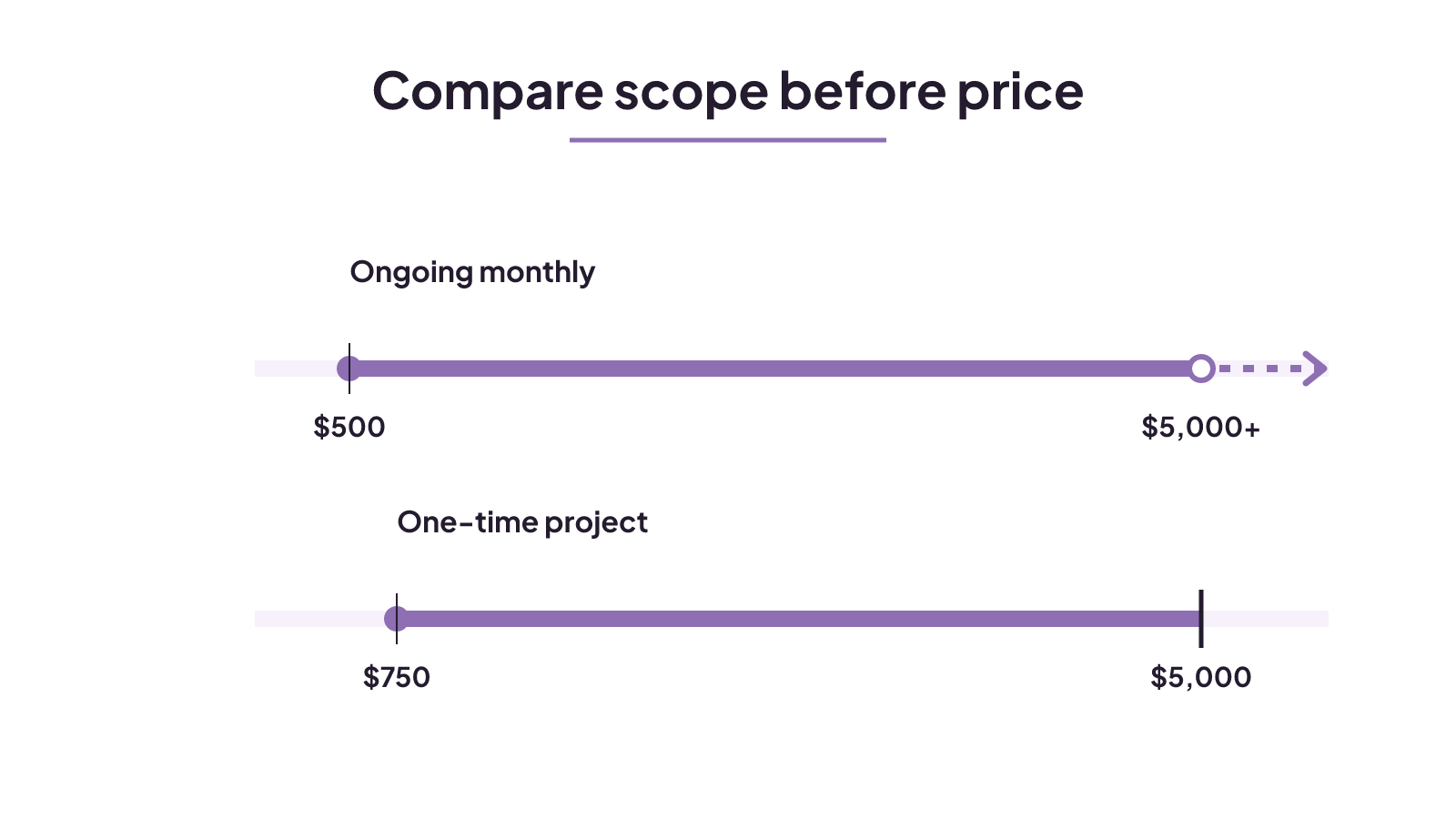
Audits, strategy builds, and one-time setup or correction projects have a different pricing shape. They are quoted from $750 to $5,000, depending on the project. Keeping that project range separate from the monthly range helps you compare a defined audit or cleanup with ongoing delivery.
A quote for an audit, strategy build, setup, or correction should identify the project it covers. A monthly proposal should identify its continuing service scope. Without those labels and deliverables, a one-time project total and a monthly fee do not answer the same buying question.
The label "affordable local SEO" does not make two proposals comparable. The same is true of "cheap local SEO." Entry packages may leave out tracking, content, technical fixes, review systems, authority building, and strategy. A low monthly fee can therefore describe a narrower set of work, although price alone does not reveal which items are missing.
Use the ranges as orientation, then return to the scorecard and the written exclusions. The 2026 pricing factors matter because a one-location practice, a multi-location group, and practices in different markets may require different service mixes.
How should a dental practice compare Colorado Springs SEO providers?
For a Colorado Springs dental practice, compare providers on the same scope and commercial terms. The right service mix depends on the business model, market, and number of locations. A proposal for one practice should not be judged against another proposal until those differences and the included workload are visible.
Start with deliverables and exclusions. Check the six scorecard areas, then note whether tracking, content, technical fixes, review systems, authority building, and strategy are included or omitted. This is where an "affordable local SEO services" package becomes specific enough to compare.
Then compare expertise, the specialists assigned, your team's workload, measurement, and expected business value. The monthly total belongs beside those facts, not above them. Our guide to choosing a local SEO company offers a neutral place to continue that evaluation.
Your practice's workload deserves its own line in the comparison. The proposal should make the provider's deliverables visible alongside the work expected from your team. It should also identify the specialists attached to the work. Those details let you compare the real operating commitment behind two similar monthly totals.
Ownership and handover need equal attention before work begins. Agree on access to content and source files, audit documents, dashboards, technical specifications, Search Console, analytics, and reporting history. The handover terms should be explicit, so your practice knows what it can access during the engagement and retain afterward.
This approach works whether a proposal is marketed as Colorado Springs local SEO or local SEO Colorado Springs. Apply the same scope, ownership, measurement, workload, specialist, and handover criteria. That produces a fair comparison without claiming that the lowest price, the largest package, or any named provider is automatically the best choice.
Is dental local SEO worth it?
Dental local SEO is worth evaluating through patient actions, not a broad promise about visibility. The relevant actions include calls, form fills, direction requests, bookings, and visits. Choose one primary conversion goal to guide the design of the profile and website pages, then make sure reporting captures that goal.
The primary conversion goal should remain visible in both profile and page design. Reporting can then show the five action types without turning a ranking or traffic number into a patient-action claim.
Local SEO also sits among other ways patients find and assess a practice. Dental practices that combine SEO, reviews, referrals, paid ads, and consistent communication create a more reliable flow of new patient inquiries. Each channel still needs measurement. Without it, you cannot know which marketing channels are working.
That is the practical answer to the benefits of local SEO question: the work can be judged through defined patient actions and connected to the rest of the practice's marketing. A ranking guarantee or vague traffic chart cannot replace calls, forms, directions, bookings, and visits as the actions the plan is meant to measure.
Turn the audit into a clear operating plan
A useful audit summary should move from findings to scheduled work. It can organize the review into five parts: the current score, the biggest issue, a competitor gap, quick wins, and a monthly plan. A clear local SEO report should keep those findings connected to visible work and measurement.
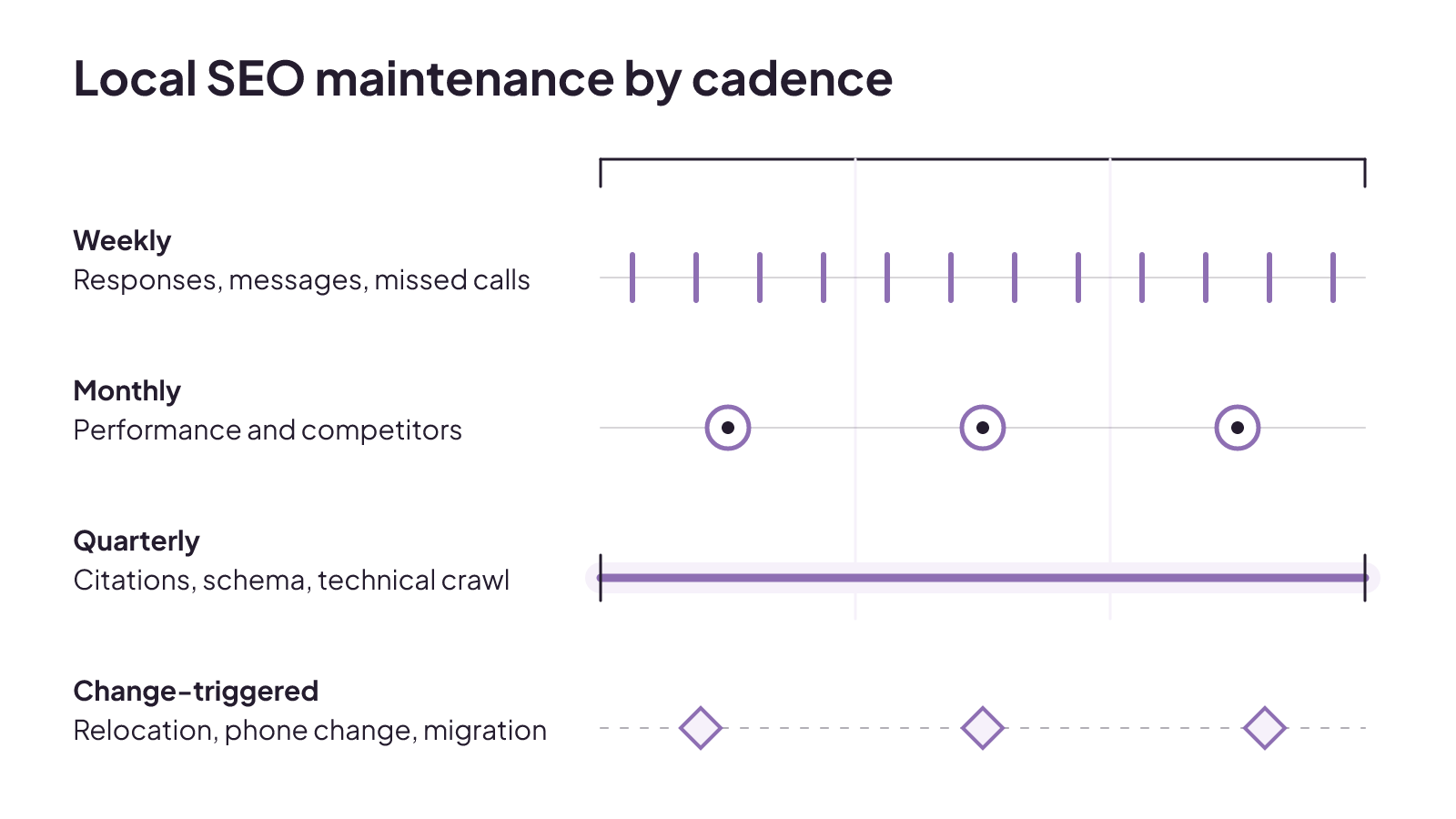
The maintenance schedule then assigns tasks to the right cadence. Review responses, Business Profile messages, questions and answers, and missed calls belong in weekly checks. Performance and competitor checks belong in monthly reviews. Citations, schema, technical crawls, local pages, internal links, and link gaps belong in quarterly reviews.
Some reviews are triggered by a change instead of a calendar date. Relocations, rebrands, phone changes, new locations, website migrations, and traffic drops should trigger a review when they happen. This keeps a major business or website change from waiting for the next quarterly cycle.
Use the Dental Local SEO Sufficiency Scorecard to compare your current proposals across the same six work areas. Then add the written exclusions, ownership, measurement, and handover terms. If you are still choosing a provider, compare local SEO companies by the work they can show.

Digital marketing for lead generation: find where the lead path breaks
Digital lead generation moves the right audience from a specific action through qualification, follow-up, and downstream measurement.
Read insight
Conversion rate optimization tools: choose by the leak, not the list
The right CRO stack starts with the unanswered funnel question, then adds measurement, behavior research, testing, or appointment tracking as needed.
Read insight
How to choose a local SEO company that can show its work
A local SEO company is worth hiring when it names the work, measures business actions, prices the scope clearly, and avoids ranking guarantees.
Read insight