
Key takeaways
- Missed call text back sends an automatic reply, but a sent text is not a recovered conversation.
- Look for a useful next step, human follow-up, and separate reporting for conversations and bookings.
- Standalone tools typically cost $20 to $100 per month, depending on SMS volume and features.
Why do missed calls deserve an immediate response?
A missed call can arrive at the exact moment someone wants pricing, availability, an appointment time, support, or a fast answer before making a decision. If that person doesn't hear back quickly, they may contact another provider. If an existing patient gets no acknowledgment, they may feel ignored.
That makes the gap bigger than a phone notification. The clinic has an inquiry, but it may not know the caller's intent. Voicemail doesn't reliably solve that problem because it may not capture why the person called, and many callers don't leave a message.
For a busy clinic, the first job is simple: acknowledge the call while the caller is still engaged and give them a way to say what they need. That first response doesn't have to settle the whole inquiry. It does need to keep the conversation open long enough for the right next step.
This is also why a fast apology by itself is a weak buying standard. The caller's real need could be a price, an open appointment, help choosing a service, or support with an existing matter. A useful workflow creates room for that need to surface. It then gives your team a clear place to continue the conversation instead of leaving another unknown entry in the call log.
Automation covers the first response gap
Missed-call text-back automatically sends a text message after an inbound call is missed. That quick first response can open a text conversation while the caller is still engaged. It also changes the team's starting point from an unexplained missed call to a channel where the caller can reply.
Without automation, staff may have to review call logs and decide manually which callers need a callback. Calls outside business hours can also remain unanswered until the next day. An automatic message covers that initial gap, but it doesn't replace helpful human follow-up.
Why do I get a text message after a missed call?
You get the message because the business has a missed-call trigger that sends an automatic text after an inbound call goes unanswered. For a clinic evaluating the workflow, the important question is what happens after delivery. The message should invite a useful reply, and the process should make human follow-up possible when the conversation needs it.
How do I text back a missed call?
If you're the caller, reply to the automatic message with what you need. If you're setting up the clinic's response, start with a concise acknowledgment, ask what the caller needs, and include a clear next step. The software should make that exchange easy to continue rather than treating delivery as the finish line.
Standalone missed-call text-back tools typically cost $20 to $100 per month, depending on SMS volume and features. Separately, cost per call is total channel spend divided by the calls generated, and it does not account for call quality on its own.
What should missed call text back software handle?
To judge the best missed call text back software for your clinic, screen the full workflow without turning the comparison into an invented score. A tool can send a quick reply and still leave booking, escalation, follow-up, and reporting disconnected.
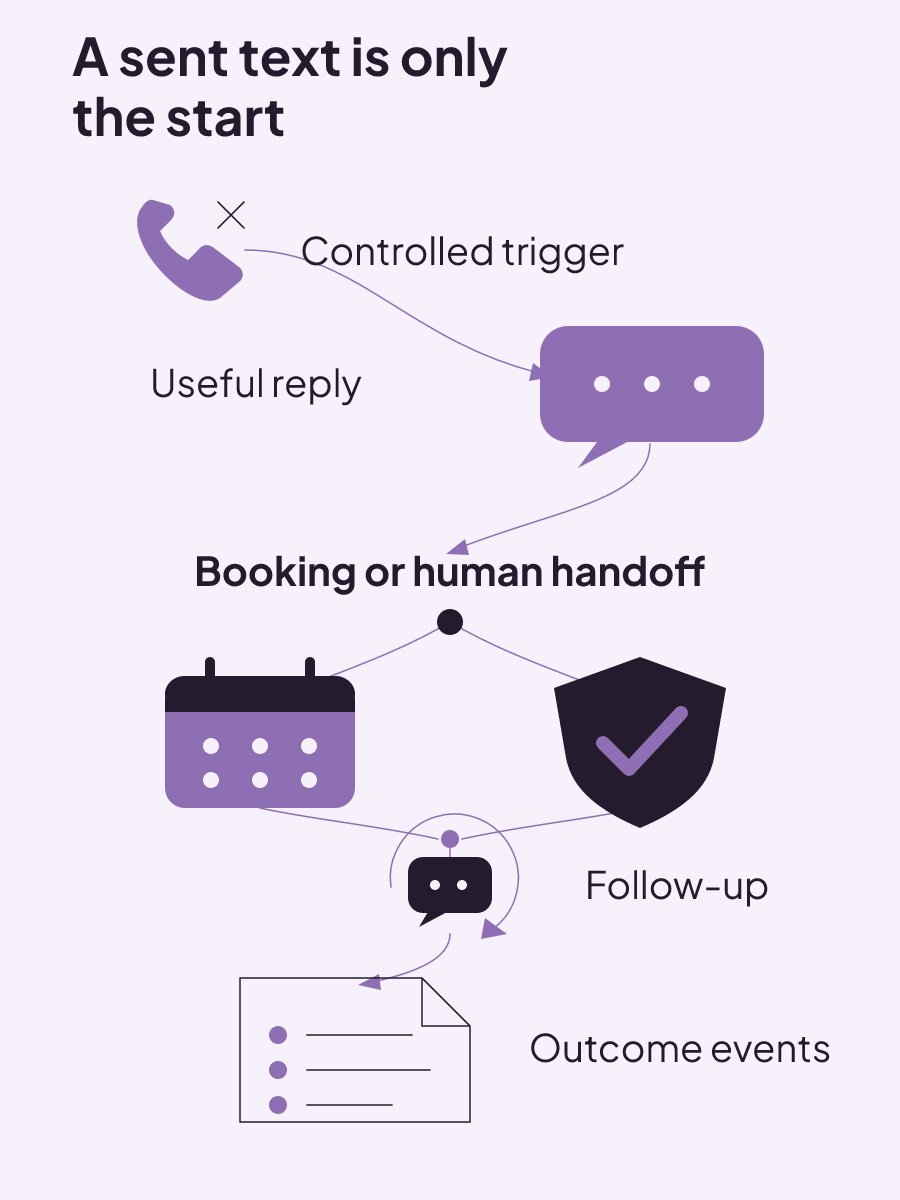
Use these checkpoints as an unweighted capability screen. Each row answers a different operational question.
| Checkpoint | Useful behavior | Observable output |
|---|---|---|
| Trigger control | Contacts the intended callers at the intended time | Missed-call time and acknowledgment delivery are recorded separately |
| Message and intent | Sends a personal, concise apology, asks what the caller needs, and gives a clear next step | The conversation records the caller's reply and selected next step |
| Broader follow-up | Places the first text inside a workflow with follow-up sequences | Follow-up activity continues beyond the initial message |
| Booking next step | Offers booking as a clear action when that is the relevant path | The caller can move from the message to booking access |
| Schedule integrity | Draws real openings from hours, staff shifts, skills, and existing appointments while preventing double-booking | Available times reflect the operating schedule and existing appointments |
| Human routing with context | Routes the conversation when automation is no longer the best path and passes intent, history, data, and sentiment | An owner receives the conversation with structured context |
| Event-level reporting | Records assignment, first human attempt, first two-way human conversation, booking, opt-out, wrong number, and delivery failure as separate events | The report distinguishes delivery, conversation, and booking events |
The screen also separates capability from visibility. A workflow may perform an action, but you still need an observable output if the team will manage or measure it. Trigger timestamps, ownership, conversation events, bookings, and failures give operators something concrete to inspect. Broad feature labels don't show where a caller stopped or whether a person took responsibility.
What AI missed call text back can add
AI missed call text back can add context before the team takes over. An AI-assisted response can connect the missed-call message to the campaign or offer that prompted the call. It can then ask whether the caller wants pricing, availability, or help choosing a service.
That makes the reply more useful than generic copy. A concise version could read: "Hi [name], sorry we missed your call. Are you looking for pricing, availability, or help choosing a service? Reply here and tell us what you need."
This also answers a common wording question: how do I text "Sorry I missed your call"? Keep the apology brief, ask a specific question, and pair it with a clear next step. Depending on the workflow, that next step may be booking, sending photos, or requesting a quote.
The system should also prevent duplicate texts and track what happens after the reply. Duplicate messages, generic copy, and missing result tracking are practical warning signs when text-back is part of a wider AI and follow-up workflow.
Campaign or offer context should improve the question, not make the message longer. The useful change is specificity: the response can acknowledge what prompted the call and present the three supported intent choices. The caller can answer with pricing, availability, or help choosing a service. The team then has a clearer reply to work from than it would get from a general apology alone.
A standalone missed-call text-back tool typically costs $20 to $100 per month, depending on SMS volume and features. Cost per call is a separate measure: total channel spend divided by the calls generated. It does not account for call quality on its own.
AI replies need governed escalation
Patient replies don't always stay inside the choices an automated message expects. In a qualitative analysis of 743 patient text responses within an integrated health system, people tried to manage appointments, request help or information, correct inaccurate data, express preferences, and voice frustration. Their replies extended beyond recognized commands and reflected an expectation of two-way communication.
The setting matters: this was an integrated health system. The practical finding is still useful when you evaluate a clinic workflow. Unexpected replies exposed limits in exclusively automated processing and opportunities to make communication more responsive.
Governed escalation gives those replies somewhere to go. The framework should define triggers for escalation, queues matched to the needed skills, service-level expectations, clear ownership, and a closed feedback loop. These aren't decorative settings. They decide whether an unexpected or frustrated reply remains inside automation or reaches a person with responsibility for it.
Each governance element closes a different gap. The trigger defines when the automated path should end. A skills-based queue sets the destination. The service-level expectation sets the response standard, while ownership makes responsibility visible. The feedback loop brings the result back into the workflow. Together, those elements turn escalation from a vague promise into a process an operator can examine.
Look closely at ownership during a software review. A routing rule is more useful when the conversation has a named owner and a service expectation. A queue is more useful when it matches the skills needed for the reply. A closed feedback loop lets the workflow account for what happened after escalation instead of ending its record at the handoff.
The five response types from the health-system analysis also show why a single catch-all route is a weak test. Appointment management, requests for help, data corrections, preferences, and frustration are not the same kind of reply. The study doesn't assign a clinic workflow to each one. It does show that patients may answer automated messages with needs that extend beyond recognized commands.
AI can help collect intent and context, but the design still needs a point where automation is no longer the right path. That boundary is part of the workflow, not an exception to it.
Measure recovered conversations, not automatic sends
For many service businesses, a recovered missed call can mean one of two outcomes: a meaningful human conversation or a completed booking after an eligible missed call. Report those outcomes separately. An automatic acknowledgment is useful, but it isn't a recovered conversation by itself.
The denominator needs care too. Repeat calls should be deduplicated within a defined window, so one persistent caller doesn't inflate the number of eligible missed calls. With that rule in place, you can keep two clear measures:
- Conversation recovery rate: eligible missed calls that lead to a meaningful human conversation, divided by deduplicated eligible missed calls.
- Booking recovery rate: eligible missed calls that lead to a completed booking, divided by deduplicated eligible missed calls.
This distinction keeps the team from celebrating message volume while the outcomes remain hidden. A delivery event tells you that the acknowledgment went out. A human conversation tells you someone engaged with the caller. A completed booking records a different result. Keeping those events separate makes the report useful to operations and patient acquisition teams.
Set the deduplication window before calculating either rate. Otherwise, repeat attempts from one caller can increase the denominator and distort the result. Keep the window visible in the reporting method so the team knows how eligible missed calls were counted. Then preserve the two outcome labels. Combining conversations and bookings into one recovery number would hide the difference the report is meant to show.
How much does missed call text back cost?
Standalone missed-call text-back tools typically cost $20 to $100 per month. The amount varies with SMS volume and features. That range covers the standalone tool category, not the full cost of a wider booking, follow-up, AI, or call-tracking workflow.
Price is only one part of the missed call text back business case. Cost per call is total channel spend divided by the number of calls generated. That calculation doesn't account for call quality on its own.
If two channels produce the same number of calls, cost per call can make them look similar even when the calls differ in qualification or outcome. Keep the formula for what it measures, then use qualified and customer outcomes for the business decision.
When you compare prices, ask what SMS volume and features the monthly amount covers. Then keep that subscription figure separate from cost per call. One is the price of the standalone software. The other divides total channel spend by generated calls. Neither calculation should be stretched into a claim about call quality.
The business case needs qualified and revenue outcomes
The missed call text back business case becomes more useful when it moves past total call counts. Three calculations connect spend to progressively more specific outcomes:
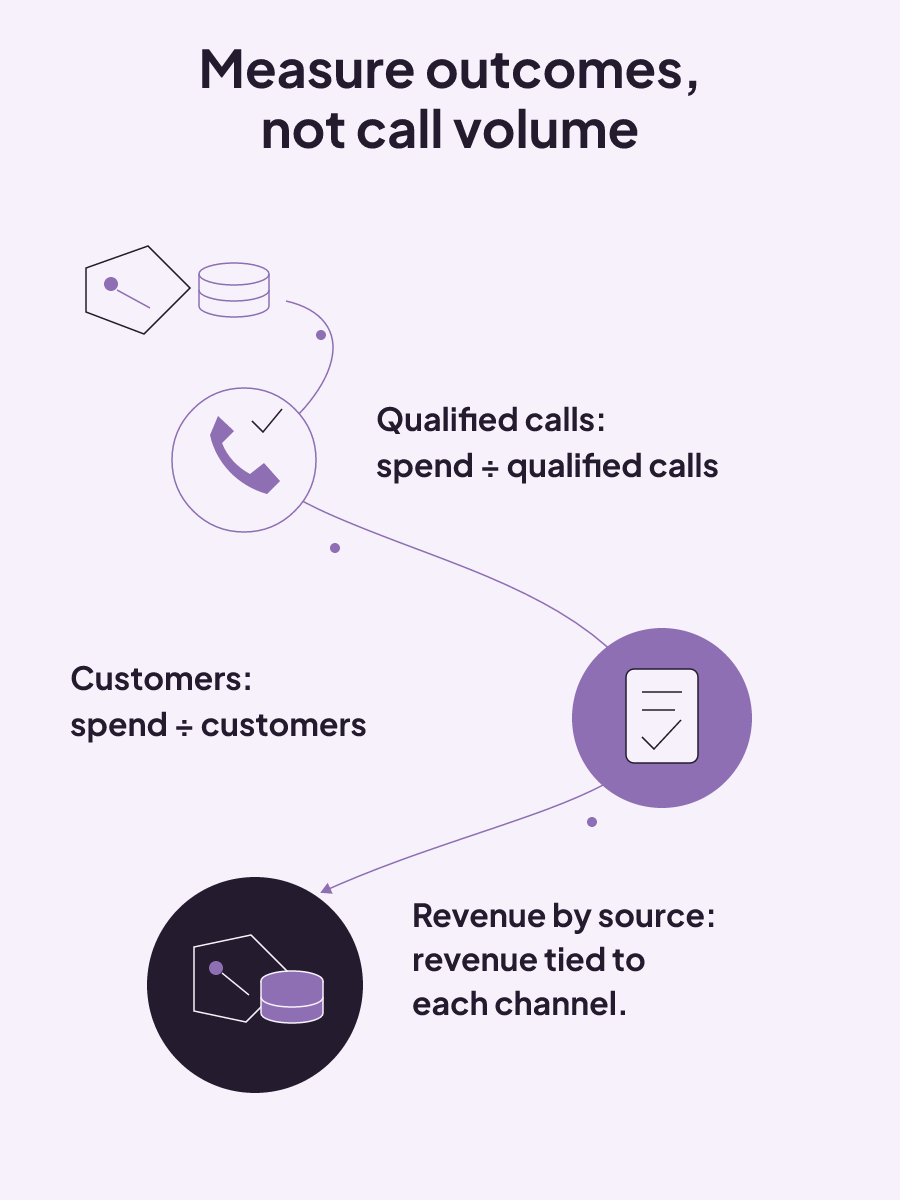
- Cost per lead is spend divided by the number of qualified calls.
- Cost per acquisition is spend divided by the number of calls that became customers.
- Revenue by source is the total revenue tied to calls from each channel.
These measures answer different questions. Cost per lead shows what you spent for qualified calls, while cost per acquisition uses calls that became customers. Revenue by source keeps the channel attached to the revenue tied to its calls.
Comparing spend with revenue by lead source can identify the most profitable channels. That comparison is stronger than using the number of automatic texts as proof that the workflow created value.
Cost per lead divides spend by qualified calls. That denominator is qualified calls, not every call the channel generated. Cost per acquisition narrows the denominator again to calls that became customers. Revenue by source then attaches revenue to the calls from each channel. These boundaries keep a large call count from standing in for a qualified lead, a customer, or revenue.
The profitability comparison needs both sides: spend and revenue tied to the same lead source. Looking only at the tool subscription leaves out total channel spend. Looking only at generated calls leaves out qualification, acquisition, and revenue. The formulas create a clean path from activity to the business outcome being measured without predicting how many future bookings the software will produce.
What does call tracking reveal about clinic operations?
Call volume needs context. Useful call-tracking measures include answer rate, billable-call rate, missed-call rate, peak call times, source and attribution. The wider set can also include average call duration, first-call resolution, cost per call, and overall call volume.
Volume alone is not enough for performance evaluation without answer rate and billable-call rate. A clinic can receive many calls and still need to understand how many were answered and what happened afterward.
Depending on the platform, healthcare call tracking may include answered and missed calls, duration, recordings, transcriptions, and handling by location. These views vary by platform.
Operational patterns can also point beyond the text-back feature. A high missed-call rate may indicate staffing or coverage gaps. Recordings and location comparisons may reveal inconsistent call handling.
That is the Ownerized take: choose around the connected path from inquiry to handoff and reporting, not the novelty of an automatic reply. We serve med spas and aesthetic clinics in the United States and Canada, and we offer patient booking and follow-up systems as part of the path from patient discovery to consultation. For existing relationships, our patient reactivation definition covers the follow-up side of recovery. See how our patient booking systems connect inquiries, handoffs, and reporting.
ROI tracking: calculate the return and label what the number proves
ROI tracking is credible when every cost is counted and each result is labeled as observed, attributed, or experimentally incremental.
Read insight
Healthcare social media marketing: choose channels, controls, and handoffs
Healthcare social channels fit different patient needs; use a question-risk-handoff matrix to set review, response, and contact ownership.
Read insight
Sample content marketing plan for med spas: a completed decision system
A sample content marketing plan works as a decision system, linking each asset to an audience need, owner, channel, approval path, KPI, and review.
Read insight