

Key takeaways
An after-hours answering service can answer, document, and route clinic calls. Live, AI, and hybrid models complete different tasks. Typical 2026 per-minute pricing is $0.75-$1.50, but the billing model, operating boundaries, and work returned to your staff matter just as much.
What is an after-hours answering service?
An after-hours answering service handles calls when your clinic is closed, including evenings, weekends, and holidays. For a medical office, the basic job can include answering the call, documenting the patient's concern, and forwarding the message to an on-call provider or staff member.
That definition covers more than a recorded greeting or a notification that somebody called. It gives you three concrete outputs to find in a proposal: the call was answered during the covered period, the concern was documented, and the message was forwarded to the named on-call provider or staff path. Check the coverage for evenings, weekends, and holidays. Then check where the documented concern appears and exactly who receives the forwarded message. These details show what your team will have when the office opens again.
A live answering service uses a remote team of professional receptionists. Those receptionists answer business calls and follow the business's instructions. An AI service uses business information and configured workflows to respond or take an available action. A hybrid model divides work between AI and human agents. The useful question is not simply who or what answers. It is which part of the caller's job gets completed before your team returns.
Start with the calls arriving after close
After closing, the same clinic number can receive very different requests. One caller may have a routine matter. Another may want an appointment. A third may have a patient concern. Some symptoms may require immediate provider attention.
Those calls should not be treated as one undifferentiated queue. A routine question may need an approved answer. An appointment request may need access to scheduling. A patient concern may need a detailed message. A symptom requiring immediate provider attention needs the right routing path. The service's role changes with the caller's job.
This is where a broad "24/7" promise becomes too thin for a buying decision. It states when calls are answered, but it does not state which requests are finished, which are handed off, or what your staff must repair later. If booking is one of the required jobs, include the connection to online booking in the evaluation. Then judge each option against the work that actually reaches your line after close.
A capability scorecard exposes the work left after the call
Use the same seven checks for live, AI, and hybrid quotes. Public pages may not show a vendor's current contract or safeguards, so confirm the customer BAA, safeguards, and clinical-scope boundary directly. Keep those written answers with the behavior, boundary, and result measure for each decision area.
| Decision area | Required behavior | Operating boundary | Metric or contract check |
|---|---|---|---|
| Capture and follow-up | Record each incoming request, document the caller's concern, and identify who needs follow-up | Flag messages that need faster routing, then leave staff a clear record | Confirm how the documented concern, follow-up need, and faster-routing flag appear for clinic staff |
| Routing and escalation | Use custom scripts, secure message routing, and documented escalation workflows | Forward messages to on-call providers or staff through the defined path | Check healthcare experience, every written script, the secure routing method, and every escalation step used during after-hours coverage |
| Booking and call-flow fit | Support appointment requests and match the clinic's normal call flow during setup | Define the appointment work and weekend coverage included | Check appointment-request support, weekend coverage, reporting, and how the setup process reflects the clinic's own call flow |
| Healthcare contracting | Make the customer BAA and safeguards available for direct confirmation | Keep a defined clinical-scope boundary for the service | Confirm the customer BAA, the stated safeguards, and the clinical-scope boundary instead of relying on missing details from a public page |
| Clinical judgment | Follow clear rules backed by proper training and oversight | Do not give medical or legal advice, promise specific outcomes, or make decisions requiring clinic judgment | Put the permitted response, required oversight, and handoff rule in writing |
| Sensitive systems | Use defined security protocols before accessing any sensitive system | Do not handle complex billing disputes without clear rules or access sensitive systems without security protocols | Confirm the access safeguards and the clear rules governing any complex billing dispute |
| Operating metrics | Report live pickup, full handling on first contact, and unanswered calls | Answer rate measures live pickup, first-call resolution measures full handling on first contact, and missed-call rate measures the percentage of unanswered calls | Define all three rates and require reporting that keeps pickup, resolution, and missed calls separate |
Live, AI, and hybrid coverage solve different parts of the call
There is no universal winner between live and AI answering. Each has strengths and limits, and some teams may need a combination.
Live receptionists can use a custom greeting, take and send detailed messages, book appointments, and qualify leads with screening questions. They can also dispatch on-call staff for emergencies, answer basic questions, transfer calls, and handle bilingual calls. Ask which of those tasks are part of the proposed coverage. Message taking, booking, screening questions, and on-call dispatch should remain separate entries in your comparison. The live model covers a broad set of possible tasks, but the plan still needs to match the calls your clinic receives.
AI can take a defined share of routine work. In one documented hybrid model, Smith.ai uses AI for routine calls and routes complex or sensitive conversations to human agents. That division gives you a concrete handoff to test: which calls stay with AI, which reach a person, and how that transfer appears in the call record.
Use that documented model as a capability example, not as a definition of every hybrid service. A hybrid proposal should identify the routine work assigned to AI and the complex or sensitive conversations sent to people. It should also show those two parts in the price. Hybrid billing can use one blended base rate, or it can combine a flat AI charge with live per-minute charges.
Can AI answer after-hours phone calls?
Yes. Documented AI products can answer after-hours calls, respond from supplied business information, and trigger certain actions. The exact workflow still matters more than the AI label.
Smith.ai documents an AI that uses supplied information to answer questions. It can also integrate with existing scheduling tools to take action. Goodcall documents 24/7 call answering, responses to common questions from business information, lead capture, and appointment requests. These examples show several available functions, but they do not make every AI service equivalent.
For an AI quote, separate the response source from the action. Record what supplied business information the system will use for answers. Then list each action included in the proposal. Smith.ai's documented scheduling-tool integration is one action. Goodcall separately documents lead capture and appointment requests. Keeping the functions named makes it easier to compare a response-only workflow with a quote that includes an action.
Cost alone can hide the handoff burden. A low-cost healthcare tool may create more staff work when it cannot sign a BAA, route urgent calls, or connect to scheduling. Your evaluation therefore needs the healthcare boundary, routing path, and scheduling connection alongside the monthly price.
How much does an answering service charge in 2026?
Typical 2026 answering-service prices vary by model and billing unit. Use these ranges as an initial budget frame:
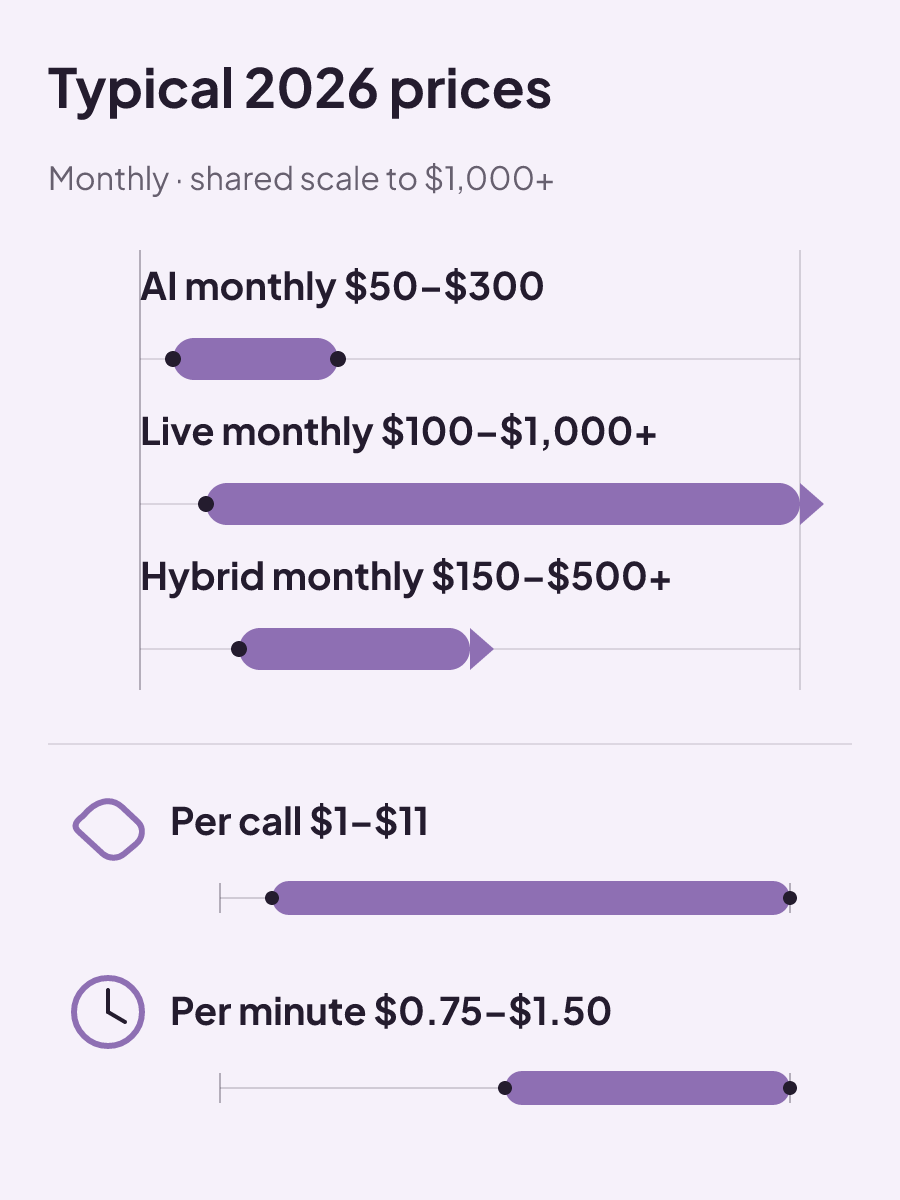
- AI service: $50-$300 per month
- Live service: $100-$1,000 or more per month
- Hybrid service: $150-$500 or more per month
- Per-call service: $1-$11 per call
- Per-minute service: $0.75-$1.50 per minute
The monthly AI, live, and hybrid figures describe service models. The per-call and per-minute figures describe usage billing. A quote can use more than one charge, so do not compare the first number on each proposal as if every proposal covers the same work.
Start by matching the range to the quote's actual unit. Then attach that unit to your clinic's expected use and required workflow. A lower base fee may not remain lower after usage, setup, or added functions are included. A higher monthly figure may still cover a different amount of work. The written quote needs enough detail to calculate the same month across all options.
Pricing units change what a busy month costs
Human-answering prices often depend on minutes, calls, hours, and the level of coverage. A traditional medical answering quote may combine a monthly base fee with per-minute charges or overage fees.
AI pricing uses a different mix of inputs. Vendors may price by location, call volume, or included workflows. A quote may also depend on the platform tier, usage, integrations, and workflow depth. Some AI phone-answering offers use a monthly software fee, usage tier, setup fee, or workflow package.
Give every pricing unit a place in your comparison. The human-service line can hold the base fee, included minutes or calls, covered hours, coverage level, and overage charge. The AI line can hold the software fee, usage tier, locations, call volume, integrations, included workflows, setup fee, and workflow package. A proposal may contain several of these fields, so preserve the whole billing structure when you move a quote into your worksheet.
The workflow deserves a line item too. Scheduling access, routing, or an included workflow can affect both the task completed and the price charged. Your cost comparison should preserve that connection instead of stripping each proposal down to one headline number.
What can push the quote above its headline price?
Several charges can change the real monthly cost after the advertised base price. AI answering quotes may add phone-number fees, texting add-ons, one-time setup fees, and per-minute overages. Monthly packages may also leave unused minutes, apply overage fees, or require a contract.
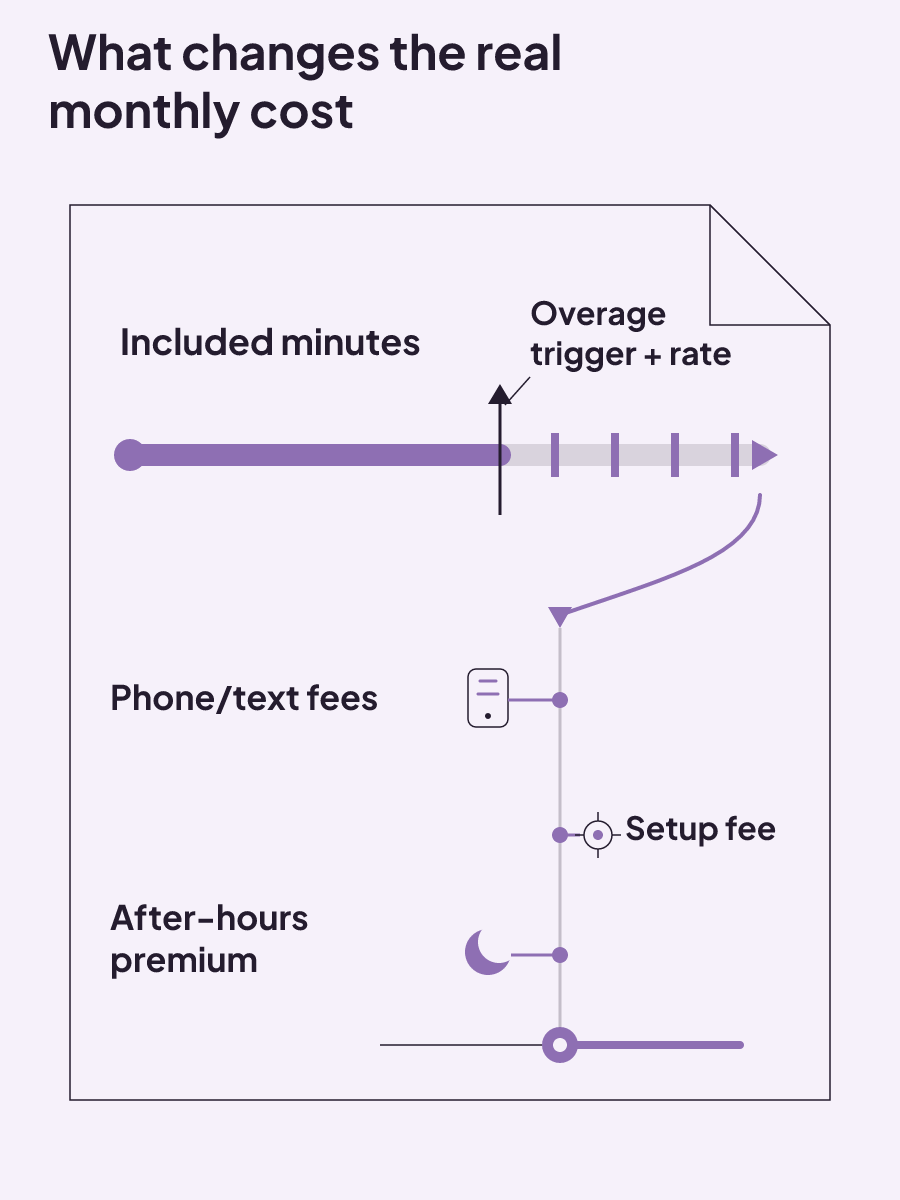
Normalize each written quote with the same list:
- Base monthly charge
- Included calls, minutes, or other usage
- Overage trigger and overage rate
- Phone-number fee
- Texting add-on
- One-time setup fee
- Any night, weekend, or holiday premium
- Contract requirement
A like-for-like comparison may require vendors to specify overage triggers and any night, weekend, or holiday premium in writing. That detail matters because an after-hours plan is specifically being bought for coverage outside ordinary business hours.
Unused minutes are another tradeoff. A package may leave paid minutes unused in a quiet month, then apply an overage fee in a busy one. The base price, included usage, and overage rule belong in the same monthly calculation. If a contract is required, keep that requirement beside the price instead of treating it as a separate footnote.
How should you test a new service before switching?
A parallel test can make the comparison observable before you replace an existing setup. One documented approach runs for 2-4 weeks, routes after-hours calls to AI, and keeps business-hours calls with the existing live service. It compares call quality, resolution rates, and caller satisfaction across those lanes.
Define those three measures before the test starts and use the same definitions for both lanes. Keep the after-hours and business-hours results separate. That way, the comparison retains the routing pattern used during the 2-4 week test instead of combining every call into one total.
During the first 30 days of a new answering approach, review every call or a significant sample. Look for successful and unsuccessful patterns. Adjust the AI configuration or give feedback to the live operator team based on what the calls show.
The 30-day review is about the calls the new approach actually handled. Record the patterns you find and the change made in response. For AI, that action can be a configuration adjustment. For a live operator team, it can be direct feedback. Continue comparing call quality, resolution rates, and caller satisfaction while those changes are made.
Put the service cost beside the value of missed calls
The service quote is only one side of the decision. You can estimate monthly missed revenue with a clinic-specific model:
Estimated monthly missed revenue = monthly missed calls x close rate x average customer value
Use your own missed-call count, close rate, and average customer value, and keep a record of all three inputs. The estimate changes when any input changes. It is a clinic-specific comparison point, not a guarantee that every answered call will close or produce that value.
Keep the time unit consistent. A monthly missed-call count produces a monthly estimate, which can sit beside the monthly AI, live, or hybrid ranges and a vendor's normalized monthly quote. If a proposal is priced per call or per minute, calculate its expected monthly charge before making that comparison.
Put that estimate beside the normalized monthly quotes and the seven capability checks. A low price that returns booking, routing, or follow-up work to your team is not the same offer as a plan that completes those tasks. Likewise, a broader workflow should still be judged by its documented boundaries and measured results.
Use the scorecard to compare written vendor quotes on the same calls, tasks, boundaries, fees, and measures. Then connect your coverage choice to the wider patient booking and follow-up workflow, including how quickly a captured request moves toward a response through your speed-to-lead process.

How to choose a local SEO company that can show its work
A local SEO company is worth hiring when it names the work, measures business actions, prices the scope clearly, and avoids ranking guarantees.
Read insight
Local SEO price guide for med spas: what should your package include?
Local SEO prices usually run $500 to $2,500+ monthly, but a fair quote depends on the work, reporting, and internal execution it requires.
Read insight
Local SEO listing guide: what to fix, maintain, and pay for
Local SEO listing management starts with accurate records, duplicate cleanup, documented corrections, quarterly audits, and full per-location costs.
Read insight